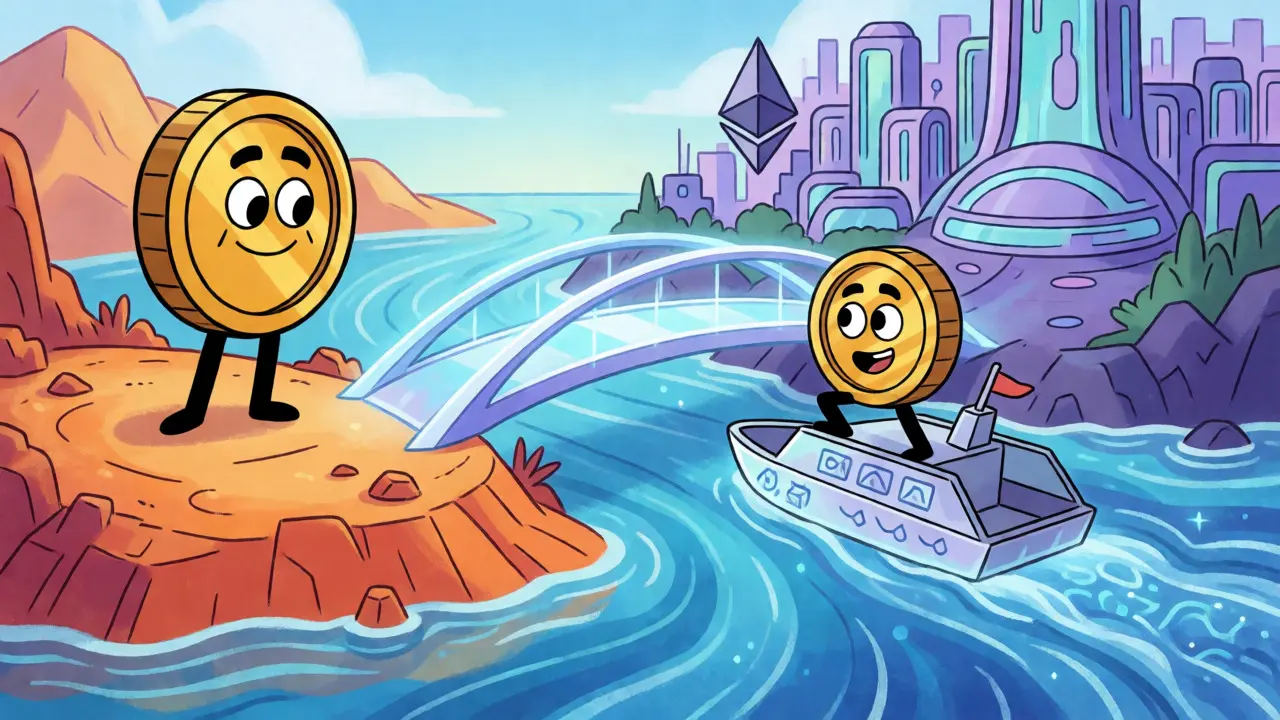
You hold Bitcoin. You want to use it in Ethereum’s decentralized finance (DeFi) ecosystem to earn yield or provide liquidity. But you can’t just send BTC to an Ethereum smart contract-it doesn’t speak the same language. This is where wrapped tokens come in. They act as a bridge, letting assets from one blockchain live on another without losing their value.
If you’ve ever wondered how people use Bitcoin on Ethereum, or why your ETH balance looks different when interacting with certain apps, this guide breaks down the mechanics of wrapping and unwrapping crypto. We’ll look at real examples like Wrapped Bitcoin (WBTC) and Wrapped Ether (wETH), explain the risks involved, and show you exactly what happens under the hood when you convert your assets.
What Are Wrapped Tokens and Why Do We Need Them?
A wrapped token is essentially a receipt for a cryptocurrency that lives on a different blockchain. Think of it like exchanging cash for casino chips. The chips aren’t money, but they represent a specific amount of money held by the casino. When you leave, you swap the chips back for cash.
In crypto, blockchains operate in silos. Bitcoin doesn’t know about Ethereum, and vice versa. To solve this, developers created wrapped tokens-tokenized versions of an asset that run on a different chain. For example, Wrapped Bitcoin (WBTC) is an ERC-20 token on Ethereum that represents Bitcoin held in reserve elsewhere. Each WBTC is pegged 1:1 to real Bitcoin. If you have 1 WBTC, someone somewhere holds 1 BTC in a vault.
The primary goal is interoperability. Without wrapping, Bitcoin holders are locked out of Ethereum’s $54 billion DeFi market. Wrapping unlocks that potential, allowing users to lend, borrow, and trade assets across ecosystems while maintaining the underlying value.
How the Wrapping Process Works Step-by-Step
Wrapping isn’t magic; it’s a structured custody arrangement. While details vary by protocol, the core mechanism follows a predictable path. Here’s what actually happens when you wrap an asset:
- Initiation: You select the asset (e.g., BTC) and the target chain (e.g., Ethereum) via a merchant or exchange interface.
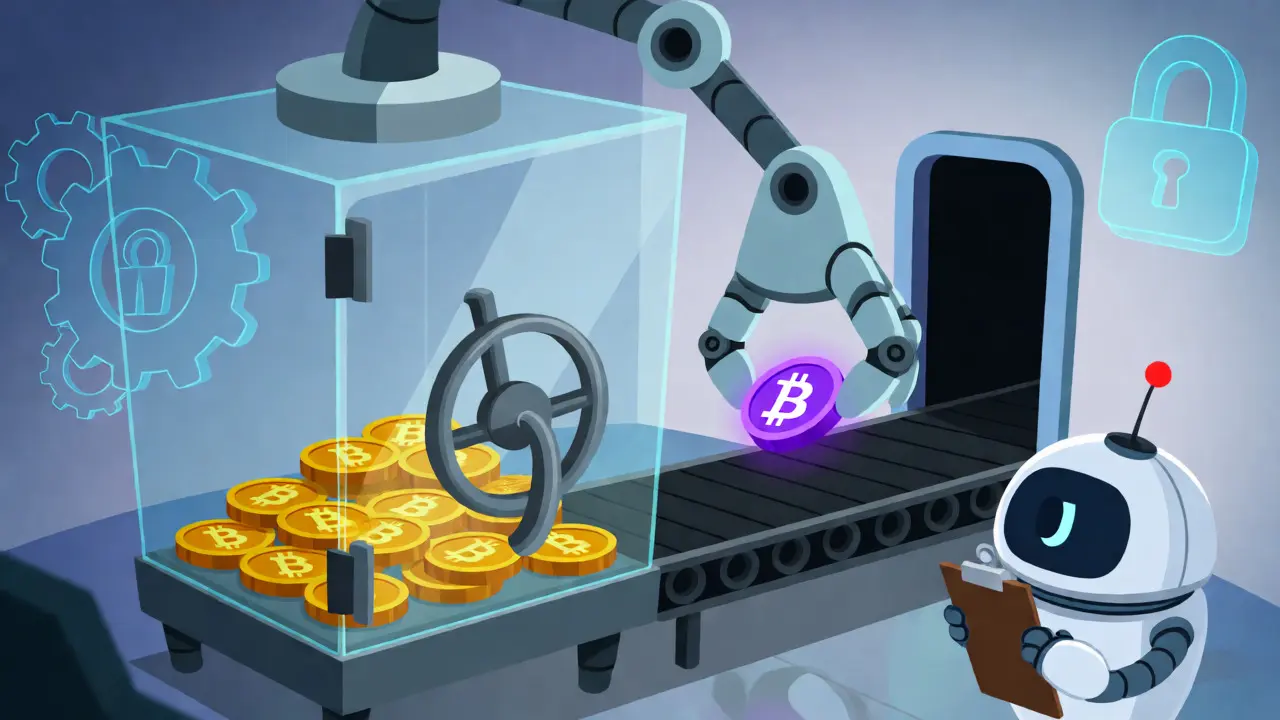
- Custody Transfer: Your original coins are sent to a custodian. This could be a centralized company like BitGo (for WBTC) or a decentralized network of nodes.
- Locking: The custodian locks your original asset in a secure wallet or smart contract. It cannot move until you decide to unwrap.
- Minting: The system creates (mints) an equivalent amount of wrapped tokens on the target blockchain. For every 1 BTC locked, 1 WBTC is minted on Ethereum.
- Delivery: The new wrapped tokens are sent to your wallet address.
Unwrapping is simply the reverse. You send the wrapped tokens back to the custodian, who burns them (destroys the digital representation) and releases the original asset back to your specified address. This process ensures that supply and demand remain balanced between the two chains.
Centralized vs. Decentralized Wrapping Models
Not all wrapped tokens are created equal. The biggest difference lies in who holds the keys to the vault. This distinction determines your risk profile.
| Feature | WBTC (Wrapped Bitcoin) | wETH (Wrapped Ether) | renBTC |
|---|---|---|---|
| Custodian Type | Centralized (BitGo) | Decentralized Smart Contract | Decentralized Network (Darknodes) |
| Trust Assumption | High (Must trust BitGo) | Low (Code is law) | Medium (Trust in node operators) |
| Use Case | Bringing BTC to Ethereum DeFi | Standardizing ETH for dApps | Alternative BTC wrapper |
| Market Share (BTC) | ~92% | N/A (Native ETH wrapper) | ~4% |
WBTC relies on a consortium of merchants and a single custodian, BitGo. This makes it highly liquid and easy to use, but introduces counterparty risk. If BitGo faces regulatory issues or technical failures, WBTC could depeg temporarily.
On the other hand, wETH uses a simple smart contract developed by 0x Labs. There is no human custodian. You lock ETH into the contract, and it gives you wETH. Because Ethereum’s native coin (ETH) isn’t technically a standard ERC-20 token, many DeFi protocols require wETH to function correctly. This makes wETH essential for everyday interaction with decentralized applications, even though it’s just a wrapper around the native currency.
Risks and Pitfalls to Watch Out For
While convenient, wrapping introduces specific vulnerabilities that don’t exist when holding native assets. Understanding these helps you avoid costly mistakes.
Custodial Risk: With centralized wrappers like WBTC, you are trusting a third party to hold your collateral. In July 2023, the Multichain bridge hack resulted in a $32 million loss because a custodial solution was compromised. Always check if the project publishes regular proof-of-reserves audits.
Liquidity and Peg Deviations: During extreme market volatility, wrapped tokens can drift slightly from their underlying price. WBTC has shown deviations of 0.8-1.2% during crashes. If you need to exit quickly, you might sell WBTC for less than the current spot price of BTC.
Smart Contract Bugs: Even decentralized wrappers depend on code. If the smart contract governing the wrap/unwrap logic has a bug, funds could get stuck. Reputable projects undergo multiple security audits, but never assume code is perfect.
Gas Fees and Delays: Wrapping requires two transactions-one to send the original asset and one to receive the wrapped version. On congested networks like Ethereum, this can cost significant gas fees. Unwrapping often takes longer (25-45 minutes) due to verification steps required by custodians.

Practical Steps to Wrap and Unwrap Safely
If you’re ready to try this yourself, follow these practical guidelines to minimize friction and error.
- Verify the Contract Address: Scams are common. Before sending funds, always check the official contract address on Etherscan or the project’s documentation. Fake WBTC tokens with similar names pop up frequently.
- Check Gas Prices: Use tools like GasNow or Etherscan’s gas tracker to time your transaction. Wrapping during low-congestion periods saves money.
- Start Small: If you’re new to a specific wrapper, test with a small amount first. Ensure the entire cycle (wrap → use → unwrap) works smoothly before committing larger sums.
- Understand Tax Implications: In many jurisdictions, including Australia and parts of Europe, wrapping is treated as a taxable event. You are effectively selling Asset A to buy Asset B. Keep records of the market value at the time of wrapping and unwrapping.
For most retail users, using a reputable exchange or integrated wallet feature is the safest route. Coinbase, for instance, reports that 87% of new users complete their first wrap within 15 minutes using their simplified interface. Direct smart contract interaction is better suited for advanced users comfortable with Solidity and manual gas management.
The Future of Interoperability
Is wrapping here to stay? Some experts argue it’s a temporary patch. Vitalik Buterin, co-founder of Ethereum, has expressed concern over the systemic risk of relying on custodial wrappers. He advocates for native cross-chain communication protocols that don’t require locking assets in vaults.
However, the market tells a different story. Total value in wrapped assets exceeded $14 billion recently, growing nearly 40% year-over-year. Institutional players like BlackRock and Fidelity are actively exploring wrapped solutions for enterprise portfolios. As long as blockchains remain fragmented, wrapped tokens will serve as critical infrastructure.
Emerging technologies like zero-knowledge proofs aim to reduce trust assumptions further. Projects are moving toward multi-custodian models-where WBTC now allows Fireblocks and Copper alongside BitGo-to distribute risk. These improvements suggest that while the method may evolve, the need for cross-chain utility remains strong.
Is wrapping cryptocurrency safe?
It depends on the implementation. Centralized wrappers like WBTC carry custodial risk-if the custodian fails, your backing asset could be at risk. Decentralized wrappers like wETH rely on smart contracts, which carry coding risk instead. Always choose established projects with public audits and proof-of-reserves.
How long does it take to unwrap a token?
Typically 15 to 45 minutes. The time varies based on network congestion and the speed of the custodian’s verification process. Decentralized wrappers can sometimes be faster, but centralized ones may have batch processing delays.
Do I pay taxes when I wrap crypto?
In many countries, yes. Tax authorities often view wrapping as an exchange of one asset for another, triggering a Capital Gains Tax (CGT) event. You should record the fair market value of both the original and wrapped tokens at the time of the transaction.
Why is wETH necessary if I already have ETH?
Ethereum’s native coin (ETH) does not fully comply with the ERC-20 token standard. Many DeFi protocols and smart contracts require ERC-20 compatibility to transfer and manage balances efficiently. wETH is simply ETH converted into an ERC-20 format so it can interact with these systems.
Can I lose money if the peg breaks?
Yes. If confidence in the custodian drops, the wrapped token’s price may fall below the underlying asset’s value (depeg). However, arbitrageurs usually step in to correct this by buying the cheap wrapped token and redeeming it for the full-value underlying asset, restoring the peg.