
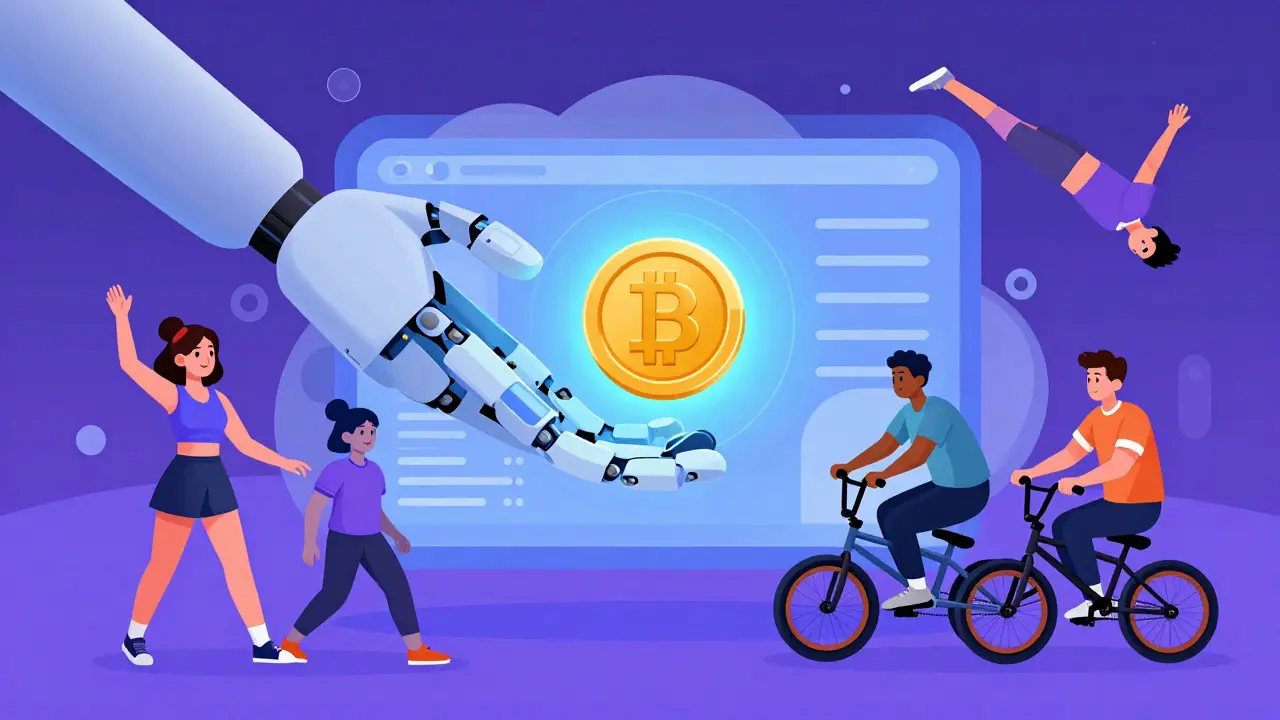
Imagine filming a skateboard trick on your phone and having an algorithm instantly score it, awarding you tokens for your performance. That is the core promise of Dotmoovs, a platform that blends remote peer-to-peer sports competition with artificial intelligence and cryptocurrency. Launched in May 2021, the project aims to democratize sports judging by removing human bias and allowing athletes of all levels to compete globally from their living rooms or local parks. The native currency, $MOOV, powers this ecosystem, serving as the entry fee for competitions and the reward for winning tricks.
However, like many niche blockchain projects, MOOV has faced significant market turbulence since its initial launch. If you are considering adding this token to your portfolio or just curious about how sports meets Web3, understanding the mechanics, risks, and current state of the project is essential. This guide breaks down what Dotmoovs actually does, how the token works, and where it stands in the broader crypto landscape as of mid-2026.
Key Takeaways
- Core Function: Dotmoovs uses AI to analyze video submissions of sports tricks, providing objective scores without human judges.
- Token Utility: MOOV is used for competition entries, rewards, and transactions within the ecosystem; total supply is 1 billion tokens.
- Market Status: As of March 2026, the token trades at micro-cap levels (~$0.0003), reflecting high volatility and significant depreciation from its all-time high.
- Accessibility: Users aged 13+ can participate, lowering barriers compared to traditional professional sports circuits.
- Risk Factor: Low trading volume and price inconsistency across exchanges indicate liquidity challenges typical of low-cap assets.
How Dotmoovs Works: AI Meets Sports
Traditional sports rely heavily on subjective human judgment, which can lead to disputes and exclusivity. Dotmoovs flips this model by leveraging computer vision and machine learning algorithms. When a user records a trick-whether it’s a BMX jump, a parkour move, or a dance routine-they upload the video to the platform. The AI analyzes the movement, difficulty, and execution against a predefined dataset to generate a numerical score.
This technology isn’t just about scoring; it’s about creating a standardized metric for athletic performance that anyone can access. You don’t need to be a pro athlete with sponsors to get recognized. You just need a smartphone and a skill set. The platform connects these users in a peer-to-peer network, fostering a community where improvement is tracked objectively over time. This approach taps into the growing interest in gamified fitness and remote competition, sectors that saw massive growth during the early 2020s and continue to evolve.
The MOOV Token: Economics and Supply
The MOOV token is an ERC-20 utility token built on the Ethereum blockchain. It serves as the fuel for the Dotmoovs engine. Here is how the token functions within the ecosystem:
- Competition Entry: Users pay a small fee in MOOV to enter specific challenges or leaderboards.
- Rewards: Winners and top performers receive MOOV payouts based on their AI-generated scores.
- Transactions: Any internal marketplace or service fee is settled in MOOV.
The total supply is fixed at 1,000,000,000 (1 billion) tokens. During the Initial Coin Offering (ICO) in May 2021, the project raised approximately $1 million, with 4% of the total supply (40 million tokens) allocated to the public sale. The remainder was distributed among team members, investors, and strategic partners. As of recent data, circulating supply figures vary between sources, ranging from roughly 192 million to 731 million tokens, suggesting ongoing vesting schedules or gradual releases. This variability is common in mid-stage projects where tokens unlock over time.
Market Performance and Volatility
Let’s talk numbers, because they tell a story of high risk and high variance. When MOOV launched, it had significant hype, reaching an all-time high of around $0.10 per token. However, as the broader crypto market cooled and specific sector attention shifted away from sports-tech NFTs, the price dropped dramatically.
As of late March 2026, market data aggregators show a wide spread in pricing, which is a red flag for liquidity. CoinMarketCap reported prices near $0.000274, while other trackers showed figures up to $0.00117. This discrepancy usually indicates thin order books and low trading volume. With 24-hour volumes often hovering between $30,000 and $80,000, moving even a modest amount of capital can cause significant price slippage. For context, major cryptocurrencies trade billions daily; MOOV trades tens of thousands. This makes it a speculative asset rather than a stable store of value.
| Source | Price (USD) | 24h Volume (USD) | Market Cap Estimate |
|---|---|---|---|
| CoinMarketCap | $0.000274 | $34,723 | ~$230,000 - $500,000 |
| CoinGecko | Varies | $32,486 | Data varies |
| Dropstab | $0.001170 | $80,646 | $856,211 |
| TradeSanta | $0.000519 | $21,731 | $519,263 |
The fully diluted valuation (FDV) sits around $4 million if all tokens were in circulation. Given the current price, the token is trading at less than 1% of its peak value. This level of depreciation suggests that either the adoption rate hasn't matched investor expectations, or the project is in a long development phase where market sentiment lags behind product progress.
NFTs and Ecosystem Expansion
Beyond just scoring tricks, Dotmoovs introduced a collection of Non-Fungible Tokens (NFTs) featuring popular athletes. These digital collectibles serve two purposes: they create additional revenue streams for the ecosystem and act as status symbols within the community. Owning a specific athlete's NFT might grant holders exclusive access to competitions or higher reward multipliers.
This integration positions Dotmoovs at the intersection of three hot topics: sports tech, AI, and Web3 collectibles. While the NFT market has cooled significantly since 2021, the underlying utility here is tied to active participation rather than pure speculation. If the platform maintains a healthy user base, these NFTs could retain value as functional assets rather than just digital art.
Risks and Considerations for Investors
If you are eyeing MOOV, keep these factors in mind. First, liquidity is the biggest hurdle. With low daily volume, exiting a large position can be difficult without crashing the price. Second, regulatory clarity for crypto-based sports competitions is still evolving. While the age restriction (13+) helps with compliance, global regulations on gaming and betting via crypto are strict in many jurisdictions.
Third, competition is fierce. Traditional sports apps and other blockchain gaming projects are vying for the same user attention. Dotmoovs needs to prove that its AI scoring is accurate enough to prevent cheating and engaging enough to keep users coming back. The lack of publicly available detailed user engagement metrics makes it hard to gauge true traction beyond token prices.
Frequently Asked Questions
What is the main use case for the MOOV token?
The MOOV token is primarily used to enter sports competitions, pay for platform services, and receive rewards for winning AI-scored athletic challenges on the Dotmoovs platform.
Is Dotmoovs only for professional athletes?
No, Dotmoovs is designed for inclusivity. Anyone aged 13 or older who meets legal requirements can participate. The AI scoring system allows amateur athletes to compete fairly against others based on objective performance metrics.
Why do MOOV prices vary so much between different websites?
Price variations occur due to low liquidity and different exchange feeds. Since MOOV trades on multiple smaller markets with limited volume, slight differences in buy/sell orders can result in significant price discrepancies across aggregators like CoinMarketCap and CoinGecko.
How does the AI scoring work?
Users upload videos of their sports tricks. Advanced computer vision algorithms analyze the footage to assess difficulty, form, and execution, generating an objective score that determines rewards and leaderboard rankings.
Where can I buy MOOV coins?
MOOV is available on various centralized and decentralized cryptocurrency exchanges. Due to its lower market cap, you may need to check specific DEXs (Decentralized Exchanges) on the Ethereum network for better liquidity and lower slippage fees.