
You click on a link promising high yields from a "new" decentralized exchange. The interface looks familiar, maybe even polished. But before you connect your wallet and risk your hard-earned ETH, you need to know one critical fact: Linkswap is no longer operational.
If you are reading this in 2026, you might be wondering why an old project name keeps popping up in search results or if there is a revival happening. The short answer is that the original Linkswap protocol, which launched during the peak of the 2021 DeFi boom, has been defunct for years. This review isn't just about telling you what Linkswap was; it’s about understanding why it failed, what happened to its users, and how to spot similar dead-end projects today.
The Rise and Fall of Linkswap
To understand Linkswap, you have to look back at early 2021. That was the era when anyone could copy-paste code, slap a new logo on it, and launch a decentralized exchange (DEX). Linkswap emerged from a project called YF Link, which tried to merge the concepts of Chainlink (price feeds) and Yearn Finance (yield aggregation). It was marketed as an automated market maker (AMM) where users could trade ERC-20 tokens against Ethereum.
When it was live, Linkswap operated as a non-custodial platform. This means you never actually sent your funds to their servers. Instead, you connected a wallet like MetaMask or Trust Wallet, and smart contracts handled the swap directly on the Ethereum blockchain. At first glance, this sounded secure. You kept control of your keys. But being non-custodial doesn't mean a project is safe from bad economics or abandonment.
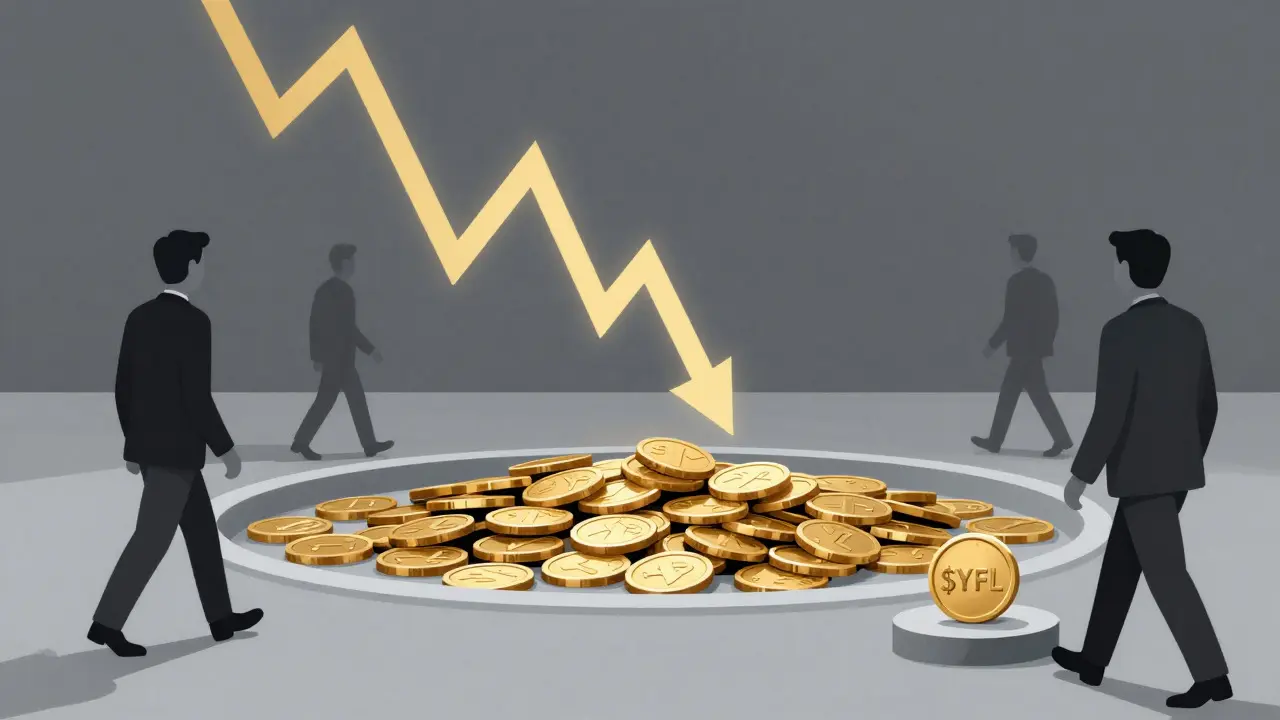
By mid-2025, major tracking sites like CoinCodex and Holder.io listed Linkswap with zero active trading pairs and zero volume. The warning labels were clear: "This exchange is no longer operational." There is no official shutdown announcement from the developers, which is typical for many small DeFi projects that simply fade away when liquidity dries up.
Is Linkswap still working in 2026?
No, Linkswap is definitively defunct. As of 2025 and continuing into 2026, data aggregators show zero trading volume and zero active pairs. The smart contracts may still exist on the blockchain, but without liquidity providers, you cannot swap any tokens.
How Linkswap Worked (And Why It Failed)
Let's break down the mechanics of Linkswap when it was alive. Like Uniswap and SushiSwap, it used the constant product formula ($x \times y = k$) to determine prices. If you wanted to swap Token A for ETH, the price depended entirely on how much of each asset sat in the pool. If the pool was shallow, your trade would cause massive slippage, meaning you got far less than the market rate.
The fee structure was simple but rigid. Linkswap charged a flat 0.30% fee on every trade. This matched the standard set by Uniswap v2 at the time. However, unlike centralized exchanges that offered lower fees for high-volume traders, Linkswap had no tiers. Everyone paid the same rate. Here is how those fees were distributed:
- 83% went to Liquidity Providers (LPs) who deposited assets into the pools.
- 17% went to stakers holding the governance token, $YFL.
This distribution model sounds fair until you look at the tokenomics of $YFL. The total supply was capped at just 50,000 tokens. While scarcity can drive value, in a small, illiquid market, it often leads to volatility and manipulation. With only 50,000 tokens in circulation, large holders could easily influence the price, making it risky for average users trying to earn rewards.
The fatal flaw wasn't the technology-it was the liquidity. In the DEX world, liquidity is king. Without deep pools, traders leave because of high slippage. Without traders, LPs earn no fees and pull their money out. This death spiral likely hit Linkswap hard. By late 2021, larger competitors like Uniswap v3 introduced concentrated liquidity, allowing LPs to earn more efficiently. Linkswap didn't innovate. It stayed static while the market evolved around it.
Linkswap vs. Modern DEX Alternatives
If you are looking for a decentralized exchange today, Linkswap is not an option. But understanding its failure helps you choose better alternatives. Let's compare the dead Linkswap model with what works in 2026.
| Feature | Linkswap (Defunct) | Uniswap v3/v4 | Symbiosis.finance |
|---|---|---|---|
| Status | No longer operational | Active, dominant market share | Active, cross-chain leader |
| Blockchain Support | Ethereum only | Multi-chain (ETH, Arbitrum, Base, etc.) | 30+ blockchains supported |
| Liquidity Model | Standard AMM (Low depth) | Concentrated Liquidity (High efficiency) | Cross-chain aggregated liquidity |
| Governance Token | $YFL (50k supply) | $UNI (1 billion supply) | $SYM (Active ecosystem) |
| User Experience | Basic, no advanced orders | Advanced tools, professional UI | Simple cross-chain swaps |
The table shows why Linkswap disappeared. It was stuck on Ethereum alone, charging fees that didn't offer competitive advantages, and lacking the technological upgrades that kept giants like Uniswap relevant. Today, platforms like Symbiosis.finance allow you to swap assets across 30 different blockchains instantly. Linkswap couldn't even bridge to Polygon or Binance Smart Chain.
Security Risks of Abandoned DeFi Protocols
Here is the scary part for anyone who might still hold $YFL tokens or has forgotten they interacted with Linkswap. When a DEX shuts down without a formal process, the smart contracts remain on the blockchain. They don't just vanish. But they become dangerous.
In a healthy DEX, developers monitor contracts for bugs and upgrade them when necessary. An abandoned contract is a sitting duck. Hackers scan for old, unpatched vulnerabilities. Even if the code was secure in 2021, new attack vectors emerge constantly. If you somehow managed to deposit funds into a Linkswap pool before it died, retrieving them might require paying high gas fees for a transaction that could fail due to lack of liquidity in the counter-pair.
Furthermore, the absence of customer support is total. Since Linkswap was non-custodial, there was no email address to send a complaint to. No CEO to call. If the front-end website goes down (which it did), you are left staring at Etherscan, trying to figure out if your tokens are trapped forever. This is the reality of "code is law" when the law is written by a team that has already left town.

How to Spot Dead Projects Before You Invest
Linkswap is a cautionary tale. You can avoid falling victim to similar situations by checking a few key indicators before using any new or obscure DeFi platform.
- Check Live Volume: Don't trust the website's homepage numbers. Go to independent trackers like CoinCodex, DexTools, or DefiLlama. If the 24-hour volume is near zero or hasn't updated in months, walk away.
- Verify Liquidity Depth: Look at the top trading pairs. If the largest pool has less than $1 million in total value locked (TVL), expect huge slippage. Your trade will eat into the price significantly.
- Examine Token Supply: Be wary of extremely low supply tokens (like Linkswap's 50k $YFL) unless there is a verifiable reason for the scarcity. Low supply often equals high manipulation risk.
- Community Activity: Check their Discord or Telegram. Are real people talking about features, or is it just bots posting "To the moon!"? A silent community is a red flag.
- Development History: Look at their GitHub repository. Have they committed code recently? If the last update was two years ago, the project is likely zombie-code.
Frequently Asked Questions About Linkswap
What happened to the YF Link ($YFL) token?
The $YFL token lost its utility when the Linkswap exchange shut down. With no trading fees being generated, there are no rewards for staking. The token likely trades on very few, if any, secondary markets, and its value is effectively negligible. Holders should treat it as a sunk cost rather than an investment.
Can I still access my funds if I left ETH in Linkswap?
Technically, your funds are still in the smart contract on the Ethereum blockchain. However, to withdraw them, you need to execute a swap transaction. If there is no liquidity in the pool (which is the case now), you cannot swap your tokens for ETH. You might be able to transfer the tokens to another wallet, but converting them back to usable currency is nearly impossible without a buyer.
Was Linkswap a scam?
It is difficult to label it a outright "scam" in the legal sense, as the code was open-source and non-custodial. Users connected their own wallets. However, it fits the profile of a "vaporware" project that failed to deliver long-term value. The artificial scarcity of the $YFL token and the rapid abandonment suggest poor planning or intentional exit strategies by the founders, even if not fraudulent by strict definition.
Why did Linkswap fail compared to Uniswap?
Linkswap failed due to a lack of innovation and liquidity. Uniswap continuously upgraded its technology (v2 to v3 to v4), expanding to multiple chains and improving capital efficiency. Linkswap remained a basic, single-chain clone with no unique features. In the competitive DEX market, mediocrity leads to irrelevance. Without network effects and deep liquidity, traders migrated to better platforms.
Are there any safe alternatives to Linkswap in 2026?
Yes. For Ethereum-based swaps, Uniswap remains the gold standard. For cross-chain needs, platforms like Symbiosis.finance or ThorChain offer robust solutions with high liquidity and active development. Always verify the current status of any DEX on DefiLlama before connecting your wallet.
The story of Linkswap is a reminder that in crypto, past performance does not guarantee future results-and sometimes, past existence guarantees nothing at all. Do your due diligence, stick to established protocols with transparent track records, and never let nostalgia for a 2021 bull run trick you into risking funds on a ghost protocol.