
Imagine you walk into a voting booth. You cast your ballot. Then, you slip out the back door, put on a mask, and vote again. And again. And again. By the time you’re done, your single opinion has drowned out everyone else’s. This is exactly what happens during a Sybil attack is a cybersecurity threat where an attacker creates multiple fake identities to gain disproportionate influence over a network. In the world of blockchain, these fake identities aren’t people in masks; they are digital nodes, wallets, or accounts controlled by one malicious actor.
The term comes from a 1973 book about a woman with dissociative identity disorder, but in crypto, it’s purely technical. An attacker floods the network with thousands of bot accounts to manipulate consensus, drain airdrops, or hijack governance votes. Because public blockchains like Ethereum are permissionless-meaning anyone can join without showing ID-they are naturally vulnerable to this kind of manipulation. So, how do we stop the bots without turning our decentralized networks into gated communities? The answer lies in modern identity verification systems that confirm user uniqueness while preserving privacy through cryptographic methods.
The Core Problem: Why Blockchains Are Vulnerable
To understand the solution, you first have to grasp why the problem exists. Public blockchains were built on a promise: financial sovereignty and censorship resistance. No bank should need to know who you are to send you money. But this openness creates a loophole. If creating a new wallet costs nothing and takes seconds, why not create ten thousand?
This is the essence of the Sybil vulnerability. In a decentralized application (dApp) offering rewards for participation, a single person can use those ten thousand wallets to claim all the rewards. In a Decentralized Autonomous Organization (DAO), they can vote their proposal through by controlling more than 51% of the voting power. According to data from Formo, DeFi incentives and airdrops are prime targets, with bot farms often claiming the majority of distributed tokens before real users even notice.
The traditional defenses-like Proof of Work (PoW) or Proof of Stake (PoS)-help at the layer-one level by making it expensive to control the network. But they don’t protect the applications built on top. A Sybil attacker doesn’t need to mine blocks; they just need to look like unique users to a smart contract. That’s where identity verification steps in.
From KYC to Zero-Knowledge Proofs
Early attempts to solve this relied on Know Your Customer (KYC) processes. You upload your passport, take a selfie, and wait. It works, but it’s clunky. It requires trusting a central authority with your sensitive data, which creates a "honeypot" for hackers. Plus, it kills the anonymity many crypto users value.
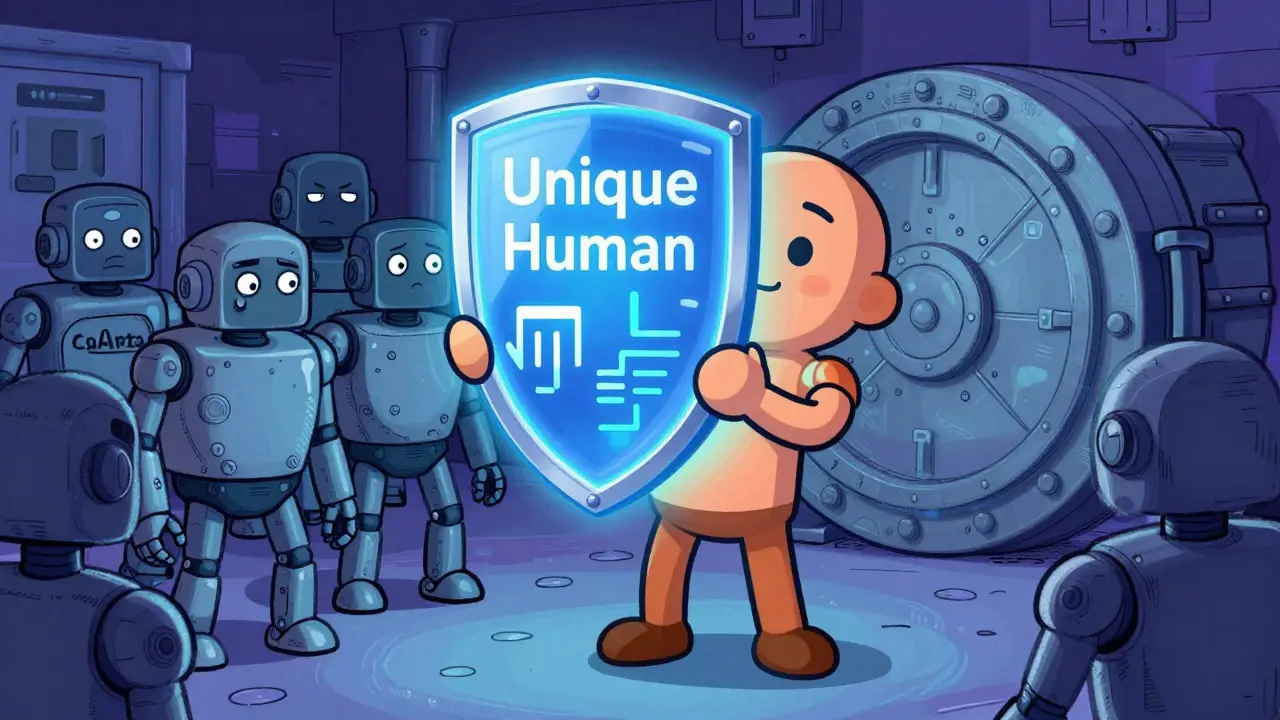
The industry is shifting toward Decentralized Identity (DID) protocols that allow users to prove attributes about themselves without revealing their underlying personal information. Instead of handing over your ID card, you generate a cryptographic proof that says, "I am a unique human being," without saying *who* you are.
This is where Zero-Knowledge Proofs (ZKPs) come into play. ZKPs allow one party to prove to another that a statement is true without revealing any information beyond the validity of the statement itself. For example, a protocol can verify that your wallet address belongs to a unique, verified human without ever seeing your name, address, or government ID number. This balances security with privacy, addressing the biggest criticism of traditional identity checks.
| Method | Privacy Level | Effectiveness | User Friction |
|---|---|---|---|
| Traditional KYC | Low (Centralized Data) | High | High (Time-Consuming) |
| Cryptoeconomic (PoS/PoW) | Medium | Medium (Wealth Bias) | Low (For Validators) |
| Phone/IP Verification | Low | Low (Easy to Spoof) | Low |
| ZKP-Based DID | High (Private) | Very High | Medium (Technical Setup) |
Real-World Applications: DAOs and Airdrops
Where does this matter most? Right now, it’s critical in two areas: DAO governance and token distribution.
In 2023, DappRadar reported that 63% of newly launched DAOs incorporated some form of identity verification for governance. Why? Because without it, governance is broken. If one entity controls 10,000 fake accounts, they can pass proposals that benefit only them, effectively stealing from the rest of the community. Identity verification ensures that each vote represents one real person or one legitimate stakeholder.
Airdrops face similar issues. Projects distribute free tokens to reward early adopters. But if bots dominate the snapshot, real users get nothing. Platforms like Formo process thousands of verifications daily, using behavioral analysis and device fingerprinting to distinguish humans from scripts. Their Q3 2023 data showed a 98.7% accuracy rate in filtering out bots, ensuring that rewards went to actual community members.
The Trade-Off: Privacy vs. Security
No solution is perfect. Implementing identity verification introduces friction. Users hate uploading documents. They fear data breaches. And purists argue that mandatory verification undermines the ethos of decentralization.
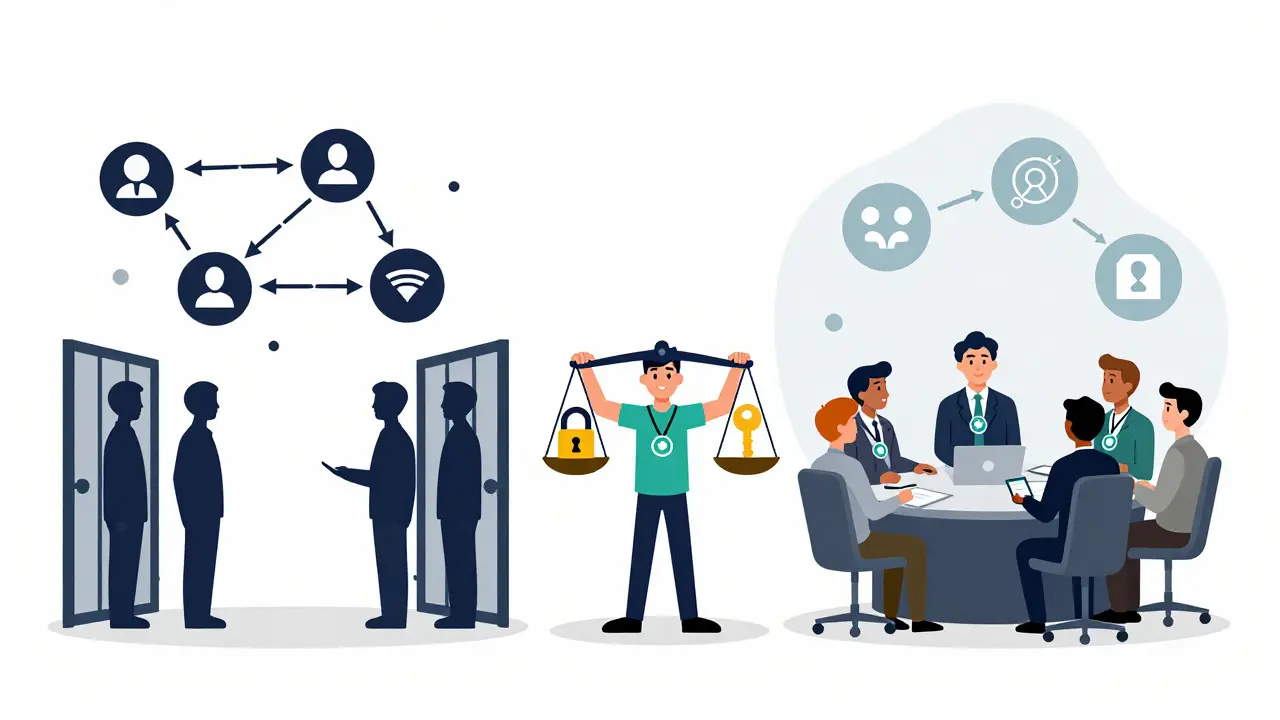
Vitalik Buterin, co-founder of Ethereum, has noted that mandatory identity verification can hurt censorship resistance. If a government can force an identity provider to blacklist certain users, then the blockchain isn’t truly permissionless anymore. This is why the trend is moving toward optional, privacy-preserving verification. You choose to verify yourself to access certain features (like voting or high-tier rewards), but your core ability to transact remains open.
There’s also the issue of global accessibility. Not everyone has a government-issued ID. Traditional KYC excludes millions of unbanked individuals. Decentralized identity solutions aim to fix this by allowing alternative forms of reputation-based verification, such as social graph analysis or historical on-chain behavior, though these methods are still maturing.
Implementation Challenges for Developers
If you’re building a dApp and want to prevent Sybil attacks, integrating identity verification isn’t plug-and-play. It requires careful planning.
- Choose the Right Provider: Established providers like Microsoft ION or Civic offer robust infrastructure but may have higher costs. Newer, blockchain-native solutions might be cheaper but less battle-tested.
- Consider User Experience: The verification process must be seamless. If it takes more than a few minutes, drop-off rates will spike. Aim for under five minutes total.
- Plan for Compliance: Regulations vary by jurisdiction. The EU’s Digital Identity Wallet framework, approved in 2023, mandates robust verification for financial apps. Ensure your solution meets local laws.
- Use Standards: Stick to W3C Verifiable Credentials standards. This ensures interoperability with other systems and future-proofs your implementation.
According to the Decentralized Identity Foundation, implementing a basic centralized system takes 2-3 weeks, while a fully decentralized ZKP-based system can take 6-8 weeks due to complexity. Budget accordingly.
The Future: Hybrid Approaches
We are heading toward a hybrid model. Pure anonymity will remain for simple transactions, but high-value interactions-governance, lending, large transfers-will require proof of uniqueness. By 2026, Forrester predicts that 60% of enterprise blockchain applications will incorporate identity verification for Sybil prevention.
The key is balance. We need systems that stop the bots without stopping the people. With advancements in zero-knowledge technology and decentralized identity standards, we are getting closer to a blockchain ecosystem that is both secure and inclusive. The era of easy Sybil attacks is ending, replaced by a new standard of verified, trusted participation.
What is a Sybil attack in blockchain?
A Sybil attack occurs when a single malicious actor creates multiple fake identities (nodes or wallets) to gain disproportionate control over a network. This can be used to manipulate voting in DAOs, double-spend coins, or drain airdrop rewards.
How does identity verification prevent Sybil attacks?
Identity verification confirms that each participant is a unique individual. By linking a wallet or node to a verified identity-or proving uniqueness via cryptographic means-it becomes economically or technically impractical for one person to control thousands of fake accounts.
Does identity verification compromise privacy?
Traditional KYC does, as it stores personal data centrally. However, modern Decentralized Identity (DID) systems using Zero-Knowledge Proofs (ZKPs) allow users to prove they are unique humans without revealing their actual personal information, thus preserving privacy.
Are Sybil attacks common in DeFi?
Yes, especially in airdrops and governance. Bot farms frequently target new DeFi protocols to claim free tokens or sway votes. This is why many projects now implement verification gates before distributing rewards.
What is the best way to implement Sybil resistance?
The most effective approach combines cryptoeconomic mechanisms (like staking) with privacy-preserving identity verification. Using W3C-compliant Verifiable Credentials allows for scalable, interoperable, and private verification.