
You see a headline about the Wolf Safe Poor People (WSPP) airdrop, and your heart skips a beat. Free crypto? Who doesn’t want that? But before you connect your wallet to some random website or Telegram bot, pause. The details surrounding this project are messy, contradictory, and screaming for caution. This isn’t just another obscure token; it’s a case study in how "charity" branding can mask high-risk speculation.
What Is WSPP Actually?
Wolf Safe Poor People is a cryptocurrency project claiming to be the first currency with a built-in program to reduce world poverty. It sounds noble, right? But dig deeper, and the story gets weird fast. The token exists on two different blockchains: Binance Smart Chain (BSC) and Polygon. Why two? Usually, when a project splits its presence across networks like this without clear utility reasons, it’s often an attempt to capture liquidity from multiple ecosystems or confuse new investors.
The BSC version has a market cap hovering around $950,000 as of late 2025, while the Polygon version is virtually worthless, sitting at roughly $51. That disparity alone should make you skeptical. How can the same "charity" token have such wildly different values depending on which chain you’re looking at? It suggests the market doesn’t trust the underlying value proposition.
The Tokenomics: A Quadrillion Problem
Let’s talk numbers, because they don’t lie. WSPP has a circulating supply of 13.5 quadrillion tokens. Yes, you read that right-quadrillion. To put that in perspective, if every person on Earth held one billion WSPP tokens, we’d still need trillions more to fill the gap. Because of this massive supply, the price per token is less than $0.00000000007. You could buy billions of them for a dollar and still not own enough to matter.
| Metric | WSPP (BSC) | Typical Utility Token |
|---|---|---|
| Circulating Supply | 13.5 Quadrillion | 1 Billion - 1 Trillion |
| Price Per Token | <$0.0000000001 | $0.10 - $100+ |
| 24h Trading Volume | <$10,000 | $1M - $1B+ |
| Exchange Listings | DEXs only | Major CEXs (Binance, Coinbase) |
This structure is classic for meme coins or pump-and-dump schemes. Legitimate projects aiming for real-world impact usually maintain tighter tokenomics to ensure stability. When you see quadrillion-level supplies, ask yourself: who actually holds these tokens? If early insiders hold 90% of the supply, any "airdrop" you receive might just be their way of offloading bags onto you.
The "Airdrop" Reality Check
Here’s the big question: Is there a legitimate WSPP airdrop happening now? Based on current data, probably not. Major airdrop tracking platforms like Airdrop Alert or CoinMarketCap’s dedicated sections don’t list active WSPP campaigns. Instead, what you’re likely seeing are phishing attempts targeting inexperienced users.
Scammers love the word "airdrop." They create fake websites that look official, ask you to connect your wallet, and then drain it. Since WSPP isn’t listed on major exchanges like Binance (it explicitly says "Not listed"), scammers know users will struggle to verify information. They rely on the fear of missing out (FOMO) to get you to click "Approve" on a malicious transaction.
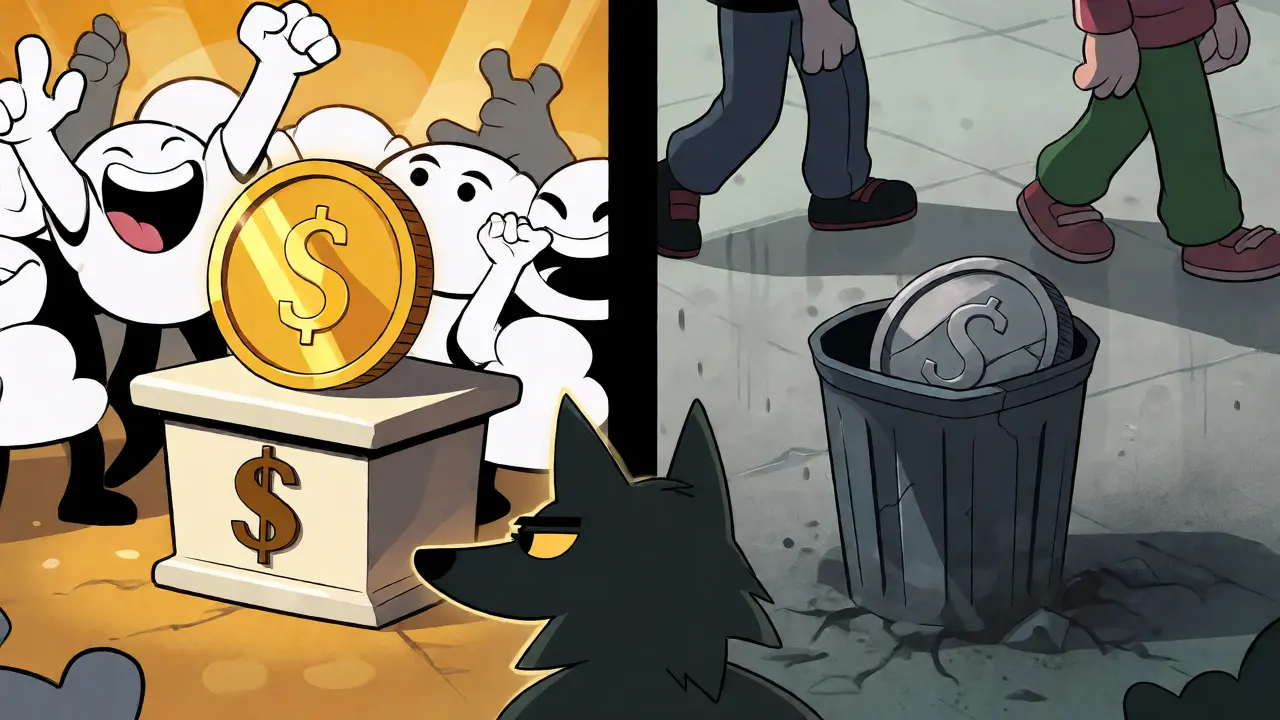
Charity Claims vs. Verifiable Impact
The project claims to use decentralized applications (DApps) to help poor people worldwide. Sounds good in theory. But where’s the proof? Compare this to established charitable crypto projects like GiveDirectly, which has distributed over $500 million through verified cash transfers, or Worldcoin, with millions of verified users. WSPP lacks public reports showing exactly how much money went to charity versus how much stayed in developer wallets.
There’s no accessible documentation detailing fund allocation. No quarterly impact reports. No partnerships with well-known NGOs like UNICEF or Red Cross that you can check independently. Without transparency, "charity" becomes just a marketing buzzword. The UN Development Programme noted in 2024 that 63% of charity-themed crypto projects lacked verifiable impact data. WSPP fits squarely into that statistic.
User Experiences: A Warning Sign
If you dig into community forums like Reddit or Trustpilot, the feedback is rarely positive. Users report issues like hidden transfer taxes exceeding 95% on sells. Imagine buying a token, watching the price double, trying to sell, and losing almost all your profit to a tax you didn’t know existed. That’s a common complaint with WSPP.
Others mention liquidity problems. With daily trading volumes under $10,000, selling a significant amount of WSPP can crash the price instantly. You might end up holding a bag of tokens you literally cannot sell without taking a massive loss. One user documented a 99.8% drop within 24 hours of purchase, with no volume to exit. That’s not investing; that’s gambling with unfavorable odds.

How to Spot a Fake WSPP Airdrop
If you’re determined to participate in any WSPP-related activity, protect yourself. Here’s a quick checklist:
- Check the Contract Address: Always verify the contract address on BscScan or Polygonscan. Scammers often deploy fake contracts with similar names.
- No Private Key Requests: Legitimate airdrops never ask for your private key or seed phrase. Ever.
- Use a Burner Wallet: Connect a fresh, empty wallet to any new dApp. Never use your main holdings wallet for unverified sites.
- Verify Social Channels: The project’s primary channel appears to be a Telegram group (@robowolfproject). Check if admins are verified and if discussions are substantive, not just bots spamming "to the moon."
The learning curve for interacting with DEXs (Decentralized Exchanges) is steep. You need to understand gas fees, slippage settings, and network switching. Mistakes here cost real money. According to Chainalysis, knowledge gaps contributed to 68% of reported user losses in similar scenarios.
Final Verdict: Proceed with Extreme Caution
Is WSPP a scam? Not necessarily in the legal sense, but it behaves like one structurally. It’s a high-risk speculative asset with minimal fundamental value. The "poverty reduction" angle seems more like branding than business model. If you’re looking for genuine blockchain-for-good investments, look for projects with transparent audits, real-world partnerships, and stable tokenomics.
For now, treat any WSPP airdrop claim as guilty until proven innocent. Don’t let the promise of free tokens cloud your judgment. In crypto, if something looks too good to be true, it usually drains your wallet.
Is WSPP listed on Binance?
No, WSPP is not listed on Binance. Binance explicitly states "Not listed" for this token. It trades primarily on decentralized exchanges (DEXs) like PancakeSwap on the Binance Smart Chain.
Why is the WSPP price so low?
The price is extremely low ($0.00000000007 range) because of the enormous circulating supply of 13.5 quadrillion tokens. High supply dilutes the value per unit, a common trait in meme coins and speculative assets.
Does WSPP actually help poor people?
While the project claims to reduce poverty via DApps, there is no verifiable evidence or public reporting of actual funds distributed to impoverished communities. Unlike established charities, WSPP lacks transparent impact metrics.
What are the risks of buying WSPP?
Key risks include low liquidity (hard to sell without crashing price), hidden transfer taxes (up to 95% on sells), potential smart contract vulnerabilities, and the possibility that "airdrops" are phishing scams designed to drain wallets.
How do I buy WSPP safely?
You must use a Web3 wallet like MetaMask or Trust Wallet. Purchase BNB or MATIC, swap it on a DEX using the correct contract address, and always start with a small test transaction to ensure the token functions as expected.