
It sounds like a contradiction that doesn’t make sense. How can a country with some of the strictest cryptocurrency laws in Southeast Asia also be one of the biggest users of it? The answer is simple: people find a way. As of late 2025 and heading into 2026, Vietnam consistently ranks among the top five nations globally for crypto adoption, despite the government’s heavy hand on regulation.
You might have seen headlines claiming Vietnam is #4 or #6. The truth is a bit more nuanced. In the Chainalysis 2025 Global Crypto Adoption Index, Vietnam sits at #6 when adjusted for population size. However, in unadjusted rankings and other metrics like retail transaction volume, it frequently hits the #5 spot. This high ranking isn't an accident; it’s the result of a massive grassroots movement pushing against regulatory walls.
The Numbers Behind the Hype
To understand why Vietnam is such a giant in this space, you need to look at the raw data. We are talking about roughly 17 million active crypto users. That represents about 17.2% of the entire population. Put that in perspective: if you walk into a crowded market in Ho Chi Minh City, nearly one in six people there is likely buying, selling, or holding digital assets.
The financial scale is even bigger. Annual crypto transactions in Vietnam exceed $100 billion. This surge is part of a broader Asia-Pacific trend, where the region saw a 69% year-over-year increase in transaction value, jumping from $1.4 trillion to $2.36 trillion. Vietnam, along with India and Pakistan, drove much of this growth. But unlike its neighbors, Vietnam does this under a cloud of legal uncertainty.
| Metric | Vietnam | Singapore | Philippines |
|---|---|---|---|
| Adoption Rate (% of Pop) | 17.2% | ~12% | ~15% |
| Institutional Access | Restricted | Open | Moderate |
| Stablecoin Policy | Banned | Regulated | Allowed |
| Primary Use Case | Remittances/Speculation | Investment/DeFi | Retail Payments |
The Regulatory Tightrope
Here is where it gets complicated. The State Bank of Vietnam (SBV) legalized cryptocurrencies in June 2025 through the Law on Digital Technology Industry. On paper, this looks like progress. They categorized crypto as either virtual assets (tokenized real-world products) or crypto assets like Bitcoin and Ether. But there’s a huge catch.
The SBV banned the issuance of fiat-backed stablecoins. No USDT, no USDC issued locally. They also prohibited securities tokens. If you want to issue a crypto asset in Vietnam, it must be backed by tangible real-world assets, not cash. Furthermore, all transactions must be settled in Vietnamese Dong (VND). This creates a massive friction point for international trade and remittances.
For businesses, the barriers are almost insurmountable. To operate as a Crypto Asset Service Provider (CASP), you need a minimum capital of 10 trillion VND (about $379 million USD). As of October 2025, the five-year regulatory sandbox pilot program launched in September had received zero applications. Why? Because the cost and complexity are too high for startups. Professor Nguyen Van Anh from Ho Chi Minh City University of Technology put it bluntly: the requirements effectively limit participation to state-owned enterprises.
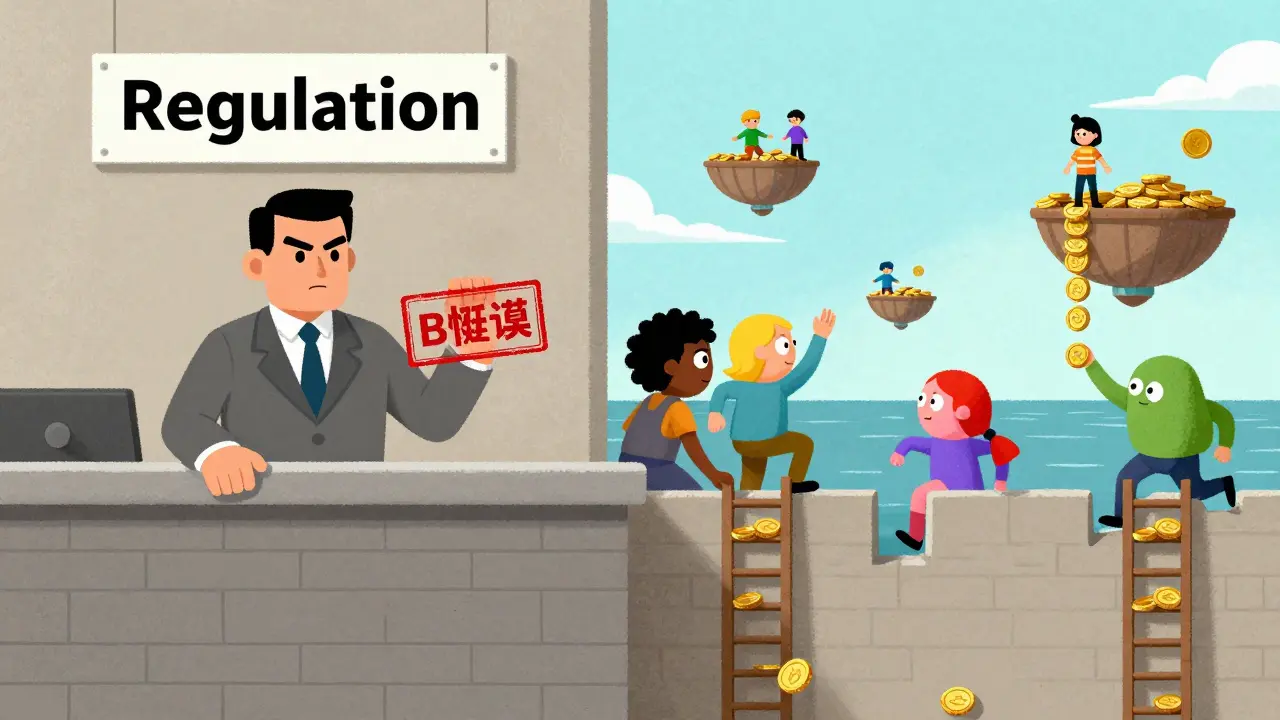
How People Actually Trade
If the official channels are closed or too expensive, how do 17 million people trade? They go offshore. A survey by OneSafe.io covering 5,000 users revealed that 87% of Vietnamese crypto users rely on foreign platforms. Binance P2P is the king here, used by 63% of traders. Bybit and OKX follow with 21% and 19% respectively.
This reliance on Peer-to-Peer (P2P) markets is a double-edged sword. It allows people to bypass restrictions, but it comes with headaches. Users report paying 3-5% premiums just to convert VND to USDT. Verification processes are complex, and converting profits back to VND can take three to four days through informal channels. On Reddit’s r/CryptoVietnam, complaints about "complex KYC" and "high fees" dominate the negative reviews.
Yet, people stay because the alternative is worse. Traditional remittance fees average 6.8%. Crypto remittances via P2P cost around 1.2%. For a family receiving $387 from abroad, that saves them significant money. Seventy-four percent of Vietnamese crypto users cite cross-border remittances as their primary use case. This economic necessity drives adoption more than any investment thesis.

The Stablecoin Problem
The ban on stablecoins is Vietnam’s biggest missed opportunity. Stablecoins act as a bridge between volatile cryptocurrencies and everyday spending. Without them, every transaction requires a risky conversion step. This restriction hurts remittances specifically. Vietnam processed $19.2 billion in international remittances in 2024. Experts estimate that if stablecoins were permitted, crypto could capture 15-20% of this market.
Compare this to the Philippines. Their more permissive environment allowed GCash’s GCrypto platform to onboard 8.7 million users since 2023. Singapore, which allows regulated stablecoin issuance, has a 32% higher institutional adoption rate than Vietnam. While Vietnam leads in retail passion, it lags in professional utility because the tools aren’t available legally.
Future Outlook: Cautious Growth
So, what happens next? The government is moving slowly. The Ministry of Finance released Draft Circular 40 in October 2025, proposing a 2% VAT and a 0.1% transaction tax on crypto trades. Meanwhile, the SBV announced a digital đồng pilot with 20 commercial banks. Some analysts believe this central bank digital currency (CBDC) could eventually integrate with crypto infrastructure, creating a hybrid system.
Chainalysis forecasts that Vietnam could rise to #4 in the 2026 index if the regulatory sandbox gains traction. Morgan Stanley projects 25-30% annual growth in the market through 2028, provided regulations evolve to allow stablecoins while maintaining safeguards. The risk remains high, though. The IMF warned in October 2025 that unregulated P2P transactions pose significant financial integrity risks. With 92% of activity happening outside formal channels, the government faces a choice: crack down harder or bring these users into the fold.
For now, the Vietnamese people have spoken. They want access to global finance, cheaper remittances, and new investment opportunities. Whether the regulators catch up to the reality on the ground will determine if Vietnam stays in the top five or slips behind neighbors who offer clearer paths.
Is crypto legal in Vietnam?
Yes, but with strict limitations. The Law on Digital Technology Industry, passed in June 2025, legalized cryptocurrencies as assets. However, using them as a means of payment is restricted, and the issuance of fiat-backed stablecoins is banned. You can own and trade them, but primarily through offshore platforms or limited local exchanges that meet high capital requirements.
Why does Vietnam rank so high in crypto adoption?
Vietnam ranks highly due to its young, tech-savvy population and high demand for remittance services. With over 17 million active users, the market is driven by individuals seeking lower fees for sending money abroad and looking for alternative investments amidst economic uncertainties. The lack of local options forces users to engage heavily with global P2P markets, boosting transaction volumes.
Can I use stablecoins like USDT in Vietnam?
You cannot issue or officially trade fiat-backed stablecoins like USDT or USDC through licensed local exchanges. However, many Vietnamese users still trade them via offshore platforms like Binance P2P. The government prohibits their issuance to maintain control over the national currency, the Vietnamese Dong.
What are the taxes on crypto in Vietnam?
As of late 2025, the Ministry of Finance proposed Draft Circular 40, which suggests a 2% VAT and a 0.1% transaction tax on crypto activities. These rules are still being finalized, but investors should prepare for taxation on their gains and transactions once fully implemented.
Which crypto apps are most popular in Vietnam?
Binance is the most dominant platform, particularly its P2P service, used by 63% of traders. Other popular offshore exchanges include Bybit (21%) and OKX (19%). Local licensed exchanges struggle to gain traction due to high regulatory barriers, leaving most retail users reliant on these international platforms.