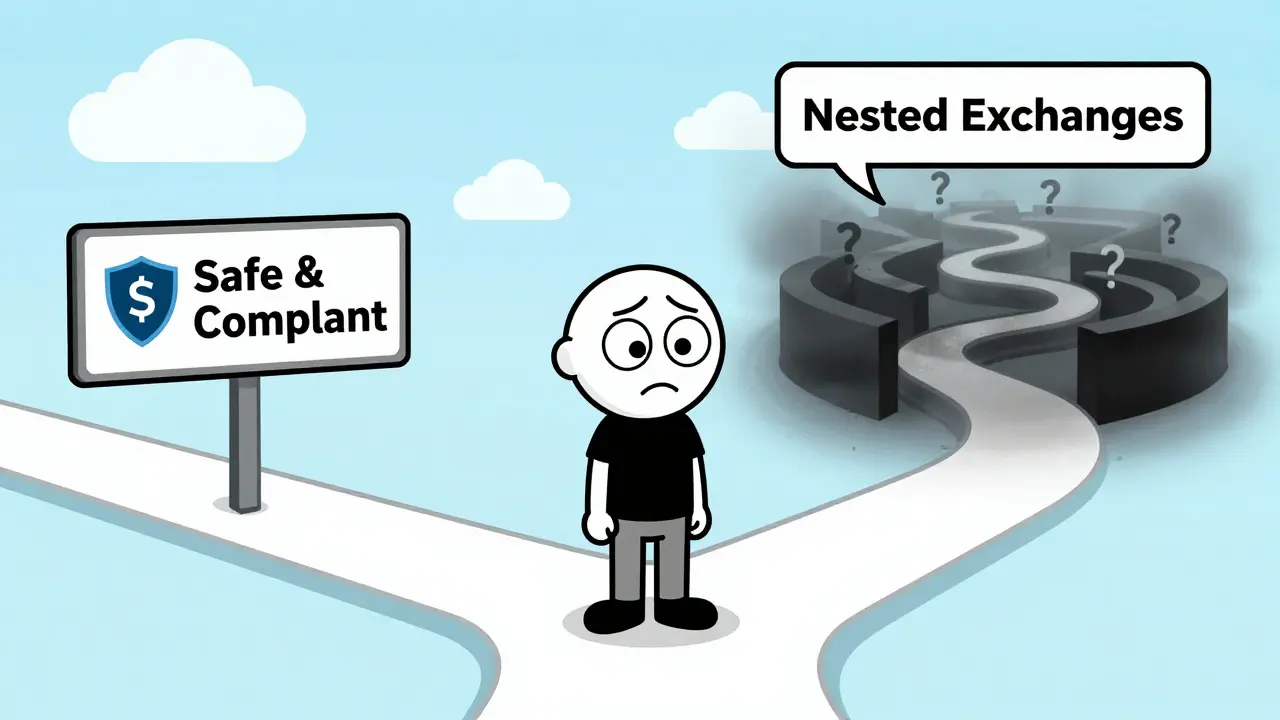
Splitting your cryptocurrency holdings across multiple platforms feels like a smart move. You want to avoid daily withdrawal limits, bypass geographic blocks, or simply hedge against one exchange going offline. It’s a common instinct in the volatile world of digital assets. But when you start hopping between exchanges specifically to dodge rules, you enter dangerous territory. The line between legitimate risk management and illegal sanctions evasion is thinner than you think.
In 2025 and 2026, regulators have sharpened their focus on exactly this behavior. Using multiple exchanges to avoid restrictions isn't just a technical workaround; it's a primary method criminals use to launder money and evade international sanctions. If you're not careful, your attempt to gain financial freedom could land you in legal trouble or result in lost funds. Let's break down how these systems work, why they are risky, and what the current regulatory landscape looks like.
The Mechanics of Nested Exchanges
To understand the risk, you first need to understand nested exchanges, which are cryptocurrency platforms that do not hold their own liquidity but instead route trades through other external exchanges. Think of them as middlemen. When you deposit Bitcoin into a nested exchange, they don't necessarily keep it in a wallet under their direct control for trading purposes. Instead, they use accounts on larger, compliant exchanges to execute your buys and sells.
This structure creates a blind spot. Because the nested exchange acts as a bridge, it obscures the original source and destination of your funds. For a legitimate user seeking arbitrage opportunities-buying low on one platform and selling high on another-this can seem convenient. However, for illicit actors, this opacity is gold. It allows them to mix clean money with dirty money, making it nearly impossible for blockchain analysts to trace the path of funds back to the original crime.
Nested exchanges often operate with lenient or non-existent Know Your Customer (KYC) and Anti-Money Laundering (AML) processes. This lack of oversight makes them attractive for those trying to hide their identity. But here is the catch: trading through these platforms means entrusting your assets to entities with significantly less security than major centralized exchanges. There are fewer guarantees, weaker insurance protocols, and a higher likelihood of fraud. If a nested exchange gets shut down by authorities, your funds might vanish without a trace.
Criminal Evasion Techniques You Should Recognize
You might not intend to break any laws, but understanding how criminals exploit multi-exchange strategies helps you identify red flags. Research from firms like Merkle Science has identified specific methods used to bypass restrictions. Knowing these patterns can help you avoid accidentally participating in sanctioned activities.
- Compromised Wallets: Criminals steal private keys from legitimate users who have completed KYC checks. They then use these "clean" identities to move funds through multiple exchanges, creating a false trail of legitimacy. If you ever buy crypto from an unknown source using a wallet that suddenly has a complex transaction history, be wary.
- Non-Compliant Exchanges: These are platforms based in countries with weak regulations or rogue nations that ignore international sanctions. Criminals use them as exit nodes to cash out illicit gains. Engaging with these platforms exposes you to counterparty risk-if the government freezes their assets, your access is cut off instantly.
- Decentralized Exchanges (DEXs): While DEXs offer privacy and autonomy, they also lack centralized oversight. Sanctioned entities often use DEXs to move funds peer-to-peer because governments cannot force code to comply with sanctions. For regular users, this means interacting with unverified counterparties where scams and rug pulls are common.
A particularly sophisticated tactic involves "multiple hops." A criminal might send funds from Exchange A to Exchange B, then to a Decentralized Exchange, and finally to a nested exchange before withdrawing to a personal wallet. Each step dilutes the audit trail. If you find yourself needing to perform similar complex maneuvers to move your own money, ask yourself why. Legitimate finance should be transparent, not labyrinthine.
Regulatory Crackdowns: The Grinex Case Study
The era of operating in the shadows is ending. Regulators are no longer just watching; they are actively dismantling networks designed to evade restrictions. A stark example occurred in March 2025 involving Grinex, a cryptocurrency exchange created by former Garantex employees to continue operations after sanctions.
Garantex was a major player in facilitating sanctions evasion until law enforcement actions led by the U.S. Secret Service disrupted its operations. In response, its creators launched Grinex. The promotional materials for Grinex explicitly stated it was formed to support customers affected by asset freezes. Despite this transparency about its intent, Grinex facilitated billions of dollars in transactions before being designated by the U.S. Treasury's Office of Foreign Assets Control (OFAC).
This case illustrates a critical point: creating a new entity to bypass restrictions does not protect you. OFAC tracks successor entities. If you use a platform known for helping users evade sanctions, you risk having your assets frozen. The Securities and Exchange Commission (SEC) has also prioritized policing unregistered crypto trading platforms. SEC Chair Gary Gensler has repeatedly stated that many crypto intermediaries are transacting in securities and must register. Operating outside these frameworks leaves you unprotected and potentially liable.
Compliance Requirements and Red Flags
If you are using multiple exchanges for legitimate reasons-such as accessing different token listings or better fee structures-you must ensure each platform adheres to strict compliance standards. Effective sanctions compliance programs require more than just a checkbox. They involve continuous monitoring and due diligence.
According to OFAC guidelines, virtual currency firms must implement internal controls that include screening, investigation, and transaction monitoring. They need to identify "red flags" that indicate illicit activity. As a user, you can look for these same indicators to judge the safety of an exchange.
| Feature | Compliant Exchange | Non-Compliant / Nested Exchange |
|---|---|---|
| KYC Process | Thorough, may take days, requires ID verification | Instant or non-existent, minimal documentation |
| Transaction Limits | Clear, tiered limits based on verification level | No limits or artificially high limits to attract volume |
| Transparency | Public proof of reserves, clear terms of service | Opaque ownership, vague policies on fund handling |
| Jurisdiction | Licensed in regulated jurisdictions (e.g., US, EU, UK) | Based in offshore havens or sanctioned regions |
| Support | Responsive, documented customer service channels | Unresponsive, relies on Telegram/Discord only |
If an exchange allows near-instant trading without limits and without asking for your identity, treat it as a significant red flag. Fair exchanges maintain transparency about their trading processes. You should be able to track the source of funds easily using blockchain explorers. Coin swap services, which operate via instant messaging without signup requirements, are another vector for restriction evasion. While convenient, they offer zero recourse if something goes wrong.
Security Risks and User Vulnerabilities
Beyond legal risks, there is the practical issue of security. Trading through nested or non-compliant exchanges exposes you to heightened cyber threats. These platforms often lack the robust cybersecurity infrastructure of major players. They are prime targets for hackers looking to exploit weak defenses.
Cybercriminals frequently exploit the lack of compliance in these platforms to facilitate money laundering, support scammers, and process ransomware payments. By associating your wallet addresses with these illicit flows, you risk getting blacklisted by compliant exchanges later. Many mainstream platforms now screen incoming deposits against databases of known illicit addresses. If your funds touch a sanctioned wallet or a known money-laundering scheme, your account could be frozen indefinitely.
Furthermore, the safety of your funds is never guaranteed with nested exchanges. Unlike banks that offer deposit insurance, most crypto exchanges operate without such protections. If a nested exchange collapses due to regulatory pressure or insolvency, you have no legal standing to recover your assets. You are essentially gambling with your capital on the hope that the middleman stays solvent and honest.

Legitimate Multi-Exchange Strategies
Does this mean you should stick to one exchange? Not necessarily. Diversification is a valid strategy, but it must be done within legal boundaries. Here is how to use multiple exchanges safely:
- Choose Regulated Platforms: Only use exchanges that are registered with relevant financial authorities. Check if they hold licenses in your jurisdiction or in reputable markets like the European Union or United Kingdom.
- Complete Full KYC: Do not shy away from identity verification. It protects you by ensuring the platform is serious about compliance. It also provides a layer of recovery options if your account is compromised.
- Monitor Transaction Histories: Keep records of why you are moving funds between exchanges. Is it for arbitrage? Better fees? Specific token availability? Having a clear, legitimate purpose helps if you ever need to explain your activity to auditors or regulators.
- Use Hardware Wallets: Regardless of which exchange you use, store long-term holdings in self-custody hardware wallets. This reduces reliance on exchange security and gives you control over your private keys.
Arbitrage, liquidity access, and risk management are legitimate reasons to use multiple platforms. The key is transparency. Ensure every platform you interact with adheres to global AML and sanctions standards. Avoid platforms that market themselves as "no-KYC" or "anonymous" if your goal is long-term, secure investing.
Future Regulatory Developments
The regulatory landscape is evolving rapidly. Authorities are adapting to the challenges posed by multi-exchange evasion strategies. The designation of entities like Grinex signals a new phase of enforcement where regulators actively pursue successor organizations created to circumvent sanctions. We are seeing increased international cooperation, with agencies sharing data to track cross-border crypto flows.
New technologies are also emerging to enhance compliance. Specialized software tools are becoming standard components of sanctions compliance programs for virtual currency firms. These tools use machine learning to detect suspicious patterns in real-time. For users, this means that attempts to obscure transactions will become increasingly difficult and likely to trigger alerts.
Tokens designed specifically for sanctions evasion, such as ruble-backed digital assets issued by firms in Kyrgyzstan, demonstrate the sophistication of current schemes. However, they also highlight the industry's need for enhanced regulatory cooperation. As enforcement actions increase, the gap between compliant and non-compliant platforms will widen. Staying on the right side of the law is not just about avoiding fines; it's about ensuring the longevity and stability of your investment portfolio.
Is it illegal to use multiple crypto exchanges?
No, using multiple exchanges is not inherently illegal. Many traders use several platforms for diversification, better rates, or access to specific tokens. However, it becomes illegal if you use these platforms to evade sanctions, launder money, or bypass anti-money laundering (AML) laws. Intent and the nature of the transactions matter significantly.
What is a nested exchange?
A nested exchange is a cryptocurrency platform that does not hold its own liquidity. Instead, it routes user trades through other external exchanges. While this can provide access to broader markets, it often lacks proper KYC/AML controls, making it a preferred tool for criminals attempting to obscure the origin of funds.
How can I tell if an exchange is compliant?
Look for exchanges that require thorough Know Your Customer (KYC) verification, publish proof of reserves, and are licensed in reputable jurisdictions. Compliant exchanges will have clear terms of service, responsive customer support, and transparent fee structures. Avoid platforms that promise instant, unlimited trading without identity checks.
What happened to Garantex and Grinex?
Garantex was a major exchange involved in sanctions evasion. After U.S. law enforcement actions in 2025, its operators created Grinex to continue operations. Grinex was subsequently designated by OFAC for facilitating billions in illicit transactions. This case shows that regulators track and penalize entities created specifically to bypass sanctions.
Are decentralized exchanges (DEXs) safer for avoiding restrictions?
DEXs offer privacy but are not necessarily safer. While they lack centralized oversight, they are often used by sanctioned entities to move funds undetected. Interacting with DEXs can expose you to smart contract risks, scams, and potential association with illicit funds, which may lead to your addresses being blacklisted by compliant platforms.