Cambodia Crypto Classification Tool
Asset Classification Tool
This tool helps determine whether a cryptocurrency asset would fall under Cambodia's Group 1 (low-risk) or Group 2 (high-risk) classification based on NBC regulations.
Quick Takeaways
- The National Bank of Cambodia (NBC) blocked 16 offshore crypto exchanges in November 2024, citing lack of licences.
- In January 2025 NBC introduced Prakas B7-024-735 Prokor, a regulatory framework that splits digital assets into low‑risk (Group 1) and high‑risk (Group 2) categories.
- Commercial banks may offer client‑facing crypto services, but they cannot hold Bitcoin‑type assets on their balance sheets.
- Only two domestic platforms - Royal Group Exchange (RGX) and Cambodian Network Exchange (CNX) - are licensed to operate under the NBC’s FinTech sandbox.
- Future steps point to a gradual expansion of permitted services, especially around stablecoins, while offshore bans remain in force.
When it comes to crypto in Cambodia, National Bank of Cambodia is the country’s central bank that oversees monetary policy and recently rolled out a strict set of rules for digital assets has taken a strong stance. If you heard the phrase “crypto ban,” you might picture total prohibition. The reality is more nuanced: the bank slapped a hard block on unlicensed overseas exchanges, yet it also created a licensing path for domestic players and even opened the door for banks to serve crypto customers. Let’s break down what actually happened, why it matters, and where the market could head next.
Background: From an Informal Prohibition to Formal Rules
Back in 2018 Cambodian regulators issued a joint statement saying any crypto activity without a licence was illegal. That warning sat on the books for years while users flocked to cheap overseas platforms like Binance and Coinbase. By 2024, the country ranked 17th globally in crypto adoption, with a market worth roughly US$7.9 million and an estimated 539 000 users by next year. The rapid growth alarmed the NBC, which feared two things: loss of control over the riel and a surge in crypto‑related fraud.
The 2024 Offshore Exchange Block
In November 2024 the Telecommunications Regulator of Cambodia (TRC) shut down access to 16 major foreign exchanges, banning over 102 domains. Binance, which had about 200 000 Cambodian users, was among the biggest victims. The regulator’s statement was crystal clear: “Platforms operating without proper licenses and authorisations are prohibited.” The move was meant to push users toward locally supervised services and to protect the financial system from money‑laundering and cyber‑crime.
Did the ban wipe out crypto activity overnight? Not quite. Many traders turned to VPNs, and peer‑to‑peer (P2P) markets kept humming. Still, the block sent a strong signal that the government would not tolerate unregulated players.
The 2025 Regulatory Framework (Prakas B7-024-735)
On 26 December 2024 NBC published Prakas B7-024-735 Prokor, which became active in early 2025. The regulation does three things:
- It classifies digital assets into two groups.
- Group 1: tokenised securities and approved stablecoins - low‑risk, backed assets.
- Group 2: all other crypto‑assets, including Bitcoin and Ethereum - high‑risk, unbacked tokens.
- It lets commercial banks hold or invest in Group 1 assets after NBC approval, but outright bans them from holding Group 2 assets on their balance sheets.
- It defines a new category called Crypto Asset Service Providers (CASPs) that need licences to operate, and it outlines the approval process for banks offering crypto‑related services.
The framework mirrors the Basel Committee’s approach to asset classification, giving regulators a clear risk‑based lens.
What Banks Can and Cannot Do
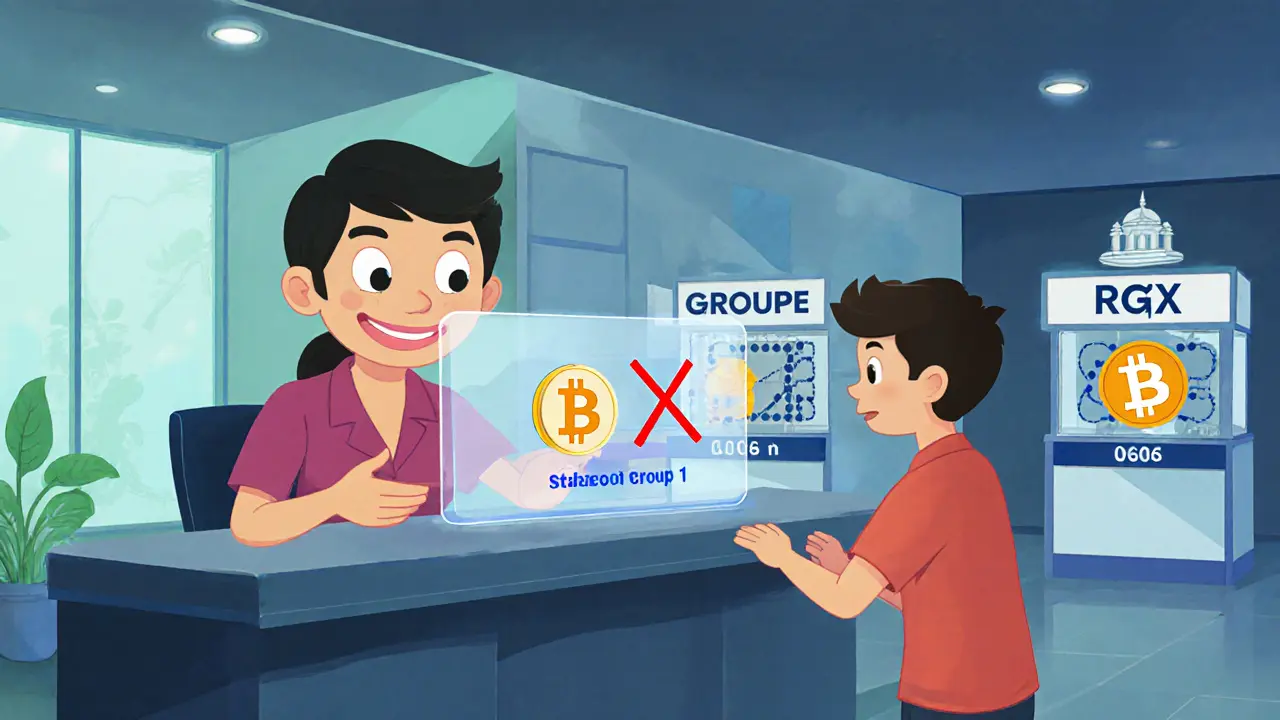
Commercial banks under NBC supervision now have a thin but important gray area:
- They may provide on‑ramping (fiat‑to‑crypto) and off‑ramping (crypto‑to‑fiat) services for clients, but only as a CASP and with prior approval.
- They can offer custody solutions for Group 1 assets, meaning a client can store a stablecoin in a bank‑run wallet.
- They cannot buy, sell, or hold Bitcoin or other Group 2 assets for themselves - the regulation explicitly calls this “their own crypto‑assets.”
In plain English: banks can act like a bridge for customers, but they can’t play the speculative game themselves.
Domestic Licensed Exchanges: RGX and CNX
While offshore platforms were blocked, NBC granted licences to only two local exchanges: Royal Group Exchange (RGX) and Cambodian Network Exchange (CNX). Both operate inside the FinTech sandbox, meaning they must meet strict AML, KYC, and reporting standards. The goal is to funnel users into a controlled environment where the central bank can monitor flows and protect the riel.
These platforms also integrate with the government‑backed payment system Project Bakong, a blockchain‑based peer‑to‑peer network launched in 2020. More than 65 % of Cambodians already use Bakong for everyday transfers, so linking crypto services to it creates a seamless bridge between traditional money and digital assets.
Impact on Users, Traders, and the Market
For the average Cambodians, the ban feels like a hurdle. Traders lost the cheap fees of Binance and had to either find VPN work‑arounds or migrate to RGX/CNX, which charge higher spreads but offer regulatory peace of mind. On the flip side, the move has spurred a wave of educational campaigns about AML and consumer protection, something that was missing in the wild offshore market.
From a macro perspective, the NBC’s actions help preserve the riel’s dominance. With fewer people using dollar‑linked crypto to bypass official channels, the central bank can keep a tighter grip on money supply and curb dollarisation. It also reduces the risk of large‑scale fraud, which has plagued the region - remember the forced‑labour crypto scams exposed in the U.S. DOJ indictment of the Prince Group in late 2024.
Future Outlook: More Licensing, Not Less
Analysts agree that Cambodia’s approach will stay “cautious but open.” The next steps likely include:
- Finalising the detailed CASP licensing rules - we should see a formal application guide by mid‑2025.
- Expanding stablecoin offerings within Group 1, potentially giving the NBC a new tool to boost liquidity in the Bakong ecosystem.
- Monitoring VPN circumvention; if it spikes, regulators may tighten internet‑filtering mechanisms.
In short, the country is moving from a blanket ban to a controlled, licensed market. That makes it a case study for other Southeast Asian nations wrestling with similar dilemmas.
FAQ
Did Cambodia completely ban cryptocurrency?
No. The ban applies only to unlicensed offshore exchanges. Domestic platforms with NBC licences can operate, and banks may offer client‑focused services under strict rules.
What are Group 1 and Group 2 assets?
Group 1 includes tokenised securities and approved stablecoins - assets backed by real value and deemed low risk. Group 2 covers all other crypto‑assets like Bitcoin, Ethereum, and most alt‑coins, which are treated as high risk.
Can I still use Binance from Cambodia?
Direct access to Binance’s website is blocked by the TRC. Some users bypass the block with VPNs, but officially the platform is unavailable without a licence.
Which local exchanges are licensed?
Royal Group Exchange (RGX) and Cambodian Network Exchange (CNX) are the only two exchanges approved to operate inside the NBC’s FinTech sandbox.
Will the ban affect the Bakong system?
Bakong is a central‑bank‑backed digital payments platform, not a crypto exchange. The ban actually aims to protect Bakong by keeping users within a regulated environment.
Comparison of Asset Groups under Prakas B7‑024‑735
| Feature | Group 1 (Low‑Risk) | Group 2 (High‑Risk) |
|---|---|---|
| Typical examples | Approved stablecoins, tokenised securities | Bitcoin, Ethereum, most alt‑coins |
| Bank exposure allowed? | Yes, with NBC approval and caps | No, direct holding prohibited |
| Regulatory scrutiny | Standard AML/KYC | Enhanced due‑diligence, stricter limits |
| Primary risk focus | Liquidity and backing asset quality | Price volatility and fraud potential |
7 Comments
Derajanique Mckinney
so like... banned binance but now we gotta pay extra on rgx? lmao. 🤡💸
Clarice Coelho Marlière Arruda
i mean, i get why they did it. p2p is still alive, but at least now my cousin ain't getting scammed by some 'crypto guru' on telegram. still... why not just regulate instead of block? 🤷♀️
Frech Patz
The regulatory distinction between Group 1 and Group 2 assets reflects a sophisticated risk-based framework aligned with international standards. Notably, the prohibition of institutional holding of Group 2 assets mitigates systemic exposure while permitting regulated intermediation through CASPs. This approach balances innovation with financial stability, offering a replicable model for emerging economies.
Nick Cooney
so banks can help you buy crypto... but can't own any? that's like a pizza place that'll deliver you pepperoni but can't eat it themselves. 😏 guess that's 'serving customers' in bureaucratic speak. also, typo: 'prokor' is not a word, but NBC sure acted like it was.
Brian Collett
Anyone else notice how Bakong is basically the backbone of this whole thing? It's wild how a government payment system built in 2020 became the perfect on-ramp for regulated crypto. The real win here isn't the ban-it's the infrastructure. Cambodia’s quietly building a digital finance ecosystem without needing to go full China.
Allison Andrews
The real question isn't whether crypto should be banned or allowed-it's whether financial sovereignty requires control over perception. The NBC isn't just regulating assets; it's regulating hope. People turned to crypto because the riel felt fragile, and dollars felt safer. Now they're being asked to trust a state-sanctioned alternative. That’s not policy-it's psychology. And psychology, unlike blockchain, can't be audited.
Anna Mitchell
Honestly? This feels like the right kind of cautious step. Not perfect, but way better than just letting people get wiped out by shady offshore sites. Slow and steady might actually win this race.