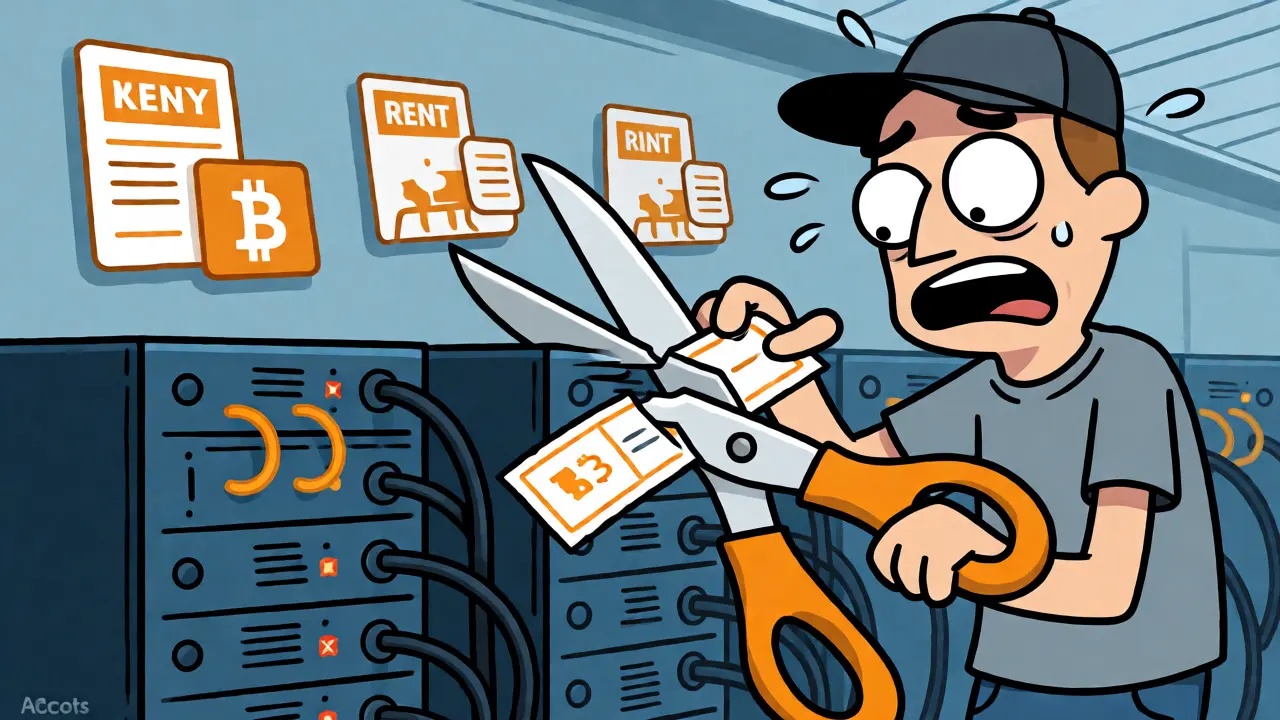
Imagine waking up one morning to find your paycheck has been cut in half, but your rent, electricity bill, and hardware costs haven't budged an inch. That’s the reality for Bitcoin miners every four years. The Bitcoin halving is a programmed event that reduces the block reward by 50%, fundamentally shifting the economic landscape for those securing the network. It’s not just a technical update; it’s a stress test that separates efficient operators from those running on thin margins.
For miners, the halving isn’t abstract theory-it’s a direct hit to their primary income source. When the April 2024 halving reduced rewards from 6.25 BTC to 3.125 BTC per block, many operations saw their monthly revenue drop overnight. If you’re wondering how this impacts the people actually running the rigs, or if you’re thinking about entering the space, understanding the mechanics of this shock is critical. We’ll break down exactly what happens to revenue, why efficiency becomes king, and how the industry adapts when the easy money disappears.
The Immediate Revenue Shock
Let’s look at the math. Before the 2024 halving, a miner finding a block earned 6.25 BTC. Afterward, that same effort yielded only 3.125 BTC. Since block rewards historically accounted for roughly 98% of total miner revenue, this was a massive blow. Transaction fees make up the remaining sliver, but they rarely cover the gap immediately. According to data from WisdomTree in mid-2024, major public miners like Bitdeer and Marathon Digital saw production declines of over 25% month-over-month right after the event. This wasn’t because they mined less work; it was because the payout for that work was literally halved.
This sudden drop creates a temporary liquidity crisis. Miners have fixed costs-electricity, hosting fees, maintenance-that don’t decrease with the reward. If the price of Bitcoin doesn’t rise quickly enough to offset the lower supply issuance, profit margins evaporate. For smaller operators without deep pockets, this period is often fatal. They can’t wait months for the market to correct itself if they’re bleeding cash every day.
Efficiency Becomes the Only Shield
When revenue drops, the only variable you can control is cost. Specifically, energy cost. The halving acts as a brutal filter, favoring miners who pay rock-bottom rates for electricity. Industry analysis suggests that miners paying below $0.04 per kWh remain profitable even at lower Bitcoin prices, while those paying $0.08 per kWh need significantly higher prices to break even. In regions where grid power exceeds $0.10 per kWh, survival post-halving is nearly impossible without extreme operational tweaks.
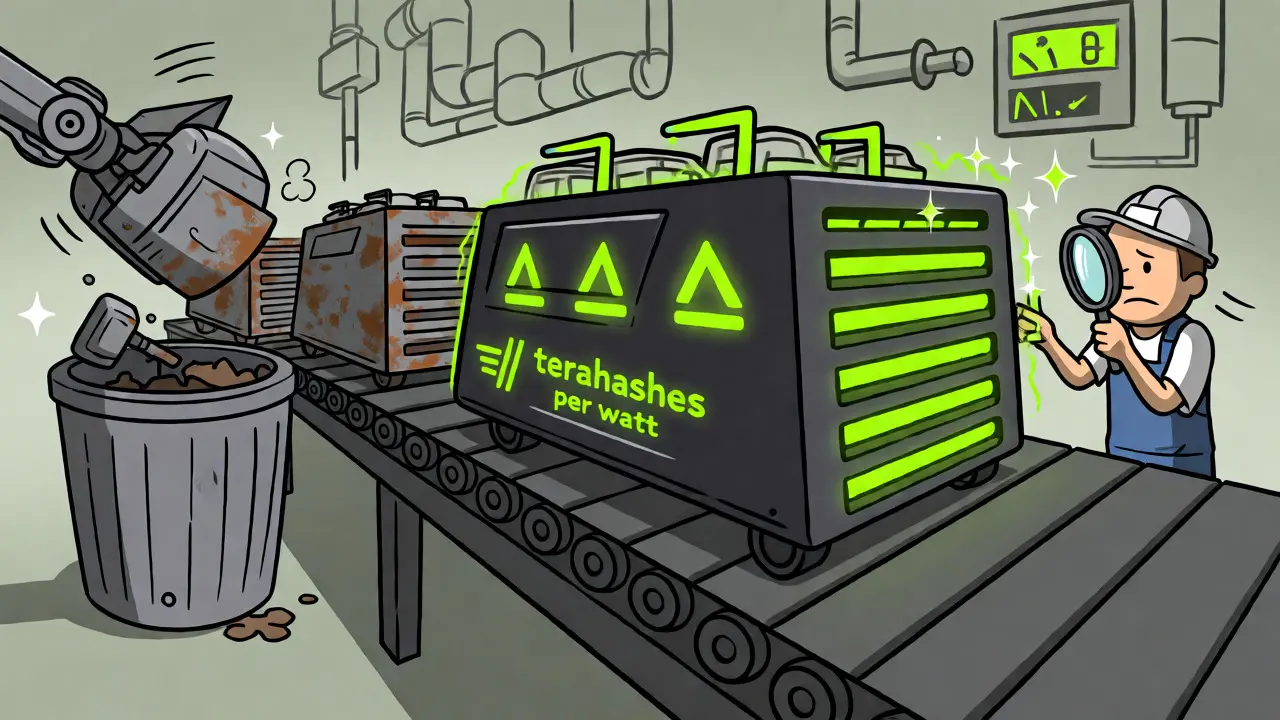
This pressure forces rapid technological adoption. You’ll see a surge in demand for high-efficiency ASICs (Application-Specific Integrated Circuits) that deliver more terahashes per watt. Older machines, which might have been profitable before, suddenly become liabilities. Hashrate Index reported that the average lifespan of mining rigs dropped from 24 months pre-halving to just 14 months afterward. Why? Because holding onto inefficient hardware means losing money on every kilowatt-hour consumed. Successful miners are those who aggressively refresh their fleets or relocate to areas with stranded energy resources, like hydroelectric dams or natural gas flares, where costs can dip as low as $0.02 per kWh.
| Electricity Cost (per kWh) | Break-even Bitcoin Price | Survival Probability |
|---|---|---|
| $0.02 - $0.03 | < $30,000 | High |
| $0.04 - $0.05 | $35,000 - $40,000 | Moderate |
| $0.07 - $0.08 | > $50,000 | Low |
| > $0.10 | > $65,000 | Critical Risk |
Consolidation and the Rise of Enterprise Mining
You won’t see mom-and-pop garage miners surviving many halvings. The trend since 2024 has been clear: consolidation. Larger, well-capitalized firms acquire weaker competitors or buy out their hardware. WisdomTree noted $1.2 billion in mergers and acquisitions within six months of the last halving. This isn’t just about scale; it’s about access to capital. Big players can weather the storm, buying up cheap equipment from bankruptcies and negotiating better hosting contracts due to their size.
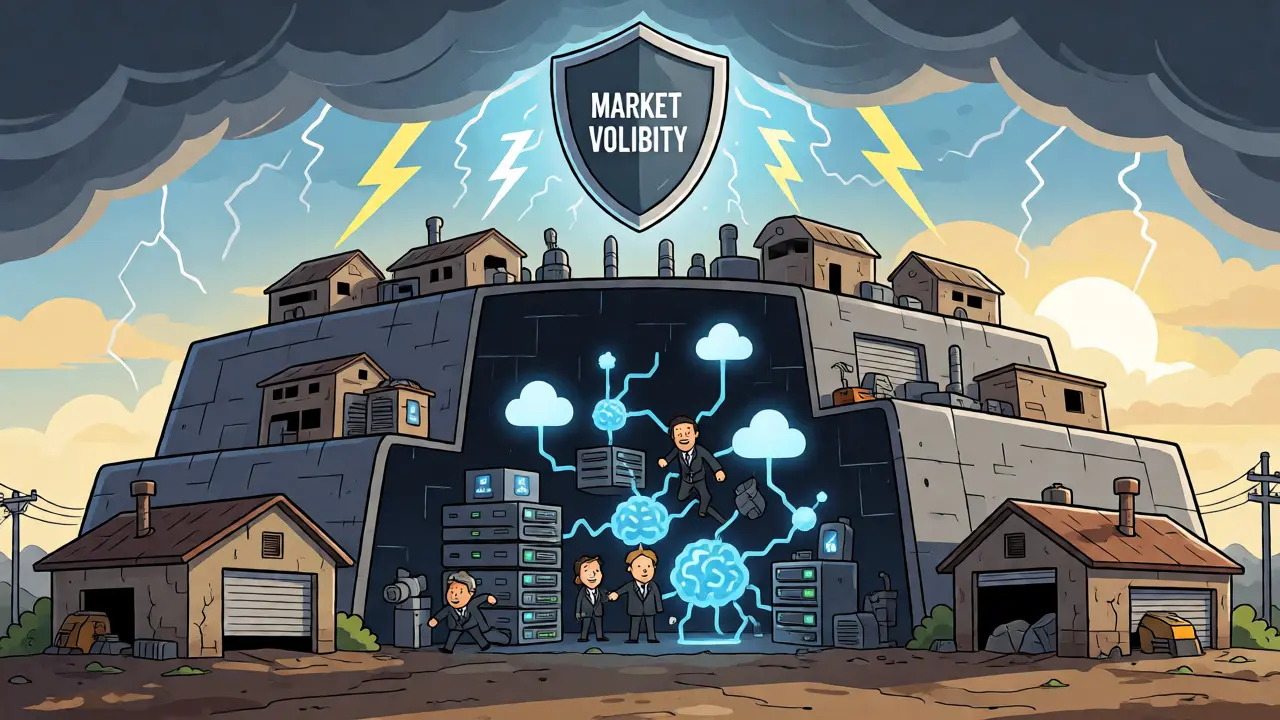
Consequently, the share of global hash rate controlled by enterprise operations has climbed to 78%, up from 65% in 2020. These companies diversify into AI compute and cloud services to stabilize cash flow when mining profits dip. For instance, some firms repurpose idle capacity for high-performance computing tasks, creating a secondary revenue stream that buffers against Bitcoin price volatility. This shift makes the network more robust but also more centralized among a few giant entities.
Network Security and the Hash Rate Dip
A common fear is that if too many miners quit, the network becomes vulnerable to attacks. Historically, hash rate does dip after a halving-often by 15-30%-as inefficient miners pull the plug. However, history also shows recovery. By July 2024, the network hash rate had bounced back to 92% of its pre-halving peak. This resilience comes from two sources: new miners coming online with cheaper energy deals, and existing miners optimizing their load-shedding strategies.
Load shedding is key here. Many miners now agree to pause operations during peak grid hours in exchange for lower rates. This flexibility helps them survive periods of low profitability. Furthermore, transaction fees play a growing role. While still small compared to block rewards, fee revenue increased notably due to network activity spikes, providing a crucial cushion. As we move toward the next halving in 2028, the protocol relies increasingly on these fees to maintain security, a transition that requires sustained user demand for block space.
Strategic Moves for Future Survivors
If you’re looking at the current landscape, three things define success: energy arbitrage, hardware agility, and financial hedging. Smart miners don’t just mine; they trade. They use futures markets to lock in prices for future production, protecting themselves from short-term dips. They also monitor regulatory environments closely, as energy policies can change overnight, impacting costs directly.
Another emerging strategy is geographic mobility. With regulations tightening in some jurisdictions, miners are moving to places with favorable energy grids and clearer legal frameworks. This isn’t just about cheap power anymore; it’s about predictable power. Access to renewable sources not only lowers costs but also appeals to institutional investors concerned about environmental footprints. EY Switzerland even suggested that the pressure to be efficient could reduce Bitcoin’s overall energy consumption per transaction, a counterintuitive benefit of the halving.
Frequently Asked Questions
Does the Bitcoin price always go up after a halving?
Not immediately. While historical trends show bullish cycles following halvings, there is usually a lag of several months. The immediate effect is often a price correction or stagnation as the market absorbs the reduced supply issuance. Miners should not rely on instant price appreciation to save them.
What happens to old mining rigs after a halving?
Many older rigs become unprofitable and are either sold to hobbyists, exported to regions with cheaper electricity, or scrapped. The resale value of older ASICs typically plummets post-halving, making it a bad time to buy outdated hardware unless you have exceptionally low energy costs.
Can small home miners survive a halving?
It is difficult. Small miners usually pay residential electricity rates, which are high compared to industrial rates. Unless they have free or extremely subsidized power, the halving often pushes their break-even price above the market price, forcing them to shut down or sell their equipment.
How do transaction fees help miners after the halving?
Transaction fees become a larger percentage of total revenue as block rewards shrink. During periods of high network congestion, fees can spike significantly, temporarily boosting miner income. Over the long term, as block rewards approach zero, fees will become the primary incentive for securing the network.
Is the network secure if hash rate drops?
Yes, generally. The Bitcoin network adjusts difficulty approximately every two weeks. If hash rate drops, difficulty decreases, allowing remaining miners to find blocks at a similar frequency. This self-correcting mechanism maintains security levels even if fewer machines are running.