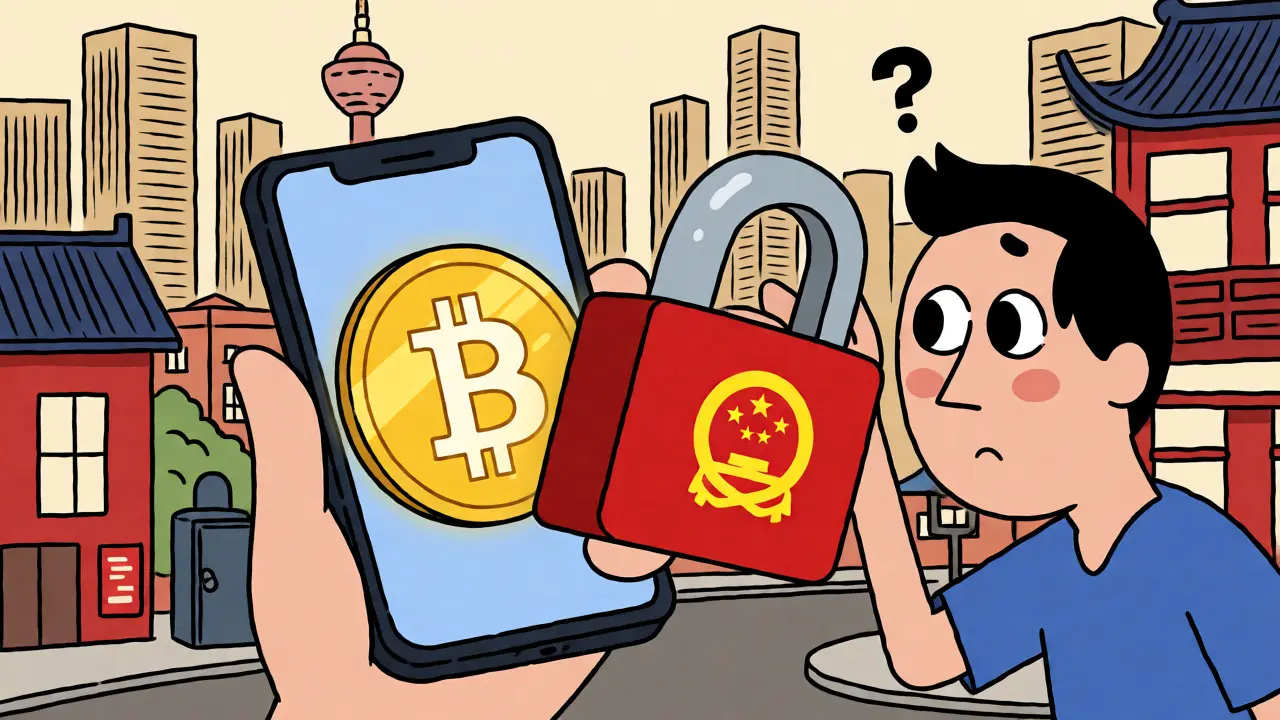
Imagine trying to buy a coffee with Bitcoin in Shanghai today. You can’t. In fact, you can’t even legally own it. If you’re a Chinese citizen, the door to the global cryptocurrency market didn’t just close-it was welded shut. As of June 1, 2025, China implemented its most aggressive crackdown yet, making all crypto activities illegal for residents. This isn’t just about banning exchanges; it’s about erasing private digital asset ownership from the financial landscape.
Why does this matter? Because China once led the world in Bitcoin mining and trading volume. Now, it stands as the strictest regulator globally, pushing its own state-backed currency while shutting out decentralized alternatives. If you’re wondering how these rules affect your wallet or business, here is what you need to know.
The Quick Breakdown
- Total Ban: Trading, mining, and individual ownership of crypto are illegal for Chinese residents.
- Enforcement: Banks and Alipay must block all crypto payment channels and monitor abnormal transactions.
- Digital Yuan Push: The government promotes the CBDC (e-CNY) as the only approved digital money.
- No Loopholes: Offshore exchanges cannot legally serve mainland clients without specific approvals, which rarely happen.
From Warnings to Prohibition: A Decade of Tightening Screws
China didn’t wake up one day and decide to hate Bitcoin. It was a slow burn that turned into an inferno. Back in December 2013, the People's Bank of China (PBOC the central bank of the People's Republic of China) issued its first warning, telling banks they couldn’t touch Bitcoin. At that point, people thought, "Okay, we’ll just use other platforms." They were wrong.
By September 2017, the government banned Initial Coin Offerings (ICOs). Overnight, 24 ICO platforms shut down. Then came the closure of BTCC, China’s oldest exchange. But those were just warm-ups. In 2021, mining got hit hard due to environmental concerns, forcing miners to flee to Texas and Kazakhstan. Finally, on May 30, 2025, the PBOC dropped Circular No. 237. Effective June 1, 2025, any activity involving virtual currencies became an "illegal financial activity."
This timeline shows a clear strategy: control capital flow, protect the yuan, and eliminate competition for their new digital currency.
What Exactly Is Banned?
The definition of "crypto activity" under Circular No. 237 is broad. It’s not just about swapping coins on Binance. The ban covers:
- Trading cryptocurrencies against legal tender (RMB).
- Swapping one crypto for another.
- Providing information intermediation or pricing services.
- Acting as a central counterparty for buying/selling.
- Token issuance financing.
Crucially, this applies to individuals too. You cannot legally hold Bitcoin, Ethereum, or stablecoins like USDT on your personal balance sheet. Financial institutions, including major banks and Alipay a third-party mobile payment platform owned by Ant Group, are required to cut off payment channels. If your bank sees a pattern of transactions linked to crypto, they will freeze your account.

The Rise of the Digital Yuan vs. Crypto
Why ban crypto if it’s so popular? The answer lies in control. China wants a digital economy, but it wants to run it. Enter the Digital Yuan also known as e-CNY, a central bank digital currency issued by the PBOC. Unlike Bitcoin, which is decentralized, the Digital Yuan is fully controlled by the state. It allows the government to track every transaction, enforce monetary policy instantly, and prevent capital flight.
For Chinese citizens, the choice is stark: use the state-approved e-CNY or risk penalties for using unapproved digital assets. There is no middle ground. While some economists whisper about a yuan-pegged stablecoin pilot in Shanghai or Hong Kong, don’t hold your breath. Strict capital controls make near-term implementation unlikely.
How Enforcement Works: Tech and Police
You might think, "I’ll just use a VPN and trade on an offshore exchange." That used to work. Not anymore. The enforcement mechanisms are now technologically sophisticated. In July 2025, police and regulators launched coordinated crackdowns specifically targeting schemes using Tether (USDT) for illicit cross-border transfers. These moves aim to curb yuan depreciation pressures.
Banks use enhanced monitoring systems to detect "abnormal transactions." If you send money to a peer-to-peer trader who then sends you back a different amount, algorithms flag it. Telecom fraud groups and OTC brokers face direct scrutiny. Local regulators also target promotional websites and self-media platforms that advertise crypto services. The message is clear: if you try to bypass the system, you become a target.

Hong Kong: The Exception That Proves the Rule
While mainland China slams the door, Hong Kong a special administrative region of China with a separate legal and economic system opens a window. Hong Kong is positioning itself as a regulated hub for Web3 infrastructure, tokenization, and digital assets. Mainland citizens can access these services if they have accounts there, but transferring funds across the border remains tricky due to capital controls.
Chinese companies can still have indirect exposure through offshore subsidiaries or products listed in Hong Kong. However, holding crypto directly on a mainland company’s balance sheet is prohibited. This creates a two-tier system: a free-market approach in Hong Kong and a command-economy approach on the mainland.
| Feature | Mainland China | Hong Kong |
|---|---|---|
| Individual Ownership | Illegal | Legal |
| Exchange Operations | Banned | Licensed & Regulated |
| Mining | Banned | Restricted (Energy focus) |
| Stablecoins | Banned | Regulated Framework Proposed |
| Primary Digital Asset | Digital Yuan (e-CNY) | Bitcoin/Ethereum/Stablecoins |
Practical Implications for Citizens
If you are a Chinese citizen living abroad, you can usually hold crypto, but bringing profits back home is difficult. Transferring large sums often raises red flags at customs and banks. For those inside China, the traditional on-ramps are closed. You can’t buy Bitcoin with a credit card. You can’t easily sell it for RMB without risking account freezes.
Some users attempt to use Over-The-Counter (OTC) desks, where you transfer RMB to a person and receive crypto in a wallet. This is risky. The government actively targets these informal networks. If caught, you could face fines or confiscation of assets. There is no insurance protection for lost crypto keys or hacked wallets because the asset itself isn’t recognized as property in the same way stocks are.
Future Outlook: Will the Ban Lift?
Don’t expect a reversal soon. The ban reinforces financial control and promotes the Digital Yuan. Industry experts note that the regulatory framework makes it highly unlikely China will fully unban private crypto ownership in the near future. The government views decentralized assets as threats to financial stability and sovereignty.
Instead of unbanning crypto, watch for more integration of the Digital Yuan into daily life-payroll, taxes, and retail payments. The goal is to make e-CNY so convenient that citizens forget they ever wanted Bitcoin. Until then, for Chinese citizens, crypto remains a black market curiosity, not a financial tool.
Can Chinese citizens legally own Bitcoin?
No. Under the comprehensive ban effective June 1, 2025, individual ownership of cryptocurrencies is considered an illegal financial activity. While possession itself might be hard to prove physically, any transaction or conversion to fiat currency is restricted and monitored.
Is mining allowed in China?
No. Mining has been banned since mid-2021 due to energy consumption concerns and has remained prohibited under the 2025 comprehensive ban. Miners have largely relocated to countries like the USA, Kazakhstan, and Russia.
Can I use an offshore exchange like Binance?
Technically, you can access offshore exchanges via VPN, but it is not legally protected. Financial institutions are ordered to block payment channels to these exchanges. Using them carries risks of account freezes and lack of consumer protection.
What is the alternative to crypto in China?
The primary alternative is the Digital Yuan (e-CNY), a Central Bank Digital Currency (CBDC) issued by the PBOC. It offers digital convenience with full government oversight and control over supply and usage.
Are stablecoins like USDT banned?
Yes. Stablecoins fall under the definition of virtual currencies. Their use for cross-border transfers and domestic settlement is prohibited. Recent crackdowns in July 2025 specifically targeted USDT-based illicit transfers.