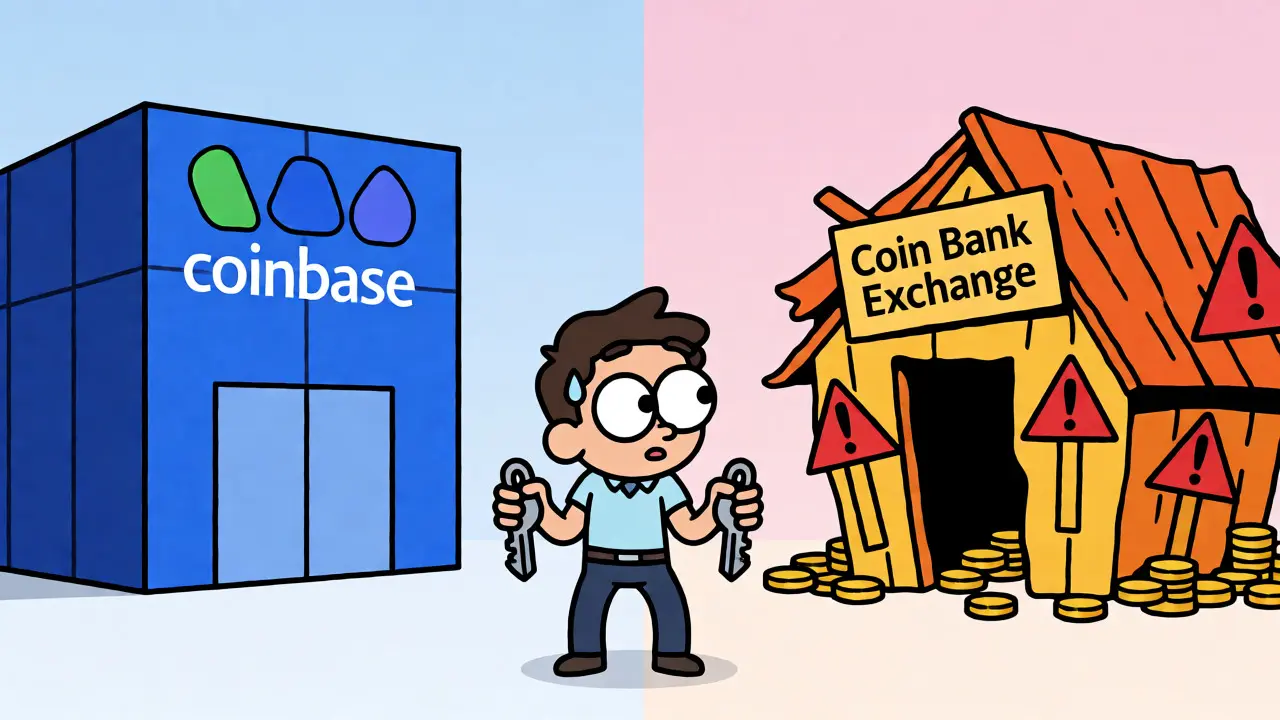
You might be hunting for the Coin Bank Exchange review, expecting to find a new platform with low fees and high yields. But here is the hard truth: as of October 2026, there is no major, regulated cryptocurrency exchange operating under the exact name "Coin Bank Exchange." If you see this name in an app store or a social media ad, it is likely one of two things: a confusion with the giant Coinbase, or worse, a fraudulent clone designed to steal your deposits.
This guide clears up the mix-up. We will look at why this name causes confusion, how to spot fake exchanges, and what you should actually use if you want a safe place to trade. Whether you are looking for the features of Coinbase or trying to avoid losing money to a scam, this breakdown gives you the facts you need to make a smart decision.
The Name Game: Confusion vs. Reality
Why do people search for "Coin Bank Exchange"? Usually, it stems from two sources. First, many beginners confuse Coinbase with other financial terms like "bank" or "exchange," creating hybrid names. Second, unregulated platforms often adopt names that sound similar to trusted brands to trick users into thinking they are dealing with a legitimate institution.
If you found an app called "Coin Bank Exchange" promising 1% daily returns or zero fees on everything, be skeptical. Legitimate exchanges like Kraken or Binance US operate on thin margins and transparent fee structures. They do not promise unrealistic profits. The closest legitimate entity matching this description is Coinbase, which has over 48 million verified U.S. users. However, Coinbase is a centralized exchange (CEX), not a bank, though it offers banking-like services such as fiat withdrawals.
| Feature | Coinbase (Likely Intent) | Generic "Coin Bank" Apps (Potential Scams) | Traditional Crypto-Friendly Banks |
|---|---|---|---|
| Regulation | SEC-registered broker-dealer | Often unregulated or offshore | FDIC insured / Central bank licensed |
| Asset Custody | 98% cold storage, audited reserves | Opaque; often no proof of reserves | Held in traditional bank accounts |
| Fees | 0.50% - 3.99% depending on method | Hidden spreads or withdrawal traps | Standard wire transfer fees apply |
| User Support | 24/7 ticket system, community hub | Slow or non-existent response times | Standard banking support hours |
Spotting the Red Flags of Fake Exchanges
Scammers love names that sound official. "Coin Bank," "Crypto Bank," or "Bitcoin Bank" are common tropes. How do you know if you are looking at a real service or a trap? Look for these specific warning signs before you deposit a single dollar.
- No Proof of Reserves: Reputable exchanges publish regular audits showing they hold customer assets 1:1. If "Coin Bank Exchange" cannot show a third-party audit from firms like Mazars or Chainalysis, walk away.
- Guaranteed Returns: Crypto markets are volatile. Any platform promising fixed daily interest rates above 10% annually without explaining the risk source is likely running a Ponzi scheme.
- Withdrawal Issues: Check recent user reviews on independent sites like Trustpilot or Reddit. If multiple users complain about being unable to withdraw funds after making a small profit, that is a classic exit scam tactic.
- Lack of Regulatory License: In the U.S., exchanges must register with FinCEN and often state regulators. In New Zealand, where I live, providers must comply with FMA guidelines. A quick search of the regulator's public register can save you thousands.
For instance, in 2024, Coinbase faced scrutiny but maintained its status by complying with SEC mandates. A fake "Coin Bank" would simply disappear or change domains when regulatory pressure mounts.
What You Probably Meant: A Deep Dive into Coinbase
Assuming you meant Coinbase, let’s look at why it dominates the market despite higher fees. Founded in 2012, Coinbase holds a 28.7% share of U.S. spot trading volume. It is the go-to choice for beginners because of its intuitive interface and educational rewards program, which pays users to learn about new cryptocurrencies.
Security Architecture: Coinbase keeps 98% of customer assets in cold storage across 17 geographically dispersed locations. This means even if their online servers are hacked, the bulk of your money remains offline and inaccessible to attackers. They also carry a $255 million crime insurance policy through Lloyd’s of London for digital assets held in hot wallets.
Fee Structure: This is where Coinbase gets criticized. Buying Bitcoin with a credit card can cost up to 3.99%. Using ACH transfers is free, but takes days to clear. For active traders, the "Advanced Trade" platform offers lower fees starting at 0.50%, but still trails behind competitors like Kraken, which offers flat 0.50% maker/taker fees on some pairs.
Staking Opportunities: You can earn passive income on holdings like Ethereum (3.8% APY) and Solana (6.2% APY). However, note that Coinbase deducts a significant commission (25-35%) from these rewards, reducing your net yield compared to staking directly on-chain.
Top Alternatives When Fees Matter More Than Branding
If you are tired of paying high spreads, consider these established alternatives. These platforms offer better pricing for intermediate and advanced users.
- Kraken: Known for security and transparency. Kraken has never been hacked since its inception in 2011. Their fee structure is more favorable for larger trades, starting at 0.16% for makers. They also offer robust margin trading options.
- Binance US: Offers the deepest liquidity among U.S.-compliant exchanges. While Binance Global faces regulatory hurdles, Binance US operates within strict U.S. laws. Fees are competitive, and the asset selection is broad, though slightly less than global counterparts.
- Gemini: Often rated highest for trustworthiness in surveys. Gemini focuses heavily on compliance and insurance. It is a favorite for institutional investors who prioritize safety over aggressive growth features. Their fee model is straightforward, with no hidden spreads on certain pairs.
Choosing between them depends on your priority. If you value ease of use and brand recognition, stick with Coinbase. If you want lower costs and don’t mind a slightly steeper learning curve, Kraken or Binance US are superior choices.
How to Safely Onboard Your First Crypto
Whether you choose Coinbase or another reputable exchange, follow this checklist to protect your funds during setup.
- Enable Two-Factor Authentication (2FA): Never rely solely on SMS codes. Use an authenticator app like Authy or Google Authenticator. SMS is vulnerable to SIM-swapping attacks.
- Verify Identity Early: Complete KYC (Know Your Customer) checks immediately. Unverified accounts have low withdrawal limits (often $50,000/day max, but much lower initially) and restricted features.
- Use Cold Storage for Long-Term Holds: Exchanges are custodial. As the saying goes, "Not your keys, not your coins." If you plan to hold for months or years, move your assets to a hardware wallet like Ledger or Trezor.
- Check Withdrawal Times: During high volatility, network congestion can slow transactions. Coinbase reported average ETH withdrawal times of 17 minutes recently, while Kraken managed 4.2 minutes. Plan accordingly if you need quick access to cash.
Remember, the "best" exchange is the one that balances security, fees, and usability for your specific needs. Don't get distracted by flashy marketing claims from unknown entities like "Coin Bank Exchange." Stick to platforms with proven track records and transparent operations.
Is Coin Bank Exchange a legit company?
There is no widely recognized, regulated cryptocurrency exchange operating under the exact name "Coin Bank Exchange." It is likely a misnomer for Coinbase or a smaller, potentially unregulated platform. Always verify regulatory licenses before depositing funds.
Why do people confuse Coinbase with banks?
Coinbase offers banking-like services such as USD savings accounts (historically), debit cards, and easy fiat deposits via ACH. Additionally, its name sounds financial, leading newcomers to assume it functions exactly like a traditional bank, though it lacks FDIC insurance for crypto assets.
What are the main risks of using unregulated crypto exchanges?
Risks include loss of funds due to hacks, inability to withdraw money (exit scams), lack of legal recourse in disputes, and sudden delisting of tokens without notice. Regulated exchanges provide consumer protections and transparency reports.
Which crypto exchange has the lowest fees for beginners?
For beginners using bank transfers, Coinbase offers 0% fees on ACH deposits. However, trading fees are higher. For lower trading fees, Kraken or Binance US are better options, though they require more technical understanding to navigate effectively.
Can I lose my money on a crypto exchange?
Yes. Unlike bank deposits, crypto assets are not FDIC insured. If an exchange fails due to fraud or bankruptcy (like FTX did), you may become an unsecured creditor and lose part or all of your investment. Self-custody mitigates this risk.