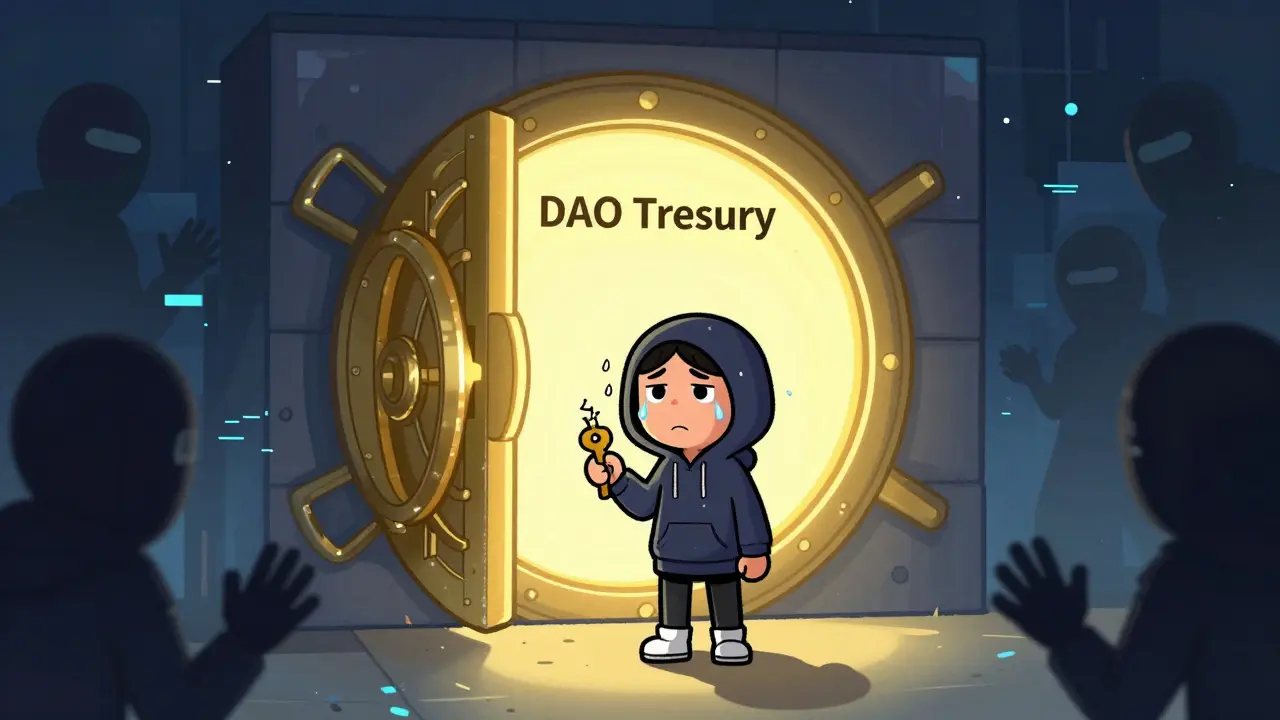
Imagine handing over the keys to a vault containing millions of dollars to a single person. Now imagine that person gets hacked, loses their phone, or decides to run away with the funds. For Decentralized Autonomous Organizations (DAOs), which manage billions in digital assets without traditional corporate structures, this scenario is not just hypothetical-it’s a daily risk. This is why Multi-Signature (MultiSig) wallets have become the non-negotiable standard for treasury management in the blockchain space.
In 2026, the question isn’t whether your DAO should use a multisig wallet, but how well you’ve configured it. With the DAO ecosystem holding over $54 billion in assets as of mid-2024, and projections showing continued growth, the stakes have never been higher. A single compromised private key can wipe out years of community effort. Multisig technology solves this by distributing control across multiple members, ensuring no one individual can move funds alone. Let’s break down exactly why this matters, how it works, and what you need to know to protect your treasury effectively.
The Core Problem: Single Points of Failure
Traditional wallets rely on a single private key. If you lose that key, your funds are gone forever. If someone steals it, they own everything. For individuals, this might mean losing a few hundred dollars. For a DAO managing grants, protocol revenue, or venture investments, it means catastrophic failure.
Consider the landscape before multisig became widespread. In the early days of Ethereum, many projects used simple wallets where one developer held the master key. The results were disastrous. Hacks, insider thefts, and accidental deletions drained treasuries regularly. According to data from Chainalysis, since 2020, multisig implementations have prevented an estimated $1.2 billion in potential losses across the industry. That’s not just a statistic; it’s proof that distributed control works.
Gnosis Safe, the dominant multisig platform launched in 2018, has become the backbone of this security shift. By version 1.3.0 (released March 2023), it offered optimized gas fees and a user interface accessible enough for non-technical team members. Today, 72.4% of top DeFi protocols by Total Value Locked (TVL) use multisig custody models. When giants like MakerDAO secure over $500 million using a 6-of-11 configuration, it sends a clear message: trust is earned through cryptographic verification, not blind faith.
How MultiSig Actually Works
You don’t need to be a cryptographer to understand multisig, but knowing the mechanics helps you configure it correctly. At its core, a multisig wallet is a smart contract on the blockchain that enforces rules about who can spend money and when.
Here’s the basic flow:
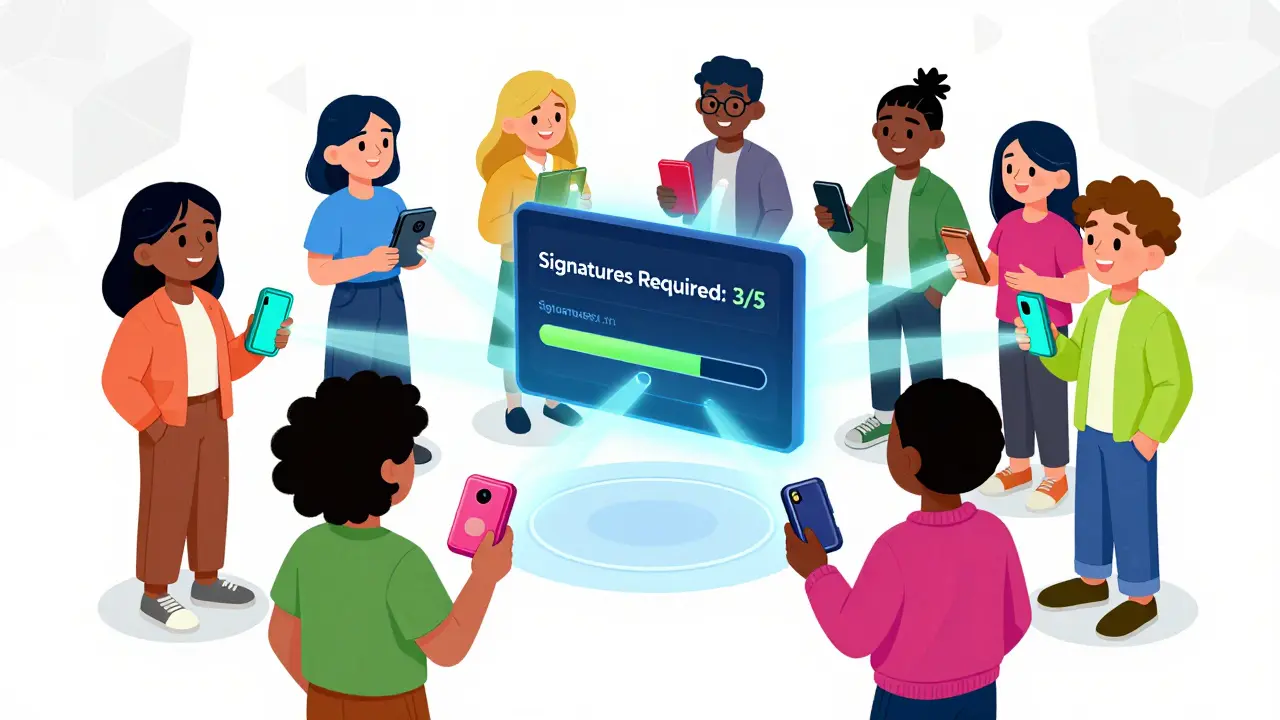
- Setup: You define a threshold. Common setups include 2-of-3, 3-of-5, or 4-of-7. This means X signatures are required out of Y total authorized signers to approve a transaction.
- Key Generation: Each signer generates their own unique private key pair, usually stored on a hardware wallet like Ledger or Trezor.
- Transaction Proposal: One member proposes a transfer. The smart contract locks the request.
- Verification: Other signers review the details-recipient address, amount, token type-and submit their digital signatures.
- Execution: Once the threshold is met, the contract broadcasts the transaction to the network.
This process adds friction, which is intentional. Friction stops impulsive decisions and gives time for scrutiny. On Ethereum mainnet, finality takes about 15 minutes, while on faster chains like Polygon, it’s under 12 seconds. However, most DAOs add a "timelock" feature, delaying execution by 24 hours even after all signatures are collected. This window allows anyone to spot errors or malicious intent before funds move.
Security vs. Convenience: The Trade-Offs
Nothing in security comes free. Multisig offers robust protection but introduces complexity. Here’s how it stacks up against alternatives:
| Feature | Single-Sig Wallet | Centralized Custodian (e.g., Coinbase) | Multisig Wallet |
|---|---|---|---|
| Security Risk | High (single point of failure) | Medium (counterparty risk) | Low (distributed control) |
| Cost | Minimal gas fees | 0.10-0.20% annual fee + setup costs | Higher gas overhead (up to 376%) |
| Control | Full individual control | Custodian holds keys | Shared collective control |
| Insurance | None | Often available | None (self-custody) |
| Hack Incidents per $100M Assets | 2.3 incidents | Varies | 0.3 incidents |
The data from Immunefi’s 2023 DAO Security Report is striking: multisig-protected DAOs experience 87% fewer successful hacks than those using single-signature wallets. But there’s a catch. Coordination takes time. Multisig DAOs take 42% longer to respond to security incidents because you need to rally multiple people. In high-frequency trading scenarios, this delay can be fatal. Yearn Finance learned this the hard way in 2022, migrating away from strict multisig for certain strategies to improve speed.
For most DAOs focused on grant distribution, protocol upgrades, or long-term asset holding, the slower response time is a worthwhile trade-off for safety. Speed kills more treasuries than caution saves them.
Real-World Success Stories and Failures
Theory is nice, but real-world application tells the truth. Let’s look at two contrasting cases.
The Success: Index Coop’s Defense
In April 2024, Index Coop faced a sophisticated exploit attempt targeting $4.2 million in assets. Because they operated on a 5-of-9 multisig configuration, attackers couldn’t simply bribe one person. They had to compromise five distinct hardware wallets simultaneously. More importantly, several signers noticed irregularities in the proposed transaction parameters. They withheld their signatures, freezing the attack. The community then coordinated a rapid audit, patched the vulnerability, and moved funds to a safer location. Without multisig, that treasury would have been empty within minutes.
The Failure: BadgerDAO’s Compromise
In 2023, BadgerDAO suffered a significant loss despite having a 3-of-5 multisig setup. The issue wasn’t the wallet itself-it was human error. Attackers used social engineering to trick individual signers into revealing their seed phrases. Once three keys were compromised, the multisig offered zero protection. As Dr. Ari Juels from Chainlink Labs noted, "Multisig creates false security if signers don't maintain proper key hygiene." The wallet is only as strong as its weakest signer’s habits.
These examples highlight a crucial lesson: technology doesn’t replace vigilance. It amplifies good practices and exposes bad ones.
Best Practices for Implementation in 2026
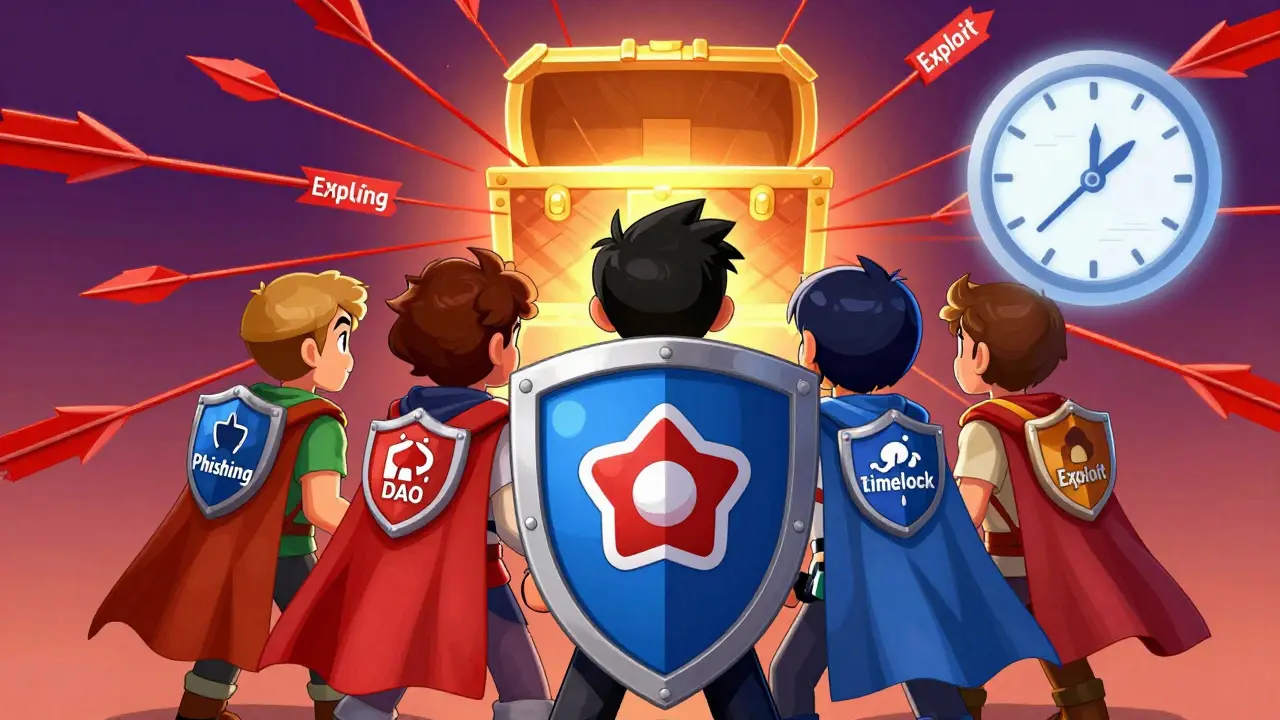
Setting up a multisig treasury isn’t plug-and-play. It requires careful planning. Based on guidelines from Consensys Academy and OpenZeppelin’s 2023 Security Framework, here are the critical steps:
- Choose the Right Threshold: Don’t default to 2-of-3 for large treasuries. The Standard DAO Framework recommends 3-of-5 for treasuries between $100K-$1M, 4-of-7 for $1M-$10M, and 5-of-9 for anything above $10M. Higher thresholds increase security but reduce operational flexibility.
- Use Hardware Wallets: Never store private keys on software wallets connected to the internet. Ledger and Trezor devices reduce exposure risks by 99.8% compared to hot wallets, according to Kudelski Security audits.
- Implement Timelocks: Enable a minimum 24-hour timelock for all transactions. This prevents rushed approvals during panic attacks or phishing attempts.
- Rotate Signers Regularly: Static signer lists create complacency. Rotate members quarterly to keep everyone engaged and reduce the risk of dormant accounts being compromised.
- Backup Keys Securely: Losing access to keys is reported in 23% of DAO incidents. Use physical steel backups and store them in geographically dispersed locations.
Expect a learning curve. GitcoinDAO surveys show contributors need 3-5 weeks to become proficient in multisig operations. Invest in training. Your treasury depends on it.
Regulatory Landscape and Future Outlook
Regulators are paying attention. In February 2024, the SEC released a DAO Framework explicitly recognizing multisig implementations with 7+ signers and 51% approval thresholds as evidence of "sufficient decentralization" for securities law exemptions. This is huge. It means multisig isn’t just a security tool-it’s a compliance strategy.
Looking ahead, Ethereum’s Pectra hard fork (scheduled for Q3 2024) promises to reduce multisig transaction costs by 35-45% through EIP-3074 optimizations. This will make frequent small transfers more viable, reducing the friction that currently discourages some teams from adopting multisig fully.
By 2027, forecasts from a16z suggest 95% of material DAOs (those with >$100K treasuries) will use multisig. It’s becoming the baseline expectation for any serious project in Web3.
What is the best multisig configuration for a new DAO?
For a new DAO with a treasury under $100,000, a 2-of-3 configuration is often sufficient. It balances security with ease of operation. As your treasury grows, upgrade to 3-of-5 or higher. Always ensure signers are trusted, active community members with separate hardware wallets.
Can multisig wallets be hacked?
The smart contract code of major multisig platforms like Gnosis Safe is heavily audited and extremely secure. However, the system can be compromised if attackers gain access to the private keys of enough signers through phishing, malware, or social engineering. The wallet itself is rarely the weak link; human behavior is.
Why do I need a timelock if I already have multisig?
A timelock adds a mandatory waiting period (usually 24-48 hours) after all signatures are collected before the transaction executes. This gives the broader community time to review the transaction, spot errors, or halt malicious activity even if the signers were coerced or made a mistake.
Is Gnosis Safe the only option for multisig?
No, but it is the most widely adopted, holding approximately 68% market share among DAOs. Alternatives include SafeSnap and custom-built solutions. However, Gnosis Safe benefits from the largest community support, extensive documentation, and regular security updates, making it the safest choice for most users.
How much does it cost to run a multisig treasury?
There are no subscription fees for open-source multisig tools like Gnosis Safe. Costs come from blockchain gas fees. On Ethereum, complex multisig transactions can cost 21,000 to 100,000 gas units. Using Layer 2 networks like Arbitrum or Polygon significantly reduces these costs, making daily operations affordable.