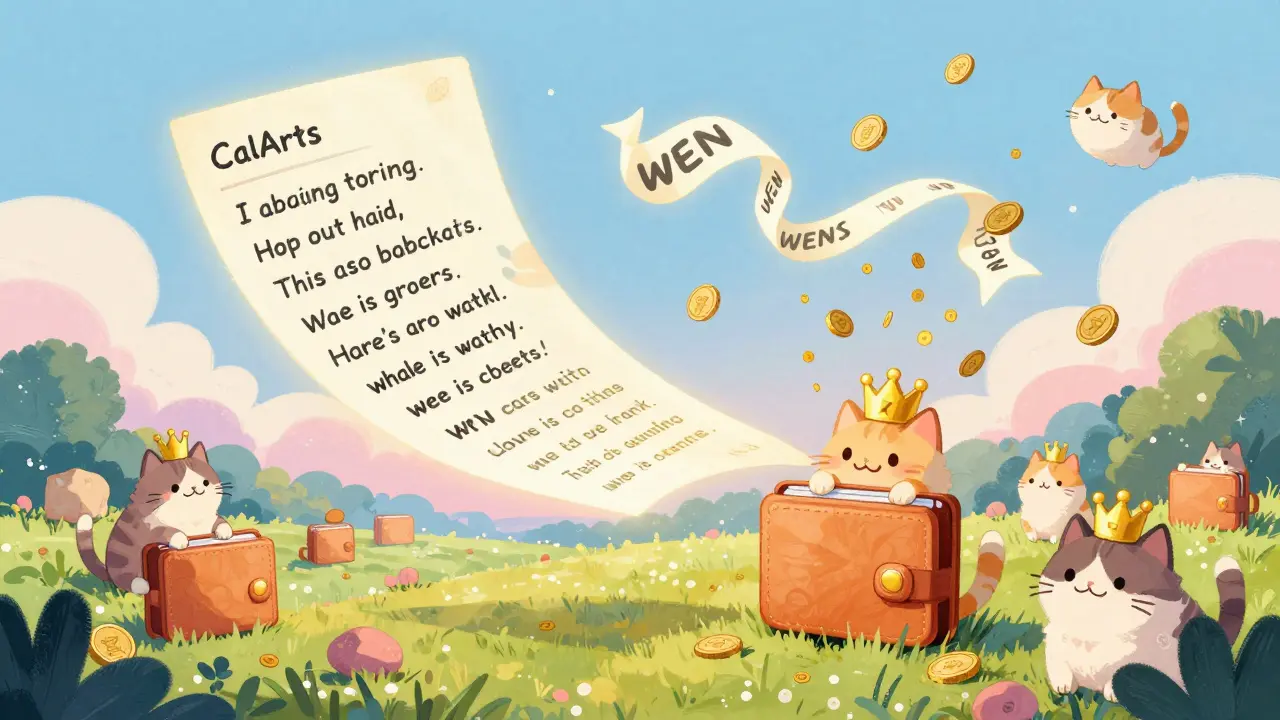
Most people think crypto coins are either serious investments like Bitcoin or wild gambling bets like Dogecoin. But Wen (WEN) is something else entirely - a memecoin born from a poem, fractionalized into a trillion tokens, and given away for free to over a million wallets. It’s not just a joke. It’s a test. A social experiment. And somehow, it stuck around.
Wen started in January 2024, not with a whitepaper or a VC pitch, but with a viral poem called "A Love Letter to Wen Bros." Written by Meow - the pseudonymous founder behind Jupiter, a major decentralized exchange on Solana - the poem was turned into a single NFT. Then, something wild happened: that NFT was split into exactly 1 trillion pieces. Each piece became one WEN token. No mining. No ICO. No presale. Just a poem, a blockchain, and a community that showed up.
How Wen got distributed - and why it matters
The Jupiter team didn’t just drop WEN randomly. They used it to stress-test their new launchpad platform before releasing their own token, JUP. The plan? Give WEN to real users across the Solana ecosystem - not just Jupiter traders, but also NFT collectors, DeFi users, and community builders. They wanted to see how the system handled mass airdrops under real conditions.
Here’s how the tokens were split:
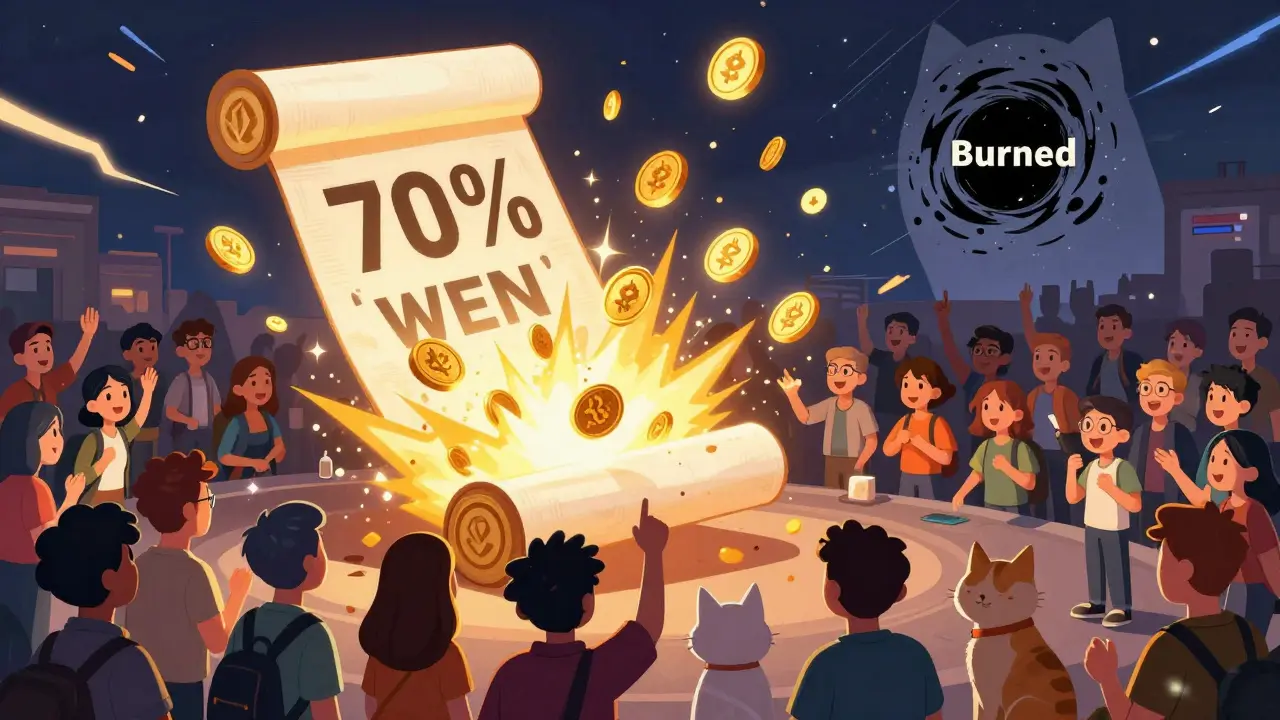
- 70% - Airdropped to over 1 million wallets
- 20% - Locked in a liquidity pool for trading
- 10% - Reserved for the project treasury
That means 700 billion WEN tokens were given out for free. But not everyone claimed theirs. Around 30% of the airdropped supply went unclaimed - and those were burned. That’s right: a third of the initial giveaway vanished into thin air. The circulating supply today? Around 730 billion tokens. That’s more than the population of the entire Earth multiplied by 90.
What can you actually do with Wen?
Wen isn’t just a meme. It’s got real uses - even if they’re weird ones.
- Tipping - You can send WEN to anyone online as a thank-you. A funny tweet? Tip them WEN. A helpful comment? Tip them WEN. It’s like digital applause you can cash in.
- Governance - Holders of WEN can vote in the Wen DAO. Want to fund a meme contest? Propose it. Want to buy a cat-themed billboard? Vote on it. The DAO is run by token holders, not a company.
- Trading - WEN trades on major Solana DEXs like Jupiter, Raydium, and Orca. You can swap it for SOL, USDC, or other tokens. Some people use it for yield farming, staking it in pools to earn more crypto.
It’s not a payment network like Bitcoin. It’s not a smart contract platform like Ethereum. It’s a community token with utility built on top of Solana’s speed and low fees. Transactions cost pennies. Confirmations take milliseconds. That’s why it works.
Market performance: Volatile, but not dead
Wen’s price history reads like a rollercoaster ride.
It hit its all-time high at BTC 0.087287 - that’s about $0.12 USD at the time. Then came the burn. When 30% of the airdropped supply was removed, panic hit. Prices dropped hard. Some wallets dumped their entire holdings. The price crashed to BTC 0.092305 - roughly $0.013 USD.
Today, WEN trades around $0.0569. That’s down 91.5% from its peak, but up 178% from its lowest point. The market cap? About $250 million. It’s ranked #1028 on CoinGecko. Not top 100. Not even top 100. But it’s still in the top 15 memecoins by market cap.
Why does it still matter? Because people still trade it. Still tip with it. Still talk about it. The volume on a normal day? Around $450,000. That’s not Bitcoin-level activity, but for a memecoin with no marketing budget? That’s impressive.
The cats. Yes, the cats.
Wen owns the two most-followed cat accounts on X (formerly Twitter): @shouldhavecat and @postsofcats. Together, they have over 2 million followers. Every day, they post memes - cats in space, cats wearing hats, cats doing yoga. No ads. No promotions. Just cats.
It’s not random. It’s strategy. Wen’s team understood that memecoins don’t survive on whitepapers. They survive on culture. On inside jokes. On shared absurdity. Those cat accounts aren’t marketing. They’re the face of the community. They’re the reason people still check in.

Why Solana? Why now?
Wen could’ve been built on Ethereum. Or Polygon. Or even Bitcoin. But it wasn’t. It was built on Solana because Solana is fast, cheap, and already full of users who love experimenting.
Solana handles 65,000 transactions per second. WEN transfers cost less than $0.0001. That’s why tipping works. That’s why the airdrop didn’t crash the network. That’s why people didn’t give up after the first drop.
Wen didn’t try to be the next Bitcoin. It tried to be the most fun thing on Solana. And it succeeded.
What’s next for Wen?
No one knows. That’s the point.
There’s no roadmap. No team in suits. No corporate sponsor. Just a DAO and a bunch of people who like cats, memes, and free crypto.
Some think Wen will fade. Others think it’ll evolve - maybe into a tipping platform for creators, or a governance hub for Solana projects. Maybe it’ll get listed on a major exchange. Maybe it won’t.
But one thing’s clear: Wen wasn’t built to last. It was built to show that crypto doesn’t always need to be serious. Sometimes, it just needs a poem, a trillion tokens, and a cat on Twitter.
Is Wen (WEN) a good investment?
Wen is not an investment - it’s a meme with utility. Its value comes from community use, not fundamentals. If you’re looking for long-term growth, WEN isn’t it. But if you enjoy participating in crypto culture, tipping creators, or joining a DAO that votes on cat memes, then holding WEN might be fun. Don’t invest money you can’t afford to lose.
Can I buy Wen on Coinbase or Binance?
No, Wen is not listed on Coinbase, Binance, or other major centralized exchanges. You can only trade it on Solana-based decentralized exchanges like Jupiter, Raydium, or Orca. You’ll need a Solana wallet like Phantom or Solflare, and some SOL to pay for transaction fees.
How many Wen tokens are there?
Exactly 1 trillion WEN tokens were created when the poem was fractionalized. But 700 billion were airdropped, and about 270 billion went unclaimed and were burned. The current circulating supply is around 730 billion tokens. That’s still the largest supply of any crypto token ever distributed.
Who created Wen?
Wen was created by Meow, the pseudonymous founder of Jupiter, a Solana-based decentralized exchange. The project was launched as a test for Jupiter’s LFG Launchpad before the JUP token airdrop. No company, no legal entity, no headquarters - just a community-driven experiment.
Why does Wen have a DAO?
The Wen DAO exists because the project was never meant to be controlled by a central team. Token holders vote on everything - from funding meme contests to choosing which cat photos get posted. It’s a way to keep the community in charge. The DAO has no budget, no employees, and no official office. Just votes.
Is Wen still active in 2026?
Yes. While its price has dropped from its peak, trading volume and community activity remain steady. The cat accounts still post daily. The DAO still votes. The liquidity pool still holds billions of tokens. It’s not growing, but it’s not dead either. It’s become a quiet fixture in the Solana ecosystem - a living relic of crypto’s playful side.
Wen isn’t the future of crypto. But it’s a reminder that crypto doesn’t always have to be about wealth. Sometimes, it’s about laughter. About belonging. About a poem, a cat, and a trillion tokens that no one really needed - but everyone wanted anyway.