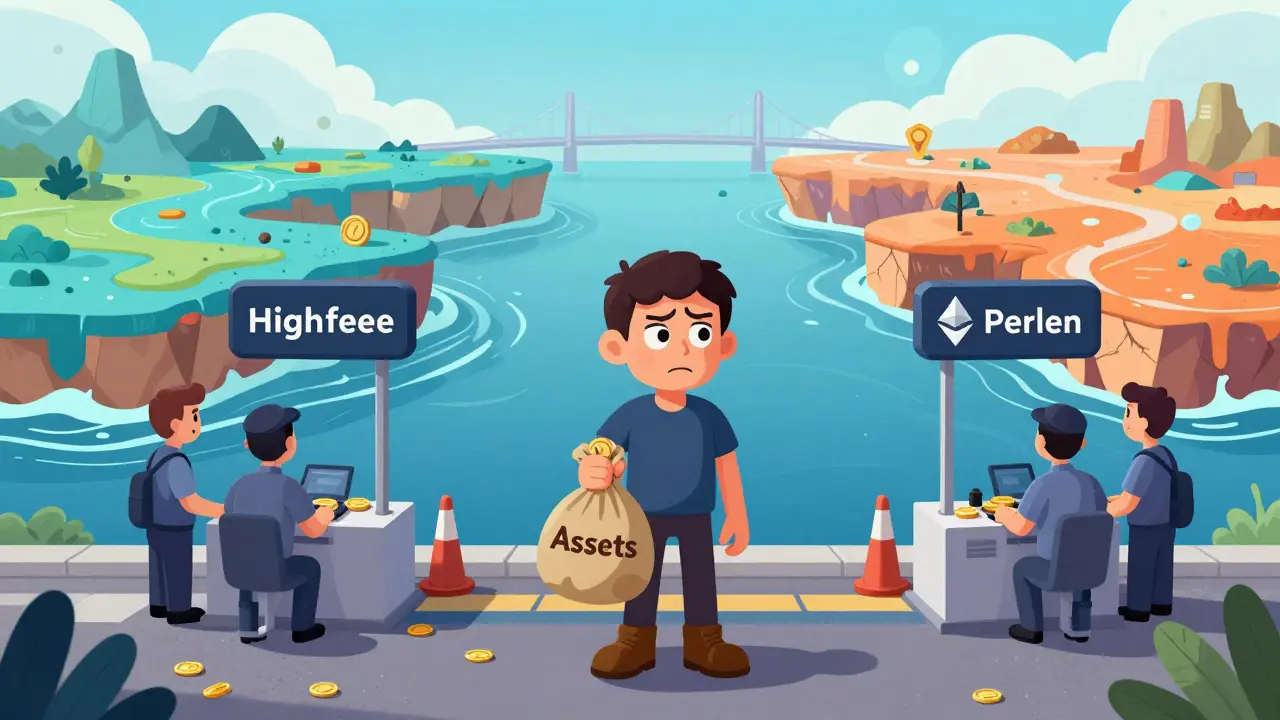
Have you ever tried to move money between different blockchains and felt like you were paying a toll fee just to get from point A to point B? That frustration is exactly what Parex (PRX) is trying to solve. It’s a cryptocurrency designed to make moving assets across networks like Ethereum, Polygon, and Polkadot cheaper and faster. But here is the catch: while the technology sounds promising on paper, the reality on the ground is a bit more complicated. As of mid-2026, Parex remains a small player in a crowded market, struggling with low adoption and limited developer support despite its innovative approach to cross-chain transactions.
The Core Idea: Why Parex Exists
At its heart, Parex is a Layer 1 blockchain network focused on interoperability. In simple terms, most blockchains are like islands. If you want to send data or value from one island to another, you need a bridge. Traditional bridges are often slow, expensive, or risky. Parex aims to fix this by using a unique mechanism called Proof of Interoperability (PoI).
Unlike traditional systems that rely on heavy mining (Proof of Work) or staking large amounts of coins (Proof of Stake), PoI focuses on verifying that transactions can safely move between different chains. The native token, PRX, acts as the fuel for this system. You use PRX to pay for gas fees-those tiny costs required to process a transaction on the network. Think of it like ETH on Ethereum, but specifically optimized for cross-chain tasks.
The project was conceptualized to address the fragmentation in the digital asset space. According to technical documentation from early 2026, Parex supports networks including Ethereum, Polygon, Binance Smart Chain (BEP20), Polkadot, and Avalanche (Avax). The goal is to create a seamless experience where you don’t have to worry about which chain your funds are sitting on.
How the Technology Actually Works
Let’s break down the tech without the jargon. When you initiate a transfer on Parex, the network uses its PEP-2 and PEP-20 protocols (sometimes referred to as DRC-16 in older docs) to manage the production and movement of tokens. Here is the interesting part: Parex employs a burn mechanism. When tokens are sent to certain production functions or used for specific cross-chain operations, they are removed from circulation. This is meant to create deflationary pressure, theoretically increasing the value of remaining tokens over time.
The network is compatible with the Ethereum Virtual Machine (EVM). This is crucial because it means developers who already know how to build on Ethereum can relatively easily port their projects to Parex. However, "relatively easy" is doing a lot of heavy lifting here. Surveys from late 2025 indicated that new developers still faced a 2-to-3-week learning curve just to get basic cross-chain functionality working. That is not insignificant when you are competing against giants like Cosmos or Polkadot.
One of the standout features is the cost. Data from Chainalysis in Q4 2025 showed that average transaction fees on Parex hovered around 0.0002 PRX. At current prices, that translates to fractions of a cent. Compare that to Ethereum, where fees can spike to dollars during busy periods, and you see the potential appeal. For micro-transactions or frequent small transfers, Parex is significantly cheaper.
Market Reality: Price and Supply
If you are looking at Parex as an investment, you need to look at the numbers coldly. The market capitalization is tiny. As of January 2026, reports indicated a circulating supply of roughly 13.6 million PRX out of a maximum supply of 77 million. The fully diluted valuation (FDV)-what the market cap would be if all tokens were in circulation-was hovering around $1.8 million. To put that in perspective, major competitors like Polkadot have market caps in the billions.
The price action has been volatile and generally weak. TradingView data from late January 2026 showed PRX trading around $0.0028 USDT, with significant daily drops common. While some snapshots showed higher prices around $0.02, these were outliers in a sea of downward pressure. The discrepancy in data sources highlights another issue: liquidity. With only a few exchanges listing PRX, mostly tier-3 platforms like MEXC and Gate, buying and selling large amounts can be difficult without moving the price drastically.
| Feature | Parex (PRX) | Polkadot (DOT) | Cosmos (ATOM) |
|---|---|---|---|
| Consensus Mechanism | Proof of Interoperability | Nominated Proof of Stake | BFT Tendermint |
| Avg. Transaction Fee | $0.00000056 | $0.0003 | $0.001 - $0.01 |
| Developer Activity (GitHub) | 12 active contributors | 214 active contributors | 147 active contributors |
| Market Cap Rank | #4869 | #12 | #25 |
| Primary Use Case | Niche Cross-Chain Bridges | Interoperable Blockchain Ecosystem | Independent App-Chains |

The Adoption Problem
Here is the hard truth about Parex: nobody is really using it yet. And not just casual users-developers aren’t building on it either. Electric Capital’s Developer Report for Q1 2026 noted a stark contrast in activity. While Polkadot had over 200 active contributors on GitHub, Parex had only 12. In the world of open-source software, code commits are lifeblood. Without developers, there are no apps. Without apps, there are no users. Without users, the token has no utility beyond speculation.
User feedback reflects this struggle. On Reddit, threads discussing Parex often highlight usability issues. One user reported that bridging from Ethereum to Polygon took 47 seconds with a negligible fee, which sounds great. But they also mentioned the interface felt "clunky" and required watching a YouTube tutorial to figure out. Another thread, titled "Parex ecosystem dying?", pointed out minimal exchange listings and a lack of team communication on Telegram. The community size has shrunk from over 7,000 members in late 2025 to under 5,000 by early 2026.
Wallet integration is another hurdle. The official Parex Wallet exists for iOS and Android, but it doesn’t integrate with major multi-chain wallets like MetaMask or Trust Wallet seamlessly. This creates friction. Most crypto users prefer managing everything in one place. If you have to download a separate, lesser-known app just to hold PRX, many will simply skip it.
Expert Opinions and Risks
Experts are divided, but the skepticism is louder than the praise. Dr. Elena Rodriguez from Delphi Digital described Parex’s technical approach as "interesting" but warned that it lacks the network effects necessary for survival. She highlighted concerns about the tokenomics, suggesting that the deflationary burn mechanism could destabilize the ecosystem if volume doesn’t pick up. Essentially, if people stop using it, the burning stops, but the pressure to sell might continue, driving the price down further.
On the flip side, Michael Chen from Interop Labs sees potential. He calls it an "underappreciated solution" that could gain traction if it partners with major wallet providers or IoT platforms. This is a valid point. Parex isn’t trying to replace Ethereum; it’s trying to be the plumbing underneath. If it can secure a partnership with a big name, it could jumpstart adoption. However, as of mid-2026, there are zero Fortune 500 companies listed as partners. That is a red flag for enterprise viability.
There are also regulatory risks. The IMF issued a report in January 2026 warning that cross-chain infrastructure models involving token burns could face scrutiny under evolving securities laws. If regulators decide that PRX is a security rather than a utility token, it could be delisted from major exchanges, effectively killing liquidity.

Should You Use or Invest in Parex?
Let’s cut through the noise. If you are a developer looking for a robust platform to build a serious DeFi application, Parex is likely not the right choice right now. The lack of tools, libraries, and community support means you will be reinventing the wheel. Stick with Ethereum, Solana, or Cosmos unless you have a very specific reason to target Parex’s niche.
If you are a trader, understand that you are betting on a long shot. The low market cap means high volatility. A single positive announcement could send the price up 50%, but a lack of progress could see it drop just as fast. The FDV is low, which some see as room for growth, but others see as a sign that the project hasn’t captured any real value yet.
For everyday users, the benefits are theoretical. Yes, the fees are incredibly low. But if you aren’t moving millions of micro-transactions a day, does saving $0.00000056 per transaction matter? Probably not. The convenience of established networks usually outweighs the marginal savings of a niche protocol.
Future Outlook
Parex’s roadmap includes integrating with five additional blockchain networks by Q3 2026 and launching a decentralized governance system later that year. These are ambitious goals given the current resource constraints. The decline in GitHub activity suggests the team may be stretched thin. Success will depend entirely on execution and partnerships. If they can’t attract developers or secure major integrations, the risk of becoming a "zombie chain"-a network with no activity-is real.
In summary, Parex is a technically curious experiment in cross-chain efficiency. It solves a real problem (high fees and fragmentation) with a clever mechanism (Proof of Interoperability). But in crypto, technology alone rarely wins. Network effects do. Until Parex builds a critical mass of users and developers, it remains a speculative curiosity rather than a foundational pillar of the web3 infrastructure.
Is Parex (PRX) a scam?
There is no evidence to suggest Parex is a scam in the traditional sense. It has a functioning blockchain, public code, and transparent transaction history. However, it suffers from low adoption, limited liquidity, and declining developer activity, which are signs of a struggling project rather than a fraudulent one. Always do your own research before investing in low-cap cryptocurrencies.
Where can I buy PRX tokens?
As of 2026, PRX is primarily available on tier-3 cryptocurrency exchanges such as MEXC and Gate.io. It is not widely listed on major platforms like Coinbase or Binance, which limits accessibility and liquidity. Be cautious of deep slippage when trading due to low volume.
What is Proof of Interoperability?
Proof of Interoperability (PoI) is Parex’s unique consensus mechanism. Unlike Proof of Work (mining) or Proof of Stake (staking), PoI focuses on validating cross-chain transactions. It ensures that assets moved between different blockchains (like Ethereum and Polygon) are accurately recorded and secured, aiming to reduce the complexity and cost of bridging.
Why is Parex so cheap?
The low price of PRX is driven by several factors: a high total supply (77 million max), low market demand, limited exchange listings, and lack of widespread utility. Additionally, the competitive landscape is dominated by larger players like Polkadot and Cosmos, making it difficult for Parex to capture market share.
Can I use MetaMask with Parex?
While Parex is EVM-compatible, meaning it theoretically works with Ethereum-based wallets, the integration is not seamless. The official recommendation is to use the Parex Wallet app. Using MetaMask may require manual configuration of network RPC details, and even then, support for specific Parex features like cross-chain bridging may be limited compared to the native app.