
Imagine trying to send money from your bank account in New Zealand to a friend in Japan. You don’t just hand them cash; you go through a wire transfer, often dealing with fees, delays, and middlemen. Now, imagine doing that with cryptocurrency, but instead of banks, you have completely different blockchains like Bitcoin, Ethereum, and Solana. For years, this process was messy, risky, and expensive. Enter Chainflip, a protocol designed to fix the broken bridge between these digital worlds.
If you’ve been following crypto since the FTX collapse or the various bridge hacks, you know that trusting a centralized intermediary with your assets is a gamble. Chainflip promises something different: trustless, native asset swaps. No wrapped tokens. No complex bridging mechanisms that leave your funds exposed. Just direct swaps between major chains. But does it actually work as advertised? Let’s break down what Chainflip is, how its FLIP token functions, and whether it’s a viable solution for your cross-chain needs.
The Core Problem: Why We Need Better Cross-Chain Solutions
Before understanding Chainflip, you need to understand the problem it solves. The crypto ecosystem is fragmented. Bitcoin sits on one chain, Ethereum smart contracts on another, and Solana on yet another. They don’t talk to each other natively.
Traditionally, if you wanted to move Bitcoin to Ethereum, you’d use a bridge. You lock your BTC in a vault, and the bridge mints "wrapped BTC" (WBTC) on Ethereum. This creates two massive risks:
- Custodial Risk: If the bridge gets hacked, your locked assets are gone. We’ve seen billions lost this way.
- Liquidity Fragmentation: Liquidity is split across multiple versions of the same asset (BTC, WBTC, tBTC), making trading inefficient and slippage high.
Chainflip eliminates this by enabling native swaps. When you swap BTC for ETH on Chainflip, you don’t get wrapped BTC. You get actual ETH. The protocol handles the complexity behind the scenes, keeping your assets safe throughout the process.
How Chainflip Works: The State Chain and JIT AMM
So, how do you swap assets without wrapping them? Chainflip uses a unique architecture centered around its own blockchain, called the State Chain. The State Chain is an application-specific blockchain that coordinates cross-chain transactions while maintaining user custody of assets.
Here’s the step-by-step flow:
- User Initiates Swap: You decide to swap BTC for SOL via the Chainflip interface.
- Asset Locking: Your BTC is sent to a secure, multi-signature address controlled by the network’s validators. You still control the keys until the swap completes.
- State Chain Coordination: The State Chain records this transaction and signals liquidity providers (LPs) on the destination chain.
- Just-in-Time Liquidity: Instead of holding massive pools of every asset, Chainflip uses a Just-in-Time (JIT) Automated Market Maker. A novel AMM model that enables truly native cross-chain swaps without liquidity fragmentation by providing liquidity only when needed. LPs provide liquidity exactly when a swap occurs, reducing idle capital.
- Execution: The LP sends the SOL to you. Once confirmed, the BTC is released from the vault to the LP.
This process is secured by exactly 150 validators who stake the native FLIP token as collateral. If a validator acts maliciously, they lose their stake. This creates a robust security layer without relying on trusted third parties.
The FLIP Token: Utility, Economics, and Deflationary Pressure
Every protocol has a token, but not all tokens serve a real purpose. The FLIP token is the fuel that keeps the Chainflip engine running. Here’s why it matters:
- Staking for Validators: To run a node and validate transactions, operators must stake FLIP. This aligns incentives-validators have skin in the game.
- Governance: Holders can vote on protocol upgrades, fee structures, and new chain integrations.
- Fee Payment: Users pay swap fees in FLIP, creating constant demand for the token.
But the most compelling feature is its deflationary mechanism. Chainflip collects fees in USDC. A stablecoin pegged to the US dollar, used as the pairing asset for all native cross-chain swaps on Chainflip. These USDC fees are automatically used to buy back FLIP tokens from the market and burn them. As trading volume increases, more FLIP is removed from circulation, potentially driving up the price per token over time.
This is a significant shift from models where fees are paid in volatile assets or distributed to stakers indefinitely. By burning tokens, Chainflip aims to create scarcity and long-term value accrual for holders.

Chainflip vs. THORChain: A Critical Comparison
You can’t talk about cross-chain swaps without mentioning THORChain. A leading decentralized cross-chain liquidity protocol that uses its native RUNE token as the pairing asset for all swaps. Both protocols offer non-custodial swaps, but they approach the problem differently.
| Feature | Chainflip | THORChain |
|---|---|---|
| Pairing Asset | USDC (Stablecoin) | RUNE (Native Token) |
| User Experience | Simpler; no need to hold platform token | Complex; users must manage RUNE exposure |
| Supported Chains | BTC, ETH, SOL (focused launch) | BTC, ETH, BNB, LTC, DOGE, etc. (broader) |
| Liquidity Model | JIT AMM + CLL/BCLL | Pooled Liquidity |
| Validator Count | Fixed at 150 | Dynamic (currently ~70+) |
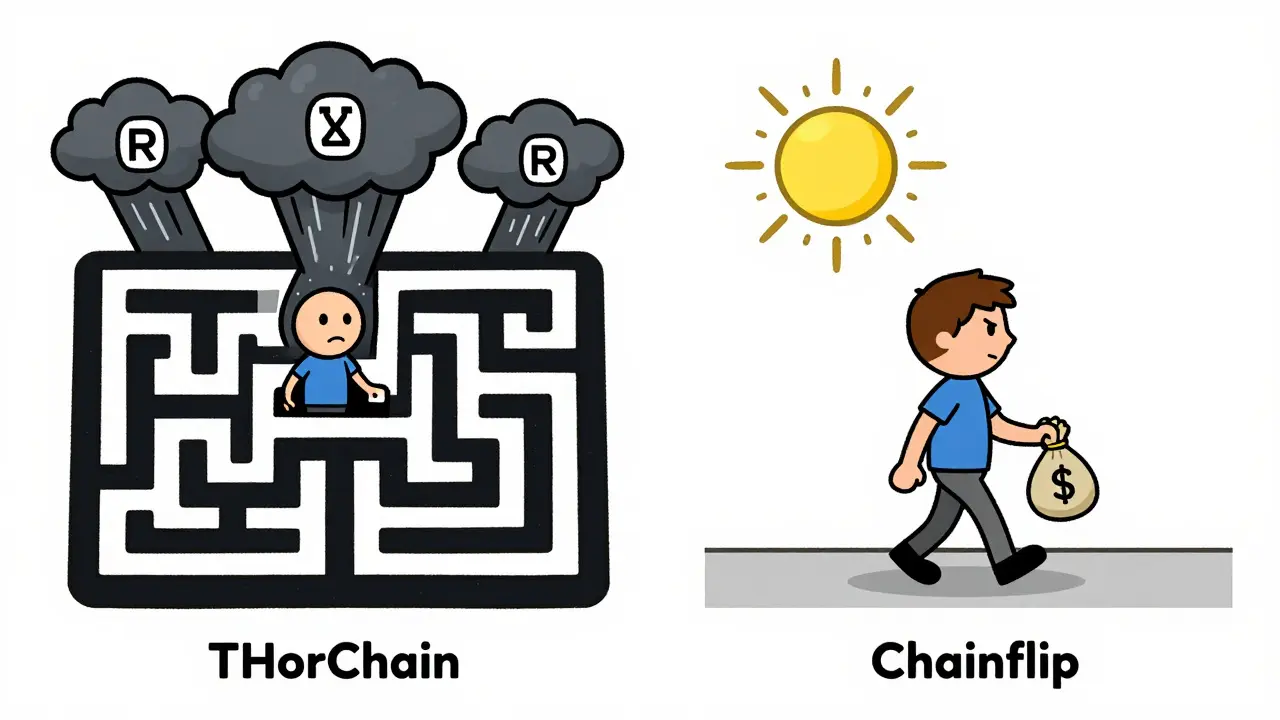
The biggest differentiator is the pairing asset. THORChain requires all swaps to go through RUNE. This means if you swap BTC for ETH, you’re indirectly exposed to RUNE’s volatility during the transaction. Chainflip uses USDC as the base pair. This simplifies the math for users and reduces volatility risk during the swap execution.
However, THORChain currently supports more chains. Chainflip started with a focused approach on Bitcoin, Ethereum, and Solana. This allows for deeper liquidity on these specific networks but limits flexibility for users wanting to swap less common assets like Dogecoin or Litecoin.
Pros and Cons: Is Chainflip Right for You?
No technology is perfect. Here’s an honest look at Chainflip’s strengths and weaknesses based on current data and user feedback.
Pros:
- Non-Custodial Security: You never give up control of your private keys. Assets are held in multi-sig addresses controlled by the network.
- Superior UX for Large Swaps: The JIT AMM model provides tight slippage for large transactions, which is often a pain point in other DEXs.
- Deflationary Tokenomics: The buy-and-burn mechanism creates potential upside for FLIP holders as volume grows.
- No Wrapped Tokens: Eliminates the risk of bridge hacks and liquidity fragmentation.
Cons:
- Limited Chain Support: Currently focused on BTC, ETH, and SOL. If you want to swap niche altcoins, you’ll need to use other platforms.
- Token Price Volatility: Like many new projects, FLIP has experienced significant price swings since its initial sale. Early investors have seen depreciation.
- Learning Curve: While the UI is clean, understanding the underlying mechanics (validators, state chain) requires some crypto literacy.
- Gas Fees: On networks like Ethereum, gas fees can still be high, though Chainflip optimizes routing to minimize this.
Real-World Use Cases: Who Should Use Chainflip?
Chainflip isn’t just for degens chasing the next 100x token. It serves specific practical needs:
- Institutional Traders: Large players moving millions of dollars between chains need tight slippage and security. Chainflip’s JIT AMM excels here.
- HODLers Rebalancing Portfolios: If you hold BTC and want to diversify into ETH or SOL without selling to fiat, Chainflip offers a seamless, tax-efficient route.
- DeFi Developers: Chainflip’s SDK allows developers to integrate cross-chain functionality directly into their apps. This opens up new possibilities for DeFi products that span multiple chains.
- Privacy-Conscious Users: By avoiding centralized exchanges, you reduce KYC requirements and maintain greater anonymity.
The Road Ahead: What’s Next for Chainflip?
Chainflip is still in its early stages. The roadmap includes several key developments:
- Expanded USDT Support: Adding Tether support across chains to increase liquidity options.
- ETH Wallet Support: Allowing users to sign State Chain transactions directly using Ethereum smart contracts, simplifying the UX further.
- Swapping App Aggregation: Integrating more swap routes within the existing app to offer better prices without adding new chains immediately.
- Chainflip Liquidity Lending (CLL): A clearing-house style lending system to improve protocol liquidity for large volatile-asset swaps.
The team is also focusing on community growth and developer adoption. As more wallets and DApps integrate Chainflip, the network effect will strengthen, potentially driving up volume and, consequently, FLIP token demand.
Final Thoughts: A Promising Player in a Crowded Market
Chainflip addresses a critical pain point in crypto: the inability to move value between chains safely and efficiently. By eliminating wrapped tokens and using a stablecoin-based pairing model, it offers a cleaner, safer alternative to traditional bridges and even competitors like THORChain.
However, it’s not without risks. The limited chain support and token price volatility mean it’s not a one-size-fits-all solution. For now, it’s best suited for users focused on Bitcoin, Ethereum, and Solana who prioritize security and simplicity over breadth of asset choice.
If you’re looking to diversify your portfolio across major chains without trusting a centralized exchange, Chainflip deserves a spot in your toolkit. Just remember to do your own research, start with small amounts, and always verify contract addresses before interacting with any DeFi protocol.
Is Chainflip safe to use?
Yes, Chainflip is considered safe because it is non-custodial. You never give up control of your private keys. Assets are held in multi-signature addresses controlled by 150 validators who stake FLIP tokens as collateral. If a validator acts maliciously, they lose their stake. However, as with any DeFi protocol, there are smart contract risks, so always double-check official links.
What is the difference between Chainflip and THORChain?
The main difference is the pairing asset. THORChain uses its native RUNE token for all swaps, exposing users to RUNE's volatility. Chainflip uses USDC, a stablecoin, which simplifies the process and reduces volatility risk. Additionally, Chainflip uses a Just-in-Time AMM model, while THORChain uses pooled liquidity.
Can I earn rewards by staking FLIP?
Currently, staking FLIP is primarily for validators who run nodes. Retail users can participate in liquidity provision through Chainflip Liquidity Lending (CLL) and Boosting Chainflip Liquidity Lending (BCLL), which offer yield opportunities. Always check the latest docs for updated staking programs.
Which blockchains does Chainflip support?
As of now, Chainflip primarily supports Bitcoin (BTC), Ethereum (ETH), and Solana (SOL). The team plans to expand support to other chains in the future, including enhanced USDT support and broader chain integration.
Why does Chainflip use USDC instead of its own token for swaps?
Using USDC as the pairing asset improves user experience by eliminating the need for users to hold platform-specific tokens for swaps. It also reduces volatility risk during the transaction process, making pricing more predictable and efficient compared to models using volatile native tokens.