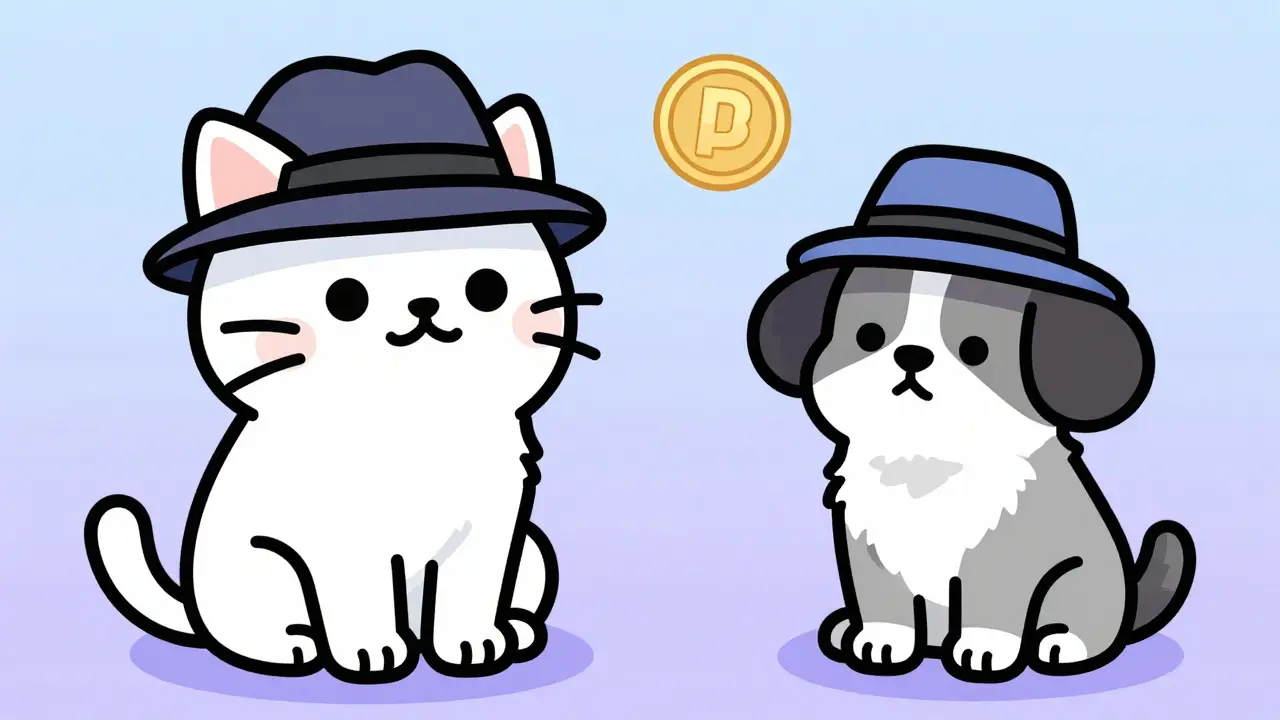
You’ve probably seen the hat. You’ve definitely heard of Dogwifhat (WIF). But what about its slightly less famous cousin? If you are scrolling through your crypto feeds and seeing mentions of CatWifHat a speculative Solana-based meme coin inspired by Dogwifhat, you might be wondering if this is just another internet joke or a potential opportunity. The short answer is that it is primarily a high-risk, community-driven asset with no underlying utility beyond speculation.
In the world of cryptocurrency, especially within the Solana ecosystem, new tokens launch daily. Some vanish overnight; others become cultural phenomena. CatWifHat (trading under tickers like CATWIF, CWIF, or CIF depending on the exchange) falls squarely into the former category for most investors, though it retains a niche following. This guide breaks down exactly what the token is, how it works, why the prices vary so wildly across platforms, and whether it deserves a spot in your portfolio-or if you should steer clear entirely.
The Origin Story: Riding the Coattails of WIF
To understand CatWifHat, you first need to understand its inspiration. In November 2023, Dogwifhat (WIF) exploded onto the scene. It was a simple concept: a dog wearing a hat. It resonated with the crypto community’s love for absurdity and low-barrier entry. By early 2024, the pattern was clear. If a dog with a hat could reach a market capitalization of nearly $1.8 billion, why not a cat with a hat?
CatWifHat CATWIF launched in early 2024 as a direct thematic counterpart to WIF. Unlike established projects that spend months building infrastructure, writing whitepapers, and auditing smart contracts, CatWifHat followed the classic "meme coin" playbook: create a token, post some funny images, and let the community take over. There is no official development team publicly associated with the project. There is no roadmap. There is no utility. The value proposition is purely social sentiment and speculative trading.
This lack of structure is both its defining characteristic and its biggest risk. When you buy CATWIF, you aren’t buying into a technology upgrade or a decentralized application. You are betting on whether other people will think the concept is funny enough to keep buying. As noted by cryptocurrency analysts, these assets are driven almost exclusively by social media trends rather than fundamental economic indicators.
Technical Specs: Built on Solana Speed
While the branding is silly, the technical foundation is serious. CatWifHat operates exclusively on the Solana blockchain. This choice is strategic. Solana is known for its high throughput and negligible transaction costs, making it the preferred home for retail traders who want to flip small amounts quickly without getting eaten alive by gas fees.
| Attribute | Detail |
|---|---|
| Blockchain | Solana (SPL Token) |
| Consensus Mechanism | Proof of History (inherited from Solana) |
| Avg. Transaction Fee | $0.00001 - $0.00025 |
| Confirmation Time | < 400 milliseconds |
| Circulating Supply | ~30.2 Trillion CWIF |
| Security Audits | None publicly documented |
The massive circulating supply-over 30 trillion tokens-is typical for meme coins. It allows users to feel like they own "billions" of shares for just a few dollars, which is psychologically appealing even if the actual value per token remains fractions of a cent. However, because there are no formal security audits, you are trusting the code blindly. In the crypto world, unaudited contracts can sometimes contain hidden functions that allow developers to drain liquidity. While there is no evidence of this happening with CATWIF specifically, the absence of verification is a red flag for cautious investors.
The Price Puzzle: Why Data Varies So Wildly
If you check the price of CATWIF today, you might get three completely different answers. This isn’t a glitch; it’s a feature of fragmented liquidity. Because CatWifHat is traded on multiple decentralized exchanges (DEXs) and smaller centralized platforms, each pool has its own order book.
For example, data from late 2025 showed significant discrepancies. One platform might list CATWIF at $0.000170, while another lists it at $0.000024. These differences occur because trading volume is low. When volume dries up, even a small buy or sell order can swing the price dramatically on one exchange without affecting others. This fragmentation makes it difficult to determine the "true" market price and increases the risk of slippage when you try to trade.
Historical data shows extreme volatility. In October 2024, the token saw weekly increases of over 5% followed by monthly declines. More concerning is the liquidity depth. Reports indicated that selling positions larger than $500 often requires splitting transactions over hours to avoid crashing the price. For a retail investor, this means getting in is easy, but getting out with any profit can be surprisingly difficult.
How to Buy and Store CATWIF
If you decide you want exposure to this asset, the process is straightforward but requires attention to detail. Since CATWIF is a Solana token, you cannot store it in a standard Bitcoin wallet. You need a Solana-compatible wallet.
- Set Up a Wallet: Download a reputable non-custodial wallet like Phantom, Sollet, or Trust Wallet. Ensure you save your seed phrase offline. Never share it with anyone.
- Fund with SOL: Purchase Solana (SOL) on a major exchange and transfer it to your wallet. You will need SOL to pay for transaction fees (gas). Even though fees are tiny ($0.00001), you must have some SOL in the wallet to execute trades.
- Connect to a DEX: Use decentralized exchanges like Raydium or Jupiter. Connect your wallet to the platform.
- Swap for CATWIF: Search for the CATWIF token contract address. Warning: Always verify the contract address against multiple sources. Scammers often create fake tokens with similar names to steal funds.
- Execute Trade: Set your slippage tolerance appropriately (often 1-5% for volatile meme coins) and confirm the swap.
The learning curve is minimal-most users can complete this setup in under 30 minutes. However, the primary challenge isn’t technical; it’s psychological. You need to be disciplined enough to exit when the hype dies down.
Risks and Realities: Is It Worth It?
Let’s be blunt: CatWifHat is not an investment in the traditional sense. It is a speculative instrument. The risks are substantial and well-documented by user experiences and market data.
- Liquidity Risk: With zero reported trading volume on some major trackers and thin depth on others, you may find yourself unable to sell your tokens without accepting a steep discount.
- Volatility: Prices can drop 50% or more in a single day based on a negative tweet or a shift in community sentiment.
- No Utility: Unlike Ethereum or Solana itself, CATWIF does not power a network. It has no staking rewards, no governance rights, and no real-world use case.
- Regulatory Uncertainty: The SEC and other global regulators have increasingly targeted tokens with no utility as potential unregistered securities. This creates compliance risks for exchanges listing the asset, which could lead to delistings.
Community sentiment is polarized. On forums like Reddit, you’ll see users celebrating quick doubles in price alongside others warning of "rug pull" risks and lost capital. The average user rating on tracking platforms hovers around 2.8 out of 5 stars, with criticism focusing heavily on low liquidity. This suggests that while the token can produce winners, it frequently produces losers.
Comparison: CATWIF vs. Other Solana Memes
How does CatWifHat stack up against its peers? It lags significantly behind the leaders. Dogwifhat (WIF) maintains a top 100 ranking with a multi-billion dollar market cap. Bonk (BONK) and Popcat (POPCAT) also hold stronger positions in the market hierarchy.
| Token | Market Cap Rank | Primary Driver | Liquidity Status |
|---|---|---|---|
| Dogwifhat (WIF) | #98 | Cultural Icon / High Volume | High |
| Bonk (BONK) | #112 | Ecosystem Integration | High |
| Popcat (POPCAT) | #147 | Community Hype | Moderate |
| CatWifHat (CATWIF) | #1753+ | Niche Speculation | Very Low |
CATWIF’s main advantage is its low entry price. You can buy billions of tokens for a few dollars. But remember: having billions of worthless tokens is still worth nothing. The low price does not imply undervaluation; it reflects the market’s assessment of its limited demand.
Final Thoughts
CatWifHat is a pure play on internet culture and short-term speculation. It benefits from the speed and low cost of the Solana blockchain but suffers from the inherent fragility of meme coins with no utility. If you are looking for stable growth or technological innovation, look elsewhere. If you are an experienced trader who understands how to manage risk, monitor social sentiment, and exit quickly, CATWIF might offer occasional opportunities. Just don’t bet money you can’t afford to lose.
Is CatWifHat (CATWIF) a good investment?
No, it is not considered a traditional investment. It is a highly speculative meme coin with no utility, low liquidity, and extreme volatility. It should only be approached as a high-risk gamble, not a long-term holding.
What is the difference between CATWIF and WIF?
WIF (Dogwifhat) is the original and much more successful token with a multi-billion dollar market cap and higher liquidity. CATWIF is a derivative meme coin inspired by WIF, with significantly lower market cap, lower trading volume, and higher risk.
Why are there different prices for CATWIF on different sites?
The price varies due to fragmented liquidity. CATWIF is traded on multiple decentralized exchanges with separate order books. Low trading volume means small trades can cause large price swings on one platform without affecting others.
Can I store CATWIF in a MetaMask wallet?
Not directly. CATWIF is a Solana SPL token. MetaMask is primarily an Ethereum wallet. You would need to use a Solana-compatible wallet like Phantom, Sollet, or Trust Wallet to store CATWIF securely.
Does CatWifHat have a development team?
There is no officially documented development team. Like many meme coins, it is community-driven and lacks formal documentation, roadmaps, or corporate structure.