
So, you’ve heard the name Aurora and seen the ticker AURORA popping up on charts. You might be wondering if it’s just another meme coin or if there’s actual tech behind it. The short answer? It’s neither a meme nor a standalone blockchain in the traditional sense. Aurora is an Ethereum-compatible scaling solution built on top of the NEAR Protocol. But here is the twist that confuses most new investors: the AURORA token itself doesn’t pay for transaction fees. Instead, it serves as the governance key for the network.
If you are looking to understand what this coin actually does, why it exists, and whether it has value beyond speculation, you need to look past the price chart. We need to break down the architecture, the tokenomics, and the specific role the AURORA token plays in the broader ecosystem. This isn't about hype; it's about understanding the mechanics of a project designed to bridge two massive ecosystems: Ethereum and NEAR.
The Core Concept: Bridging Ethereum and NEAR
To get Aurora, you first have to understand the problem it solves. Ethereum is the king of smart contracts, but it’s slow and expensive when the network gets busy. Developers love Ethereum because of its tools-MetaMask, Hardhat, Remix-but they hate the gas fees. On the other side, you have NEAR Protocol, which is fast, cheap, and uses a sharded architecture to handle thousands of transactions per second. However, NEAR didn’t originally speak the same language as Ethereum developers.
Aurora acts as the translator. It is an Ethereum Virtual Machine (EVM) implemented as a smart contract on the NEAR blockchain. This means developers can write code in Solidity-the standard language for Ethereum-and deploy it directly onto Aurora without changing a single line of code. For users, it means you can use your existing MetaMask wallet and pay fees in ETH, not a new, unfamiliar token. This seamless compatibility is Aurora’s biggest selling point. It removes the friction of learning a new ecosystem while giving you the speed and low costs of NEAR.
What is the AURORA Token Used For?
This is where things get interesting, and also where many people make mistakes. If you go to the Aurora network to swap tokens or play a game, you do not spend AURORA tokens. You spend ETH. The AURORA token is strictly a governance token.
Think of it like this: if Aurora were a company, ETH would be the cash used to buy products, and AURORA would be the stock that gives you voting rights on how the company is run. Holders of AURORA participate in the AuroraDAO. This decentralized autonomous organization makes critical decisions about the future of the protocol. These decisions include:
- Voting on protocol upgrades and technical changes.
- Allocating funds from the treasury to support ecosystem projects.
- Determining the direction of development for new features like Virtual Chains.
Because the token is purely for governance, its value is tied to the perceived importance of having a say in the network’s direction. As the Aurora ecosystem grows and more significant decisions come to the table, the demand for these voting rights could theoretically increase.

Tokenomics: Supply, Circulation, and Burns
Let’s look at the numbers, because supply dynamics matter. The AURORA token has a fixed maximum supply of 1 billion tokens. There will never be more than that. As of late 2025, the circulating supply was approximately 641.6 million tokens, meaning about 64% of all possible AURORA tokens are already in circulation.
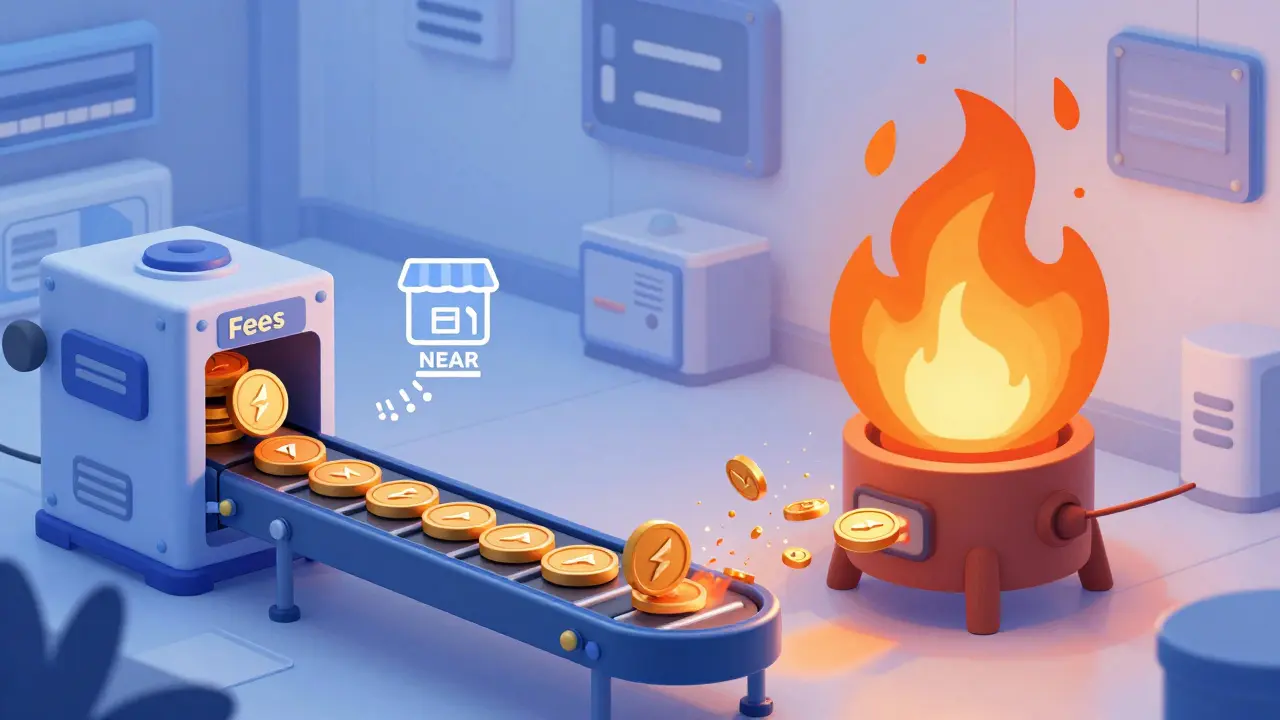
Here is the kicker: Aurora has a deflationary mechanism built into its economics. This is known as a buyback-and-burn model. Here is how it works step-by-step:
- Users pay transaction fees on Aurora using ETH.
- These ETH fees are converted into NEAR tokens by the protocol.
- The AuroraDAO uses a portion of these collected NEAR tokens to buy AURORA from the open market.
- The purchased AURORA tokens are permanently burned (destroyed).
This creates a direct link between network usage and token scarcity. The more people use Aurora, the more fees are generated, the more AURORA is bought back and burned. In late 2023, for example, over 10,000 AURORA tokens were burned in a single event. While this might seem small compared to the total supply, it establishes a precedent that active usage reduces the available supply, which can create upward pressure on price if demand remains steady or increases.
Aurora Cloud Console and Virtual Chains
Aurora isn’t just sitting still. The team has been pushing hard into infrastructure with the launch of the Aurora Cloud Console. This is a no-code platform that allows founders to launch their own "Virtual Chains" without needing to manage validators or complex node infrastructure.
A Virtual Chain is essentially a fully EVM-compatible blockchain that runs as a smart contract on NEAR. It comes pre-integrated with oracles, identity services, and bridge infrastructure. Why does this matter for the AURORA token? Because each new Virtual Chain expands the Aurora ecosystem. More chains mean more developers, more users, and more transaction volume. Remember the burn mechanism we discussed earlier? More volume means more burns. This feature positions Aurora not just as a bridge, but as a hub for a multi-chain future where custom blockchains are easy to deploy.
Market Position and Competitors
You can’t talk about Aurora without talking about who it’s fighting against. The landscape is crowded. Aurora competes directly with Ethereum Layer-2 solutions like Arbitrum and Optimism. It also competes with other EVM-compatible Layer-1 blockchains like Polygon, Avalanche, and Binance Smart Chain.
So, why choose Aurora? Its main differentiator is its underlying technology. Unlike Arbitrum or Optimism, which use rollup technology to compress transactions before posting them to Ethereum, Aurora leverages NEAR’s native sharding and proof-of-stake consensus. This gives it sub-second finality and potentially higher throughput without the complexity of rollups. For developers who want Ethereum compatibility but are tired of Ethereum’s congestion, Aurora offers a smoother path.
| Feature | Aurora (AURORA) | Arbitrum | Polygon |
|---|---|---|---|
| Underlying Tech | EVM on NEAR Protocol | d>Optimistic Rollup on EthereumSidechain / zkEVM | |
| Fee Currency | ETH | ETH | MATIC / POL |
| Token Utility | Governance Only | Governance (ARB) | Staking, Fees, Governance |
| Finality Speed | Sub-second (via NEAR) | Minutes to Days (challenge period) | Seconds |
| Burn Mechanism | Yes (Buyback & Burn) | No | No |
As of late 2025, AURORA had a market capitalization of roughly $47-48 million. This places it in the mid-tier range for altcoins. It’s not a blue-chip giant like Bitcoin or Ethereum, but it’s established enough to have real liquidity and developer activity. The risk here is adoption. If developers continue to flock to Arbitrum or Optimism due to network effects, Aurora struggles to gain traction. But if the Virtual Chains strategy takes off, Aurora could carve out a unique niche as the go-to infrastructure for custom EVM chains.
Risks and Considerations
No investment is without risk, and Aurora has its share of challenges. First, remember that AURORA is a governance token only. It doesn’t generate yield through staking rewards in the traditional sense (like Proof-of-Stake coins do). Your return depends entirely on the appreciation of the token’s price, which is driven by speculation and governance demand.
Second, Aurora relies heavily on the health and success of the NEAR Protocol. If NEAR faces major security issues or loses market share, Aurora suffers by association. They are technically distinct but economically linked.
Finally, the competition is fierce. Ethereum Layer-2s are improving rapidly. Arbitrum Orbit and Optimism’s Superchain initiatives are making it easier for others to build too. Aurora needs to continuously innovate to stay ahead. The introduction of the Cloud Console is a strong move, but execution is everything.
Is AURORA the same as NEAR?
No, they are different. NEAR is the underlying Layer-1 blockchain. AURORA is the governance token for the Aurora network, which is an EVM-compatible layer built on top of NEAR. You use NEAR to secure the base network, but you use AURORA to vote on Aurora-specific decisions.
Do I need AURORA tokens to use the Aurora network?
No. To transact on Aurora, you need ETH to pay for gas fees. You do not need to hold AURORA tokens to swap assets, interact with dApps, or bridge funds. You only need AURORA if you want to participate in governance via the AuroraDAO.
How does the AURORA burn mechanism work?
The AuroraDAO collects transaction fees (in NEAR) from the network. It then uses a portion of these funds to buy AURORA tokens from the open market and permanently burn them. This reduces the circulating supply over time, linking network usage to token scarcity.
Can I stake AURORA tokens to earn rewards?
Unlike NEAR, AURORA is not a staking token for network security. It is primarily a governance token. While some platforms may offer liquidity mining incentives for providing AURORA liquidity, the token itself does not have a native staking reward mechanism for securing the blockchain.
What is the maximum supply of AURORA?
The maximum supply of AURORA is capped at 1 billion tokens. This fixed supply helps prevent inflation, though the circulating supply decreases further due to the periodic buyback-and-burn events executed by the DAO.