
When the Taliban took full control of Afghanistan in August 2021, they didn’t just take over government buildings-they shut down the economy. Foreign aid froze. Banks stopped operating. International wire transfers vanished. Millions of Afghans woke up one day with no way to pay for food, medicine, or rent. The only thing left standing? Crypto.
It wasn’t a choice. It was survival.
By 2022, 97% of the population was projected to live below the poverty line. Food was available in markets, but no one had cash. The Afghan afghani collapsed. Banks refused to release savings. The world turned its back. And that’s when people started using Bitcoin and USDT-secretly, silently, dangerously.
How Crypto Became Afghanistan’s Lifeline
Before the Taliban, Afghanistan’s financial system was already fragile. Most people didn’t have bank accounts. They relied on hawala, an informal money-transfer network. But when sanctions hit after the Taliban’s return, even hawala got squeezed. Money from relatives overseas-often in the U.S., Europe, or Pakistan-stopped flowing.
Then came crypto.
Families abroad started sending Bitcoin or Tether (USDT) directly to mobile numbers. No bank needed. No paperwork. No approval. Just a QR code scanned on a phone. HesabPay, a local app built for Afghan users, exploded in popularity. In three months, it had over 380,000 users. People used it to pay for groceries, send money to relatives in rural areas, even pay for school fees.
It worked because crypto doesn’t need a government to function. It runs on phones, not banks. And in a country where 8.6 million out of 40 million people had internet access, that was enough.
The Taliban’s Ban: A Law No One Could Enforce
In August 2022, the Taliban declared cryptocurrency trading haram-forbidden under Islamic law. They said it was gambling. No real value. No backing. A sin.
They shut down exchanges. Revoked licenses. Arrested traders. By November 2022, recorded crypto transactions had dropped to just $80,000 a month. Officially, the market was dead.
But underground? It was alive.
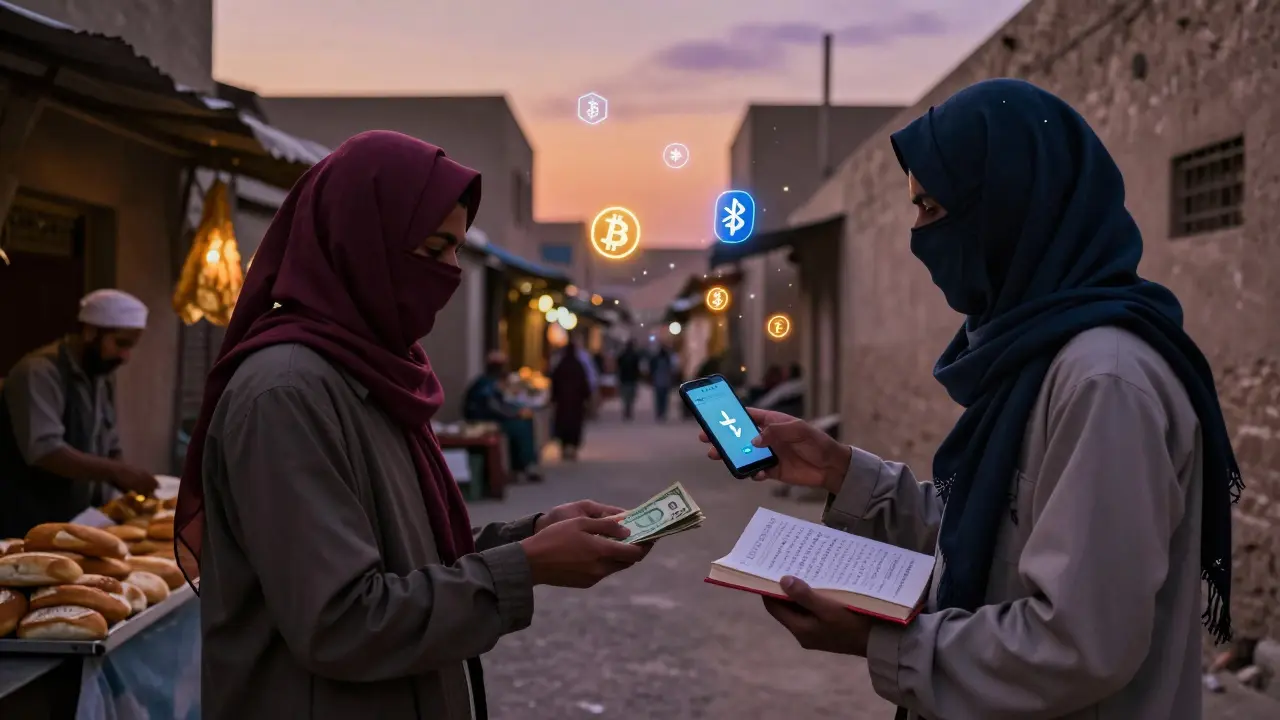
The Taliban could ban exchanges. They couldn’t ban peer-to-peer trades. A man in Kabul could meet a friend in a café, hand over cash, and receive USDT on his phone. No trace. No paper trail. No bank record. Even if the Taliban raided a house, they couldn’t find the money-it wasn’t in a vault. It was in a digital wallet, hidden on a phone.
And the more they cracked down, the more creative people got. Traders started using offline methods-Bluetooth transfers, SMS codes, even handwritten private keys. One trader in Kandahar told a journalist he kept his seed phrase on a scrap of paper inside his son’s schoolbook. The Taliban searched the house. They didn’t touch the book.
Bitcoin and USDT: The Only Currencies That Still Work
Not all crypto is equal. In Afghanistan, only two matter: Bitcoin and USDT.
Bitcoin is used for long-term storage. It’s volatile, but it’s global. If you have Bitcoin, you can move it anywhere-even if you’re stuck in Afghanistan.
USDT, on the other hand, is the real workhorse. It’s pegged to the U.S. dollar. Stable. Reliable. People use it to buy food, pay rent, even hire drivers. It’s the closest thing Afghanistan has to cash anymore.
Forex dealers, once seen as shady operators, became the new banks. They’d take USDT from traders and give them Afghanis in cash. They’d take Afghanis from customers and send USDT overseas. No paperwork. No questions. Just a handshake and a phone call.
These dealers don’t operate in shops. They meet in alleyways, in parked cars, in crowded bazaars. They’re not rich. They’re just the only ones who still have access to the outside world.
Internet Blackouts and the New War on Access
By 2024, the Taliban realized they couldn’t stop crypto by banning exchanges. So they went after the internet.
In September 2024, they ordered nationwide internet blackouts across five northern provinces: Kunduz, Badakhshan, Baghlan, Takhar, and Balkh. The official reason? To stop "immoral content." The real reason? To cut off crypto.
Connectivity dropped to less than 1% of normal levels. Mobile data vanished. Wi-Fi disappeared. People couldn’t check prices. Couldn’t send payments. Couldn’t contact family abroad.
Traders in Peshawar, Pakistan, who relied on Afghan customers to confirm orders via WhatsApp, suddenly had no way to communicate. A shopkeeper in Peshawar told me his Afghan buyers used to send photos of goods before paying. Now? Silence. No photos. No payments. No sales.
But even blackouts didn’t kill crypto. They just made it harder. People started using mesh networks-ad-hoc phone-to-phone connections that don’t need the internet. Some traders use satellite phones. Others wait for rare moments of connectivity, then rush to send a transaction before the signal cuts again.

Women, Books, and the Hidden Cost of Control
The Taliban’s crackdown isn’t just about money. It’s about control.
In 2025, they removed books written by women from university libraries. They banned 18 courses on democracy, human rights, and gender studies. They stopped girls from attending school past sixth grade. And they’ve made it nearly impossible for women to work, travel, or even leave their homes without a male guardian.
But here’s the irony: crypto doesn’t care who you are.
A woman in Herat can receive USDT from her brother in Canada. She can use it to buy medicine for her mother. She can pay a local tailor to make clothes. She can send money to her sister in Kabul-all without asking permission.
That’s why the Taliban fear crypto. It’s not just about money. It’s about autonomy. It’s about women accessing the world without their permission. It’s about people bypassing their rules.
And that’s why the underground crypto network is more than an economy. It’s a quiet rebellion.
What Happens Next?
Will crypto disappear in Afghanistan?
No.
Not as long as people are hungry. Not as long as banks stay closed. Not as long as families overseas still have money to send.
The Taliban can ban exchanges. They can cut the internet. They can arrest traders. But they can’t stop people from wanting to survive.
Every day, someone in Afghanistan finds a new way to send or receive crypto. A hidden app. A neighbor with a satellite dish. A phone call that turns into a code. A wallet stored on a USB drive buried under a floorboard.
The world watches. The UN warns. Aid groups scramble. But on the ground, people are already solving the problem themselves.
Crypto didn’t fix Afghanistan’s economy. But it kept millions from starving.
And until the banks reopen, the sanctions lift, and the Taliban change their minds-it will keep doing that.