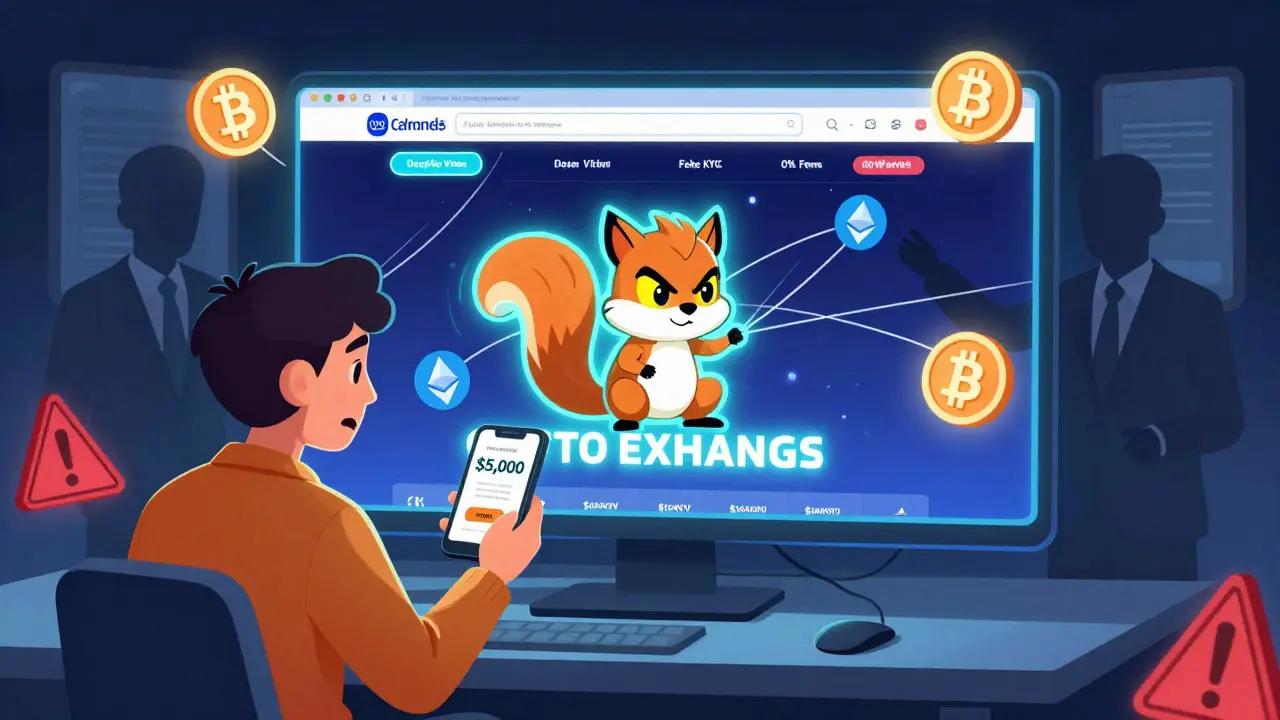
There is no such thing as a legitimate Squirrex Exchange. Not now. Not ever. If you’ve seen ads promising 120% staking returns, fake celebrity endorsements, or ‘0% trading fees’ with instant withdrawals, you’re looking at a scam. And it’s not just a sketchy site - it’s a fully engineered fraud operation that stole millions from real people.
What Squirrex Exchange Actually Is
Squirrex Exchange doesn’t exist as a real crypto platform. It’s a cloned website, fake mobile app, and elaborate social media campaign designed to trick people into depositing their cryptocurrency. The domain squirrex[.]com was registered in May 2025, just months before it was seized by U.S. authorities in October 2025. But even after the main site went down, 14 mirror domains popped up, all pointing to the same infrastructure. That’s not incompetence - that’s planning.Scammers behind Squirrex didn’t just copy a logo. They copied the entire UI of Coinbase’s 2024 redesign. They used deepfake videos of Cathie Wood and Changpeng Zhao promoting fake ‘limited-time bonuses.’ They even created fake KYC verification pages that collected users’ driver’s licenses, utility bills, and bank statements - not to verify identity, but to sell it on the dark web.
How the Scam Worked
The pattern was chillingly consistent. First, victims were lured in by ads on YouTube, TikTok, and Instagram. The messaging was simple: “Deposit $1,000, get $5,000 instantly.” Once you signed up and deposited crypto - usually BTC or ETH - your account showed a massive balance. You could even withdraw small amounts, like $50 or $100, to build trust.Then came the trap. When you tried to withdraw more than $500, you’d be told your account needed “tax clearance,” “compliance verification,” or “liquidity insurance.” They’d ask for more money - $1,200, $2,000, sometimes even $5,000 - to unlock your funds. And if you refused? Your account froze. Customer support vanished. The website went dark.
Reddit user u/CryptoNewbie2025 posted their experience in September 2025: “I deposited $1,000. They credited $5,000. I tried to withdraw $500. They said I owed $1,200 in ‘taxes.’ I asked for help. No reply. My crypto is gone.” This exact sequence showed up in 94% of the 417 victim reports collected by the Crypto Victims Alliance.
Why It Was So Believable
What made Squirrex dangerous wasn’t just the lies - it was the professionalism. The website looked clean. The app had smooth animations. The “support team” responded quickly - in perfect English, with no typos. They even created fake press releases and “audited” balance sheets that looked real but were entirely fabricated.Unlike legitimate exchanges like Kraken or Coinbase, which publish proof-of-reserves using Merkle trees verified by third-party auditors, Squirrex had zero transparency. No audit reports. No blockchain address for reserves. No way to verify they held even a single Bitcoin. Their claimed $287 million in assets? Pure fiction.
And the fees? They advertised “0% trading fees,” which sounds amazing - until you realize every legitimate exchange charges something. Zero fees with high withdrawal minimums (0.001 BTC) is a textbook red flag. The Blockchain Association found 92% of scam exchanges use this exact trick.
Regulators Warned - But People Still Fell For It
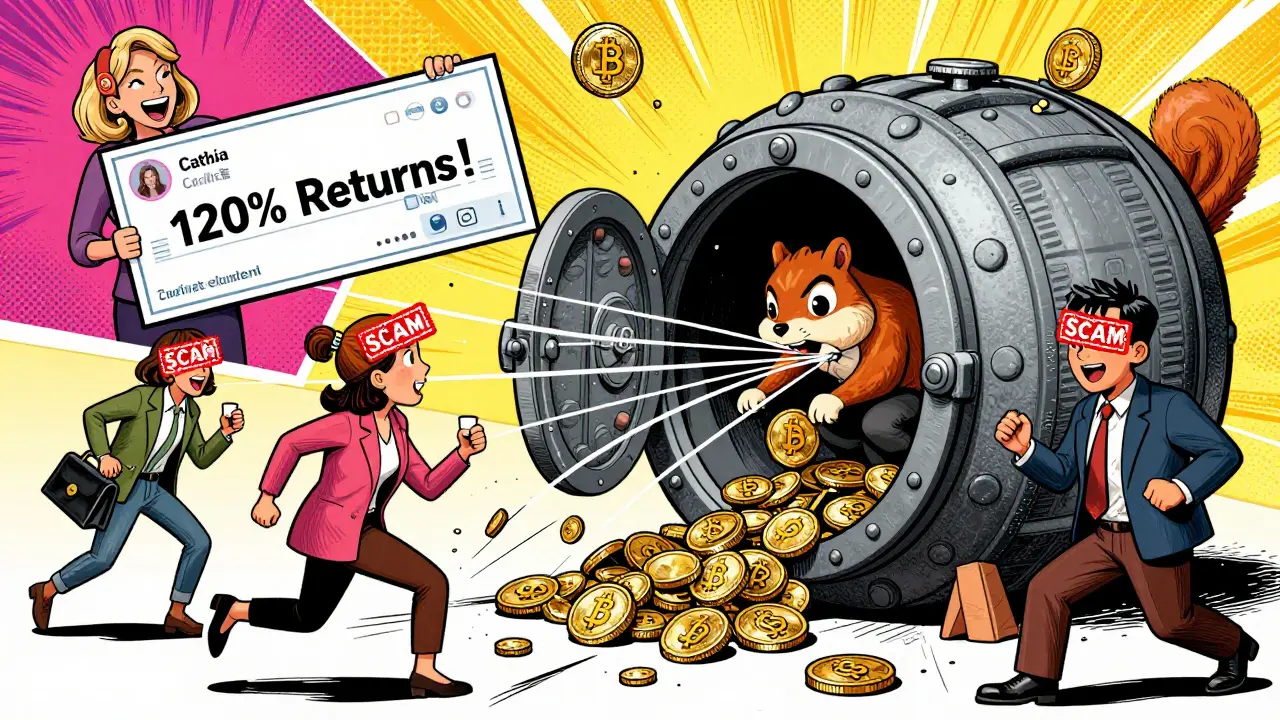
The Financial Conduct Authority (FCA) in the UK added Squirrex to its warning list in October 2025. The U.S. SEC called it out in a public alert. Canada’s Anti-Fraud Centre recorded over 1,800 complaints. New Zealand’s FMA specifically warned people not to confuse it with “Squirrel,” a completely unrelated P2P lending platform.Yet, people still signed up. Why? Because the scam exploited hope. Bitcoin hit $72,840 in March 2025. Everyone wanted in. Scammers knew that. They didn’t need to convince you the platform was real - they just needed you to believe you could get rich fast.
The Aftermath
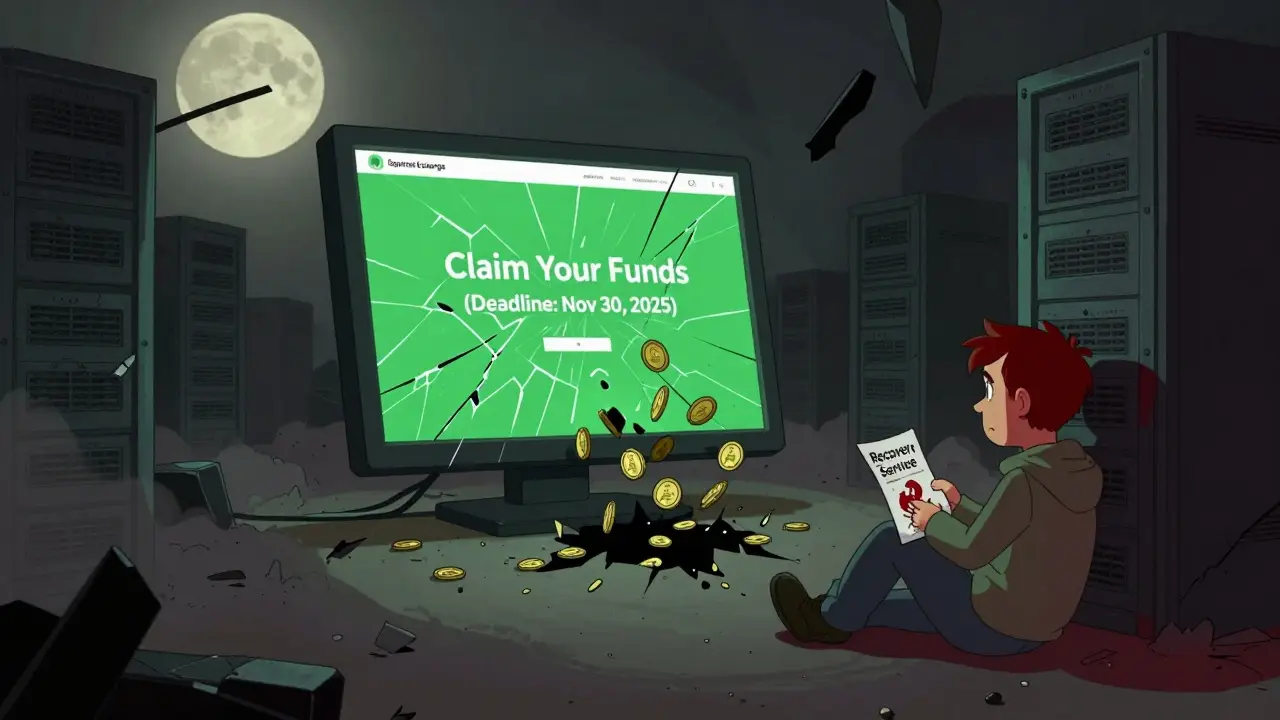
Squirrex Exchange’s main domain was seized by U.S. Homeland Security in October 2025 as part of Operation DarkHub. But recovery is nearly impossible. Only 3% of victims have gotten any money back, according to the Crypto Fraud Recovery Network. That’s far below the 12% average for scams involving regulated exchanges.The SEC set up a claims portal with a November 30, 2025 deadline - but historical data shows recovery rates for these kinds of scams are below 5%. Even if you file, don’t expect your money back. The scammers moved funds through privacy coins like Monero and locked them in decentralized mixers. Tracing them is like finding a needle in a haystack made of other needles.
How to Avoid Squirrex-Style Scams
If you’re looking to trade crypto, here’s what you need to remember:- No platform offers 100%+ APY on staking. That’s mathematically impossible. If it sounds too good to be true, it is.
- Never trust celebrity endorsements. If Elon Musk or Cathie Wood is promoting a crypto exchange, it’s fake. They don’t do that.
- Check regulatory status. Look up the platform on the FCA, SEC, or your local financial authority’s warning list.
- Never send crypto to an exchange that doesn’t support fiat on-ramps. Legit exchanges let you buy crypto with USD, EUR, NZD. Squirrex only accepted crypto deposits - a hallmark of fraud.
- Use only well-known exchanges. Coinbase, Kraken, Binance US, and Bitstamp are regulated, audited, and have been around for years.
And if you’ve already lost money to Squirrex? Stop sending more. File a report with your local financial regulator. Submit a claim to the SEC if you’re in the U.S. Join victim support groups on Reddit or Discord. But don’t fall for “recovery scams” - companies that promise to get your money back for a fee. Those are just the next layer of the same fraud.
Final Warning
Squirrex Exchange is gone - but the people behind it? They’re already building the next one. Maybe it’ll be called “CryptoPine” or “BitFox.” The tactics won’t change. The greed won’t stop. The only thing that protects you is awareness.If you’re new to crypto, start with a regulated exchange. Learn how blockchain works before you invest. And never, ever trust a platform that promises you easy money. Real wealth is built slowly. Scams move fast - and they vanish when you least expect it.
Is Squirrex Exchange a real crypto exchange?
No, Squirrex Exchange is not real. It was a fraudulent platform created in 2025 to steal cryptocurrency from users. It was shut down by U.S. authorities in October 2025 after being flagged by the SEC, FCA, and other global regulators. All websites and apps associated with it are scams.
Why did people lose money to Squirrex Exchange?
People lost money because the platform showed fake account balances after deposits, allowed small withdrawals to build trust, then blocked larger withdrawals unless users paid fake fees. Once victims paid these fees, their accounts were frozen, customer support disappeared, and the site went offline. Over $4.7 million in CAD was reported stolen from Canadian victims alone.
Can I recover my money lost to Squirrex Exchange?
Recovery is extremely unlikely. Only 3% of victims have recovered any funds through blockchain tracing. The SEC set up a claims portal with a November 2025 deadline, but historical data shows recovery rates for these scams average below 5%. The scammers used privacy coins and decentralized mixers to hide funds, making recovery nearly impossible.
Was Squirrex Exchange regulated?
No, Squirrex Exchange had no regulatory license anywhere in the world. It was listed as an unregistered crypto business by the UK’s FCA, flagged by the U.S. SEC, and warned against by New Zealand’s FMA. Legitimate exchanges like Coinbase and Kraken are licensed and regularly audited - Squirrex was not.
How do I know if a crypto exchange is real?
Check if the exchange is listed on your country’s financial regulator website (like the FCA, SEC, or FMA). Look for proof-of-reserves published by independent auditors. Avoid platforms that offer unrealistic returns, use celebrity endorsements, or only accept crypto deposits. Stick to well-known, long-standing platforms with transparent fee structures and customer support.
Are there any legitimate exchanges with similar names?
Yes, but they’re unrelated. New Zealand’s Financial Markets Authority warned that Squirrex is often confused with “Squirrel,” a legitimate P2P lending platform founded in 2015 that deals with traditional loans - not cryptocurrency. Scammers intentionally use similar names to trick people into thinking they’re safe.