
Imagine a ledger that anyone can read, but no single person can control. That is the core promise of a public blockchain, which is a decentralized digital ledger system where anyone can participate in transaction validation without permission from a central authority. Unlike private databases used by banks or corporations, these networks are open to all. You don't need an invitation to join. You just need an internet connection.
The concept might sound abstract, but it powers some of the most valuable financial assets in the world today. From the original digital gold standard to platforms running complex global applications, public blockchains have evolved far beyond their early days as simple experimentations. Understanding how they work-and which ones matter-is crucial for anyone navigating the modern digital economy.
The Pioneer: Bitcoin
Every story about public blockchains starts with Bitcoin, which was the first decentralized cryptocurrency launched in January 2009 by the pseudonymous Satoshi Nakamoto. It wasn't designed to be a platform for apps or games. Its purpose was singular: to create a peer-to-peer electronic cash system that didn't rely on trusted intermediaries like banks.
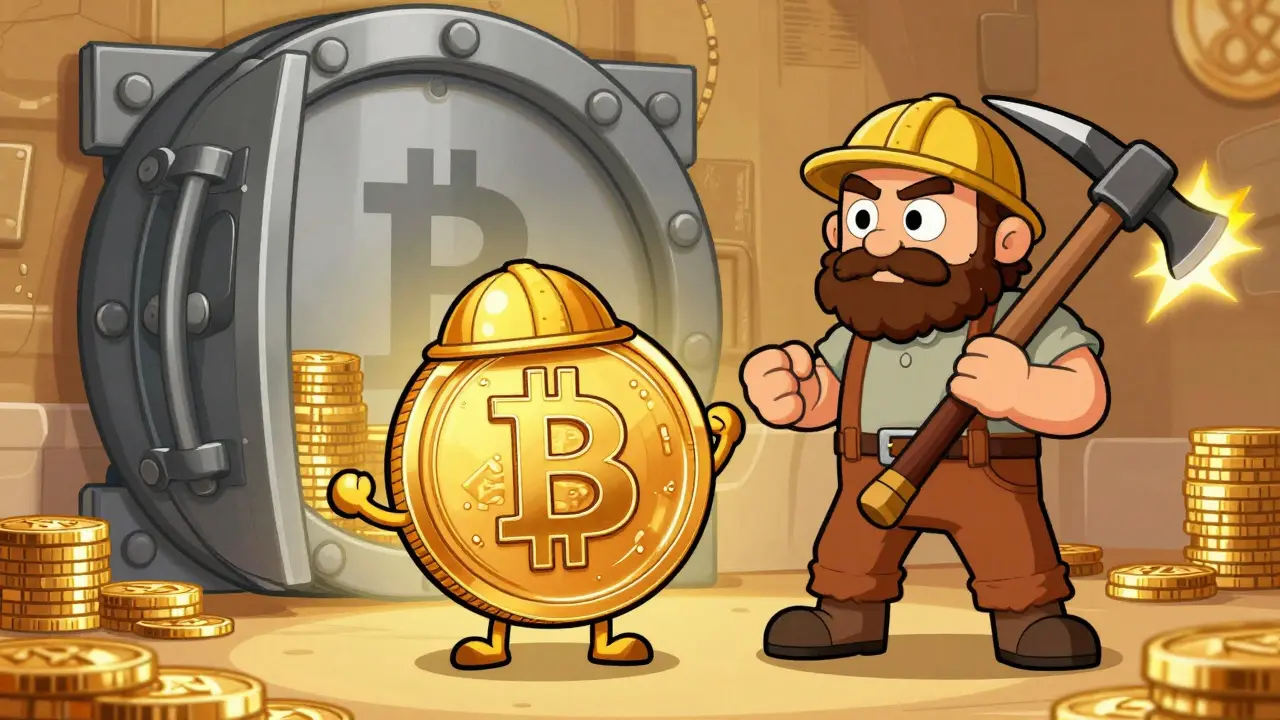
Bitcoin operates on a strict set of rules enforced by cryptography and consensus. When you send Bitcoin, your transaction is grouped with others into a 'block.' Miners compete to solve complex mathematical puzzles using the SHA-256 hashing algorithm. The first one to solve it gets to add the block to the chain and earns a reward. This process, known as Proof-of-Work (PoW), secures the network. To alter any past transaction, a hacker would need to control more than 51% of the network's computing power-a feat estimated to cost billions of dollars and requiring immense energy resources.
Today, Bitcoin is less about daily coffee purchases and more about being a store of value. Often called 'digital gold,' it processes around 300,000 transactions daily. While this sounds low compared to Visa, Bitcoin prioritizes security and decentralization over speed. With over 15,000 full nodes distributed across more than 100 countries, it remains the most decentralized network in existence. Its simplicity is its strength; there are no complex smart contracts to hack, just a robust, immutable record of ownership.
The World Computer: Ethereum
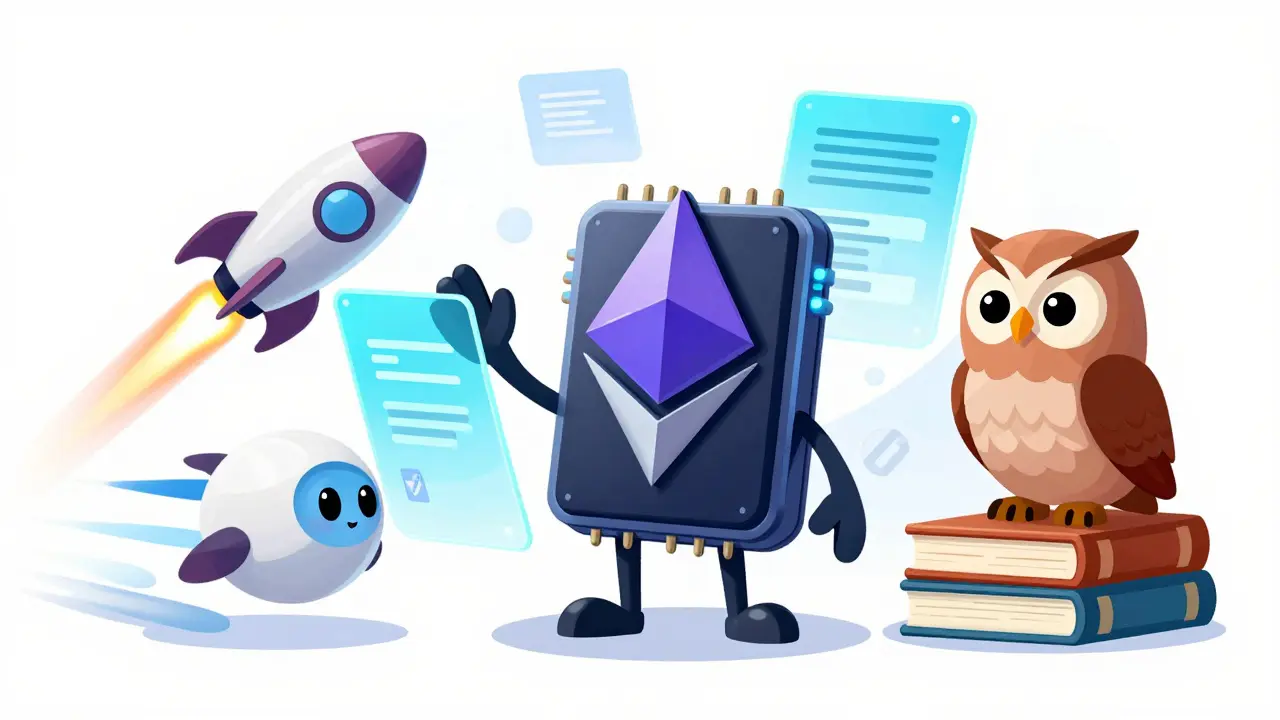
If Bitcoin is digital gold, then Ethereum is a programmable blockchain platform launched in 2015 by Vitalik Buterin that enables the creation of decentralized applications and smart contracts. Proposed in a 2013 whitepaper, Ethereum expanded the vision of blockchain from a simple ledger to a global computing engine. It introduced 'smart contracts'-self-executing agreements with the terms directly written into code.
This innovation changed everything. Developers could build decentralized applications (dApps) on top of Ethereum. Today, the network supports thousands of dApps, ranging from decentralized finance (DeFi) protocols managing billions in assets to non-fungible token (NFT) marketplaces. Ethereum uses the Solidity programming language, allowing for Turing-complete computation. This means it can handle complex logic, not just simple transfers.
A major shift occurred in September 2022 with 'The Merge.' Ethereum transitioned from energy-intensive Proof-of-Work to Proof-of-Stake (PoS). Instead of miners using electricity to secure the network, validators now stake 32 ETH to participate in consensus. This change reduced Ethereum's energy consumption by 99.95%, making it significantly more environmentally friendly while maintaining high security. However, this complexity comes with a trade-off: higher technical barriers for users and developers, and historically volatile 'gas fees' during peak usage times.
High-Speed Challengers: Solana and Cardano
As Ethereum grew popular, scalability became a bottleneck. Transactions slowed down, and fees skyrocketed. This opened the door for newer public blockchains focused on speed and efficiency. Two notable examples are Solana and Cardano.
Solana, launched in 2020, aims to be the fastest public blockchain. It achieves this through a unique consensus mechanism called Proof-of-History (PoH), combined with Proof-of-Stake. By creating a historical record that proves a specific event occurred at a specific moment in time, Solana allows validators to process transactions in parallel rather than sequentially. The result? Theoretical speeds of up to 65,000 transactions per second (TPS). This makes it attractive for high-frequency trading and gaming applications. However, this speed has come at the cost of stability, with the network experiencing several outages in recent years due to congestion.
On the other hand, Cardano takes a more academic approach. Launched in 2017, it employs the Ouroboros Proof-of-Stake protocol, which was developed through rigorous peer-reviewed research. Cardano prioritizes sustainability and formal verification methods to ensure smart contracts are bug-free before deployment. While it may not match Solana's raw speed, Cardano offers a highly stable and secure environment, appealing to projects that require long-term reliability over immediate hype.
Comparing Public Blockchains
| Feature | Bitcoin | Ethereum | Solana | Cardano |
|---|---|---|---|---|
| Consensus Mechanism | Proof-of-Work | Proof-of-Stake | Proof-of-History + PoS | Ouroboros PoS |
| Primary Use Case | Store of Value / Digital Gold | Smart Contracts / DeFi / NFTs | High-Speed Payments / Gaming | Secure Smart Contracts / Governance |
| Transactions Per Second (TPS) | 4-7 | 15-30 (Layer 1) | Up to 65,000 | ~250 (scalable) |
| Block Time | 10 minutes | 12 seconds | 400 milliseconds | 20 seconds |
| Programming Language | Script (Limited) | Solidity | Rust, C, C++ | Haskell, Plutus |
| Energy Consumption | Very High | Low (post-Merge) | Low | Low |
Key Considerations for Users and Developers
Choosing which public blockchain to use depends entirely on your goals. If you are looking for a safe place to store wealth with minimal counterparty risk, Bitcoin is the clear choice. Its network effect is unmatched, and its security model has been battle-tested for over a decade. Institutional investors increasingly view it as a hedge against inflation, similar to physical gold.
However, if you want to build an application, lend money, or trade tokens, Ethereum remains the dominant ecosystem. Despite higher fees during busy periods, it has the largest developer community and the most liquidity. Layer-2 solutions like Arbitrum and Optimism are currently processing the majority of Ethereum transactions, drastically reducing costs while inheriting Ethereum's security.
For developers seeking high throughput for gaming or real-time data applications, Solana offers compelling performance metrics. Yet, users must weigh this against the network's history of downtime. Reliability is critical in finance, and a halted chain means frozen funds. Cardano provides a middle ground for those who prioritize academic rigor and long-term stability over rapid feature releases.
Regulatory landscapes also play a role. In the European Union, the MiCA regulation classifies Bitcoin as a virtual asset and Ethereum as a utility token, subjecting them to different compliance requirements. In the United States, the SEC continues to debate the status of various tokens, creating uncertainty for enterprises. Always consider the legal implications in your jurisdiction before engaging deeply with any blockchain network.
Frequently Asked Questions
What is the main difference between Bitcoin and Ethereum?
Bitcoin is primarily designed as a decentralized currency and store of value, focusing on security and simplicity. Ethereum is a programmable platform that allows developers to build decentralized applications (dApps) and execute smart contracts, making it more versatile but also more complex.
Are public blockchains anonymous?
No, public blockchains are pseudonymous, not anonymous. All transactions are recorded on a public ledger visible to everyone. While your name isn't attached to your wallet address, sophisticated analysis tools can often link addresses to real-world identities based on transaction patterns and exchange records.
Why do Ethereum gas fees fluctuate so much?
Gas fees represent the cost of computational effort required to process transactions on the Ethereum network. When many users try to transact simultaneously, demand exceeds the available block space. Users bid higher fees to get their transactions processed faster, causing prices to spike. Layer-2 solutions help mitigate this issue.
Is Bitcoin energy consumption still a problem?
Bitcoin uses Proof-of-Work, which requires significant electricity for mining. Critics argue this is environmentally harmful. However, proponents note that a growing percentage of mining operations utilize renewable energy sources or excess grid capacity. Ethereum, by contrast, switched to Proof-of-Stake in 2022, reducing its energy use by 99.95%.
Can I use Solana for everyday payments?
Yes, Solana is designed for high-speed, low-cost transactions, making it suitable for everyday payments. Its fast block times and negligible fees allow for near-instant settlements. However, users should be aware of the network's occasional stability issues and choose reliable wallets and exchanges.
What happens if a public blockchain is hacked?
Public blockchains themselves are extremely difficult to hack due to their decentralized nature and cryptographic security. A successful attack would require controlling 51% of the network's hash rate (for PoW) or staked coins (for PoS), which is economically unfeasible for large networks like Bitcoin and Ethereum. Most 'hacks' actually occur in smart contracts or user wallets, not the underlying blockchain protocol.
Which blockchain is best for beginners?
Bitcoin is generally considered the easiest for beginners because of its simplicity and widespread support. Setting up a wallet and sending/receiving BTC is straightforward. Ethereum is also beginner-friendly for basic transfers, but interacting with dApps requires understanding concepts like gas fees and seed phrases, adding a layer of complexity.