
The clock is ticking for every cryptocurrency business operating in the European Union. With Markets in Crypto-Assets Regulation (MiCA) fully applicable since December 30, 2024, the era of fragmented national rules has ended. But here is the catch: you are not necessarily dead in the water if you don't have your full license yet. You might be sitting in a transitional period. However, these "grace periods" vary wildly from country to country, and misunderstanding them can lead to immediate shutdown or heavy fines.
If you are running a crypto exchange, wallet provider, or issuing tokens, knowing exactly when your local deadline hits-and how it interacts with cross-border services-is critical. This guide breaks down the messy reality of MiCA transition periods, who gets extra time, and what happens when that time runs out.
What Are MiCA Transition Periods?
Transition periods, often called "grandfathering" provisions, allow existing crypto businesses to keep operating while they prepare their full application for a MiCA license. Before MiCA, each EU member state had its own laws. Some countries had strict rules, others had almost none. To prevent chaos, regulators allowed firms already registered under old national laws to continue working until they could meet the new, higher standards.
However, this is not a free pass. During this period, you are essentially on borrowed time. You must submit your application by a specific date and demonstrate that you are moving toward full compliance. The maximum window provided by the EU framework is 18 months from the full application date, but individual countries have chosen shorter timelines.
Crucially, being in a transition period means you do not have full MiCA status. You cannot use the "passporting" rights-the ability to serve clients across all EU countries with one license-until you get your official approval. You are stuck serving only the jurisdiction where you hold your temporary registration.
The Patchwork of Deadlines Across Europe
This is where it gets tricky. The EU set the rules, but each National Competent Authority (NCA) decided its own internal timeline. There is no single "EU deadline." Instead, there is a patchwork of dates that depends entirely on where your company is legally registered.
| Country / Region | Application Deadline | Full Compliance Deadline | Notes |
|---|---|---|---|
| Czech Republic | July 31, 2025 | July 1, 2026 | Longest standard window; strict application requirements. |
| Belgium | Varies | July 1, 2026 | Extended transition for existing VASPs. |
| Poland | Varies | July 1, 2026 | Similar extended timeline to Czechia/Belgium. |
| Lithuania | Earlier 2024/2025 | January 1, 2026 | Tighter schedule than the max 18-month rule. |
| Netherlands | Mid-2025 | Mid-2025 | Rapid implementation; first licenses issued Dec 2024. |
| Finland | October 31, 2024 | June 30, 2025 | Very short window; high scrutiny from FIN-FSA. |
| Norway (EEA) | Varies | December 30, 2025 | Follows EEA alignment timeline. |
Notice the disparity? A firm in the Netherlands faced a much faster track to compliance compared to one in Poland. If you are expanding into multiple markets, you need to track the shortest deadline among all jurisdictions where you actively solicit customers.
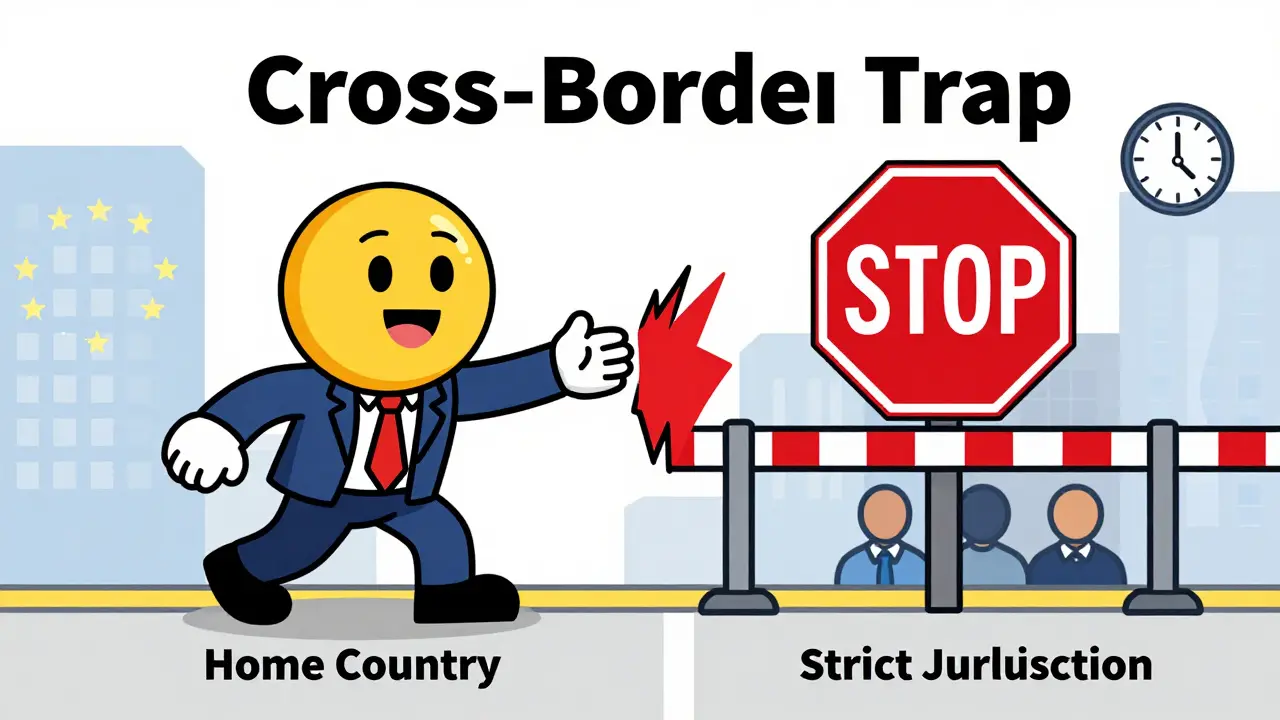
The Cross-Border Trap: One Rule to Rule Them All?
Imagine you are registered in Germany, which offers a relatively smooth transition process. But you also market heavily to clients in France or Finland, which have stricter or shorter timelines. What happens?
The European Securities and Markets Authority (ESMA) made this clear in late 2024: if you provide services across borders during a transition period, you must comply with the shortest applicable transitional period among all member states where you operate.
Let's say your home country gives you until July 2026, but you have active clients in a country where the transition ends in June 2025. You effectively lose your right to serve those specific clients once that shorter deadline passes, unless you secure full MiCA authorization before then. If you don't get approved in time, you must stop serving clients in that jurisdiction immediately. You cannot just "wait it out" because your home regulator is slower.
This creates a massive operational headache. You might need to geo-block users from certain countries during the gap between the short deadline and your eventual full license approval. Failure to do so is considered a violation of consumer protection and market integrity rules.
Case Study: Finland’s Rapid Shutdown Risk
Finland serves as a stark warning for crypto businesses relying on legacy registrations. The Finnish Financial Supervisory Authority (FIN-FSA) moved aggressively. Existing virtual currency providers had to apply for authorization by October 31, 2024, to continue operating under national law until the hard stop on June 30, 2025.
By that October deadline, only seven companies had submitted applications. For any other registered entity that missed this window, the right to provide services terminated automatically. Even for those seven applicants, there was no guarantee. If the FIN-FSA issues a negative decision, operations cease immediately. As of mid-2025, Finland still reported zero fully authorized MiCA CASPs, highlighting the difficulty of meeting the new corporate governance and capital requirements quickly.
This case illustrates that "transition" does not mean "guaranteed continuation." It means "conditional continuation pending review." Regulators are looking closely at management competence, own funds, and information security. If your old setup doesn't match MiCA's rigorous standards, your transition period ends early.
What You Lose During Grandfathering
Many founders think that staying in the transition period is a safe harbor. It isn't. While you avoid immediate shutdown, you miss out on the biggest benefit of MiCA: the passport.
Once you are a fully licensed Crypto-Asset Service Provider (CASP), you can offer services anywhere in the EU and EEA without needing separate licenses in each country. This is the "single passport" principle. During the transition period, you do not have this status. You are restricted to your home jurisdiction (and potentially others only if bilateral agreements or specific short-term allowances exist, which are rare).
Furthermore, investors and institutional partners are increasingly wary of dealing with non-MiCA compliant entities. Banks may hesitate to open accounts for firms that haven't secured their full license, citing higher compliance risks. Being "in transition" signals that you haven't yet passed the ultimate test.

Compliance Checklist: Preparing for Full Authorization
To survive the transition and secure your license, you need to align with traditional financial services standards. MiCA treats crypto businesses like banks or investment firms in many ways. Here is what regulators are checking:
- Corporate Governance: Clear organizational structure, defined roles for management, and independent oversight mechanisms.
- Management Competence: Proof that key executives have the necessary experience and knowledge to run a regulated financial entity.
- Own Funds: Adequate capital reserves to cover operational risks. This isn't just about having cash; it's about demonstrating solvency under stress scenarios.
- Data Transparency: Robust systems for reporting transactions and holding client data securely.
- Information Security: Cybersecurity measures that meet industry best practices to protect against hacks and data breaches.
- Conflict of Interest Management: Policies to ensure that your business interests don't override client interests, especially if you trade against your own customers.
If you are currently operating with a lean startup model, expect significant upfront costs to build these structures. This is why some smaller firms are choosing to merge or exit rather than face the compliance burden.
Strategic Moves for 2025 and Beyond
As we move through 2025, the landscape is shifting. Countries like the Netherlands and Germany have started issuing full MiCA licenses rapidly, with over 40 CASPs licensed by mid-2025. These early movers now enjoy the competitive advantage of passporting rights. They can onboard clients from France, Italy, and Spain seamlessly, while competitors stuck in longer transition periods in other nations are playing catch-up.
For businesses still in transition, the strategy should be aggressive preparation. Don't wait until the last month. Engage with your National Competent Authority early. Ask for feedback on your draft application. If you are serving clients in multiple countries, map out the earliest expiry date among those jurisdictions and treat it as your effective deadline for securing full authorization.
Consider whether relocating your legal entity to a jurisdiction with faster processing times makes sense. While changing domicile is complex, starting fresh in a hub like Malta or the Netherlands might be faster than fighting a backlog in a slower-moving authority. However, weigh this against the cost of migrating your user base and regulatory history.
Final Thoughts on Navigating the Maze
MiCA is not just another regulation; it is a fundamental shift in how crypto operates in Europe. The transition periods were a necessary bridge, but the bridge is ending. For some, it ends in mid-2025. For others, it stretches into 2026. But regardless of the date, the goal remains the same: become a fully authorized CASP.
Ignore the deadlines, and you risk losing your business. Misunderstand the cross-border rules, and you risk violating international regulations. Use this time wisely to build robust compliance frameworks, secure your funding, and position yourself for long-term growth in a regulated market. The wild west days are over; the age of professional, accountable crypto finance is here.
Can I continue operating in the EU without a MiCA license?
Only if you fall under a specific transitional period granted by your national regulator. This allows you to operate temporarily while preparing your application. Once your transition period expires, you must have full authorization or cease operations. Additionally, you cannot offer services cross-border freely during this time without risking violations.
What happens if my transition period expires before I get my license?
You must immediately stop providing crypto-asset services in the affected jurisdictions. Continuing to operate without authorization after the deadline is illegal and can result in severe fines, forced closure, and criminal liability for executives. In some cases, regulators may grant short extensions, but this is not guaranteed.
Do I need a new license for each EU country?
No, that is the main benefit of MiCA. Once you obtain a full CASP license in one EU member state, you gain "passporting rights." This allows you to provide services across all other EU and EEA countries without needing separate national licenses. However, you must notify your home regulator before entering new markets.
How does MiCA affect stablecoins?
MiCA introduced specific rules for Asset-Referenced Tokens (ARTs) and E-Money Tokens (EMTs), commonly known as stablecoins. These rules took effect earlier, on June 30, 2024. Issuers of stablecoins must hold adequate reserves, maintain transparency, and adhere to strict redemption policies. Non-compliant stablecoins cannot be offered in the EU.
Which countries have the fastest MiCA licensing processes?
As of mid-2025, the Netherlands, Germany, and Malta have been among the fastest to issue full MiCA licenses. The Netherlands issued its first licenses immediately upon full applicability in December 2024. Companies seeking rapid market access often consider establishing their headquarters in these jurisdictions, though they must balance this with operational and tax considerations.