
DAO Legal Jurisdiction Comparison Tool
This tool helps you compare key legal frameworks for DAOs across different jurisdictions. Select your needs to see which jurisdictions match your requirements.
Select Your Requirements
Jurisdiction Comparison
| Country/Jurisdiction | For-Profit | Minimum Members | Registration Time | EU Recognition | Key Benefits |
|---|---|---|---|---|---|
| Wyoming (DUNA) | No | 100+ | Under 1 week | No | Perfect for nonprofit DAOs, strong liability protection |
| New Hampshire | Yes | Varies | 2-4 weeks | No | First operational framework, for-profit capability, official registry |
| Vermont | Yes | Varies | 2-4 weeks | No | Business-friendly LLC structure, strong liability protection |
| Tennessee | Limited | Varies | Varies | No | Smart contracts recognized as legal agreements |
| Malta (ITAS) | Yes | Varies | 3-6 months | Yes | Only EU-recognized option, full legal personality |
| Other Jurisdictions | No | N/A | N/A | No | Operates as unincorporated association, high liability risk |
Key Recommendations
Based on your selection, your ideal jurisdiction is:
Think of a company with no CEO, no boardroom, and no employees signing paychecks. Instead, decisions are made by people voting with tokens they bought online. That’s a DAO - a Decentralized Autonomous Organization. But here’s the problem: if something goes wrong, who do you sue? Who pays the taxes? Can a DAO sign a contract? In 2025, the answer still depends on where you are.
What Exactly Is a DAO?
A DAO runs on smart contracts - code stored on a blockchain that automatically enforces rules. Members join by buying governance tokens. These tokens give them voting power. Want to spend funds? Propose it. Members vote. If it passes, the money moves automatically. No middlemen. No managers. Just code and consensus. But here’s the catch: traditional law was built for companies with names, addresses, and people in charge. DAOs have none of that. They’re not corporations. They’re not partnerships. They’re something new. And the legal system is scrambling to catch up.Wyoming’s DUNA: The Nonprofit Model
Wyoming was the first U.S. state to give DAOs a legal identity. In March 2024, it passed the Decentralized Unincorporated Nonprofit Association (DUNA) law. Under DUNA, a DAO can register as a legal entity. It can open bank accounts, own property, sue, and be sued. Members get limited liability - meaning their personal assets are protected if the DAO gets sued. But there’s a big trade-off: DUNA DAOs can’t make profits for members. They must be nonprofit. That means no dividends, no profit-sharing. If your DAO is trying to build a profitable DeFi protocol, DUNA won’t work. It’s great for community grants, open-source software, or charity projects. Not for startups chasing returns. Wyoming requires at least 100 members to form a DUNA. That’s meant to stop one person from controlling the whole thing. It’s a smart rule - prevents founder-led shells. But it’s also a barrier. Most DAOs have fewer than 100 active voters. Many can’t even meet that threshold.New Hampshire’s DAO Act: The First Operational Framework
New Hampshire didn’t wait. In 2024, it passed its own DAO Act, effective July 2025. Unlike Wyoming, it doesn’t force DAOs into a nonprofit box. DAOs here can be for-profit. They can distribute profits. They can raise capital like a traditional LLC. The real breakthrough? New Hampshire is building an official DAO registry. The Secretary of State is hiring vendors to create a digital system where DAOs can register, file documents, and get a legal ID. This isn’t just a law - it’s infrastructure. Once live, it’ll be the first state-run DAO registry in the U.S. New Hampshire’s law also lets DAOs designate a legal agent - someone who can receive court papers. That’s a big deal. Courts need someone to serve. Without it, lawsuits stall. This fixes a major legal gap.Virginia, Vermont, and Tennessee: The Emerging Players
Virginia is pushing legislation to let DAOs register as Limited Liability Companies (LLCs) under its existing LLC law. That’s huge. It means DAOs could use the same legal structure as a local bakery or tech startup - just with code instead of paper bylaws. Vermont’s Blockchain-Based LLC (BBLLC) law, passed in 2023, already lets DAOs register as LLCs. Members get liability protection. The DAO can own assets. It can enter contracts. It’s one of the most business-friendly models in the U.S. Tennessee passed a DAO recognition law in 2024. It doesn’t create a new entity type, but it says smart contracts can satisfy legal requirements for agreements. That’s subtle but powerful. It means a DAO’s voting rules can legally count as a contract.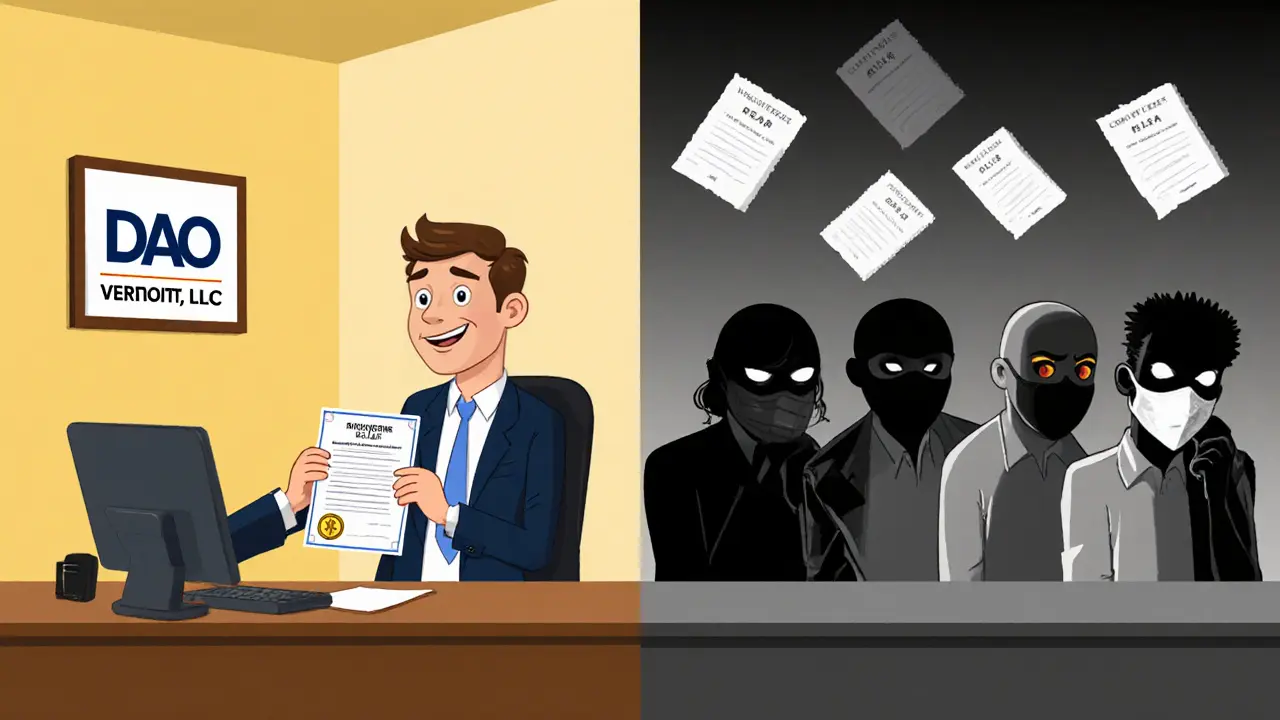
Malta: The EU’s DAO Hub
Outside the U.S., Malta leads. Its Innovative Technology Arrangements and Services (ITAS) Act lets DAOs get certified by the Malta Digital Innovation Authority (MDIA). Once certified, a DAO has legal personality across the EU. It can open bank accounts, hire staff, and sign contracts in any EU country. Malta’s rules are strict. DAOs must submit detailed technical documentation. They need a physical presence on the island. They must appoint a resident agent. They’re subject to audits. It’s not easy. But for DAOs wanting to operate across Europe, it’s the only clear path. The catch? Malta’s model is expensive and bureaucratic. It’s designed for serious players - not hobbyist collectives. Still, it’s the only EU-wide option.The Legal Gray Zones
Most places still don’t recognize DAOs as legal entities. In those areas, DAOs exist as unincorporated associations - basically, a group of people with a shared goal. That’s dangerous. In 2022, the CFTC sued Ooki DAO for violating derivatives trading rules. The court treated it as an unincorporated association. That meant every member could be held personally liable. The ruling sent shockwaves through the space. If you hold a single token in a DAO that breaks the law, you could be on the hook for millions. No one wants that. That’s why legal recognition matters. Without it, DAOs are walking legal landmines.Why Jurisdiction Matters
If you’re starting a DAO in 2025, you can’t just pick a blockchain and go. You need to pick a jurisdiction too. - Want to make money? Avoid Wyoming’s DUNA. Go for New Hampshire or Vermont. - Want to operate in Europe? Malta is your only real option. - Want to avoid paperwork? You’re out of luck - every legal DAO needs some form of registration. - Want to protect your personal assets? Only states with LLC or DUNA laws offer that. - Want to stay fully decentralized? You’re fighting the system. Every legal framework requires a physical contact point. Some DAOs try to operate without registration. That’s risky. Banks won’t work with them. Payment processors shut them down. Partners won’t sign contracts. In 2025, unregistered DAOs are digital ghosts - invisible to the real economy.
The Future Is Hybrid
The most successful DAOs in 2025 aren’t trying to be fully decentralized. They’re hybrid. They use blockchain for voting and transparency. But they register as LLCs in Vermont or New Hampshire. They hire a legal agent. They file annual reports. They pay taxes. They’re not the pure, code-only DAOs from 2021. They’re practical. They understand that to scale, they need to play by real-world rules. The tension between decentralization and legal compliance isn’t going away. But the winners will be the ones who find the balance - using blockchain for trust and transparency, while using law to protect themselves and their members.What Should You Do?
If you’re building or joining a DAO:- Know your jurisdiction. Don’t assume your DAO is protected just because it’s on Ethereum.
- Don’t join a DAO without knowing if it’s registered. Ask: "Is this DAO legally recognized? Where?"
- If you’re starting one, pick your legal home before you launch. Vermont, New Hampshire, and Malta are the safest bets.
- Don’t ignore taxes. Even nonprofit DAOs may owe them. Consult a blockchain-savvy accountant.
- Understand liability. If your DAO breaks the law, you could be on the hook - unless you’re in a state that gives you protection.
What’s Next?
More states will follow. California, Texas, and Florida are watching closely. The SEC and IRS are watching too. Federal rules are coming. They’ll likely force DAOs to comply with securities laws, anti-money laundering rules, and tax reporting. The next five years will decide if DAOs become mainstream business tools - or remain niche experiments with legal risks. The bottom line: DAOs aren’t lawless. They’re just waiting for the law to catch up. And in 2025, the law is finally starting to move.Can a DAO be sued?
Yes - but only if it has legal status. In states like Wyoming, Vermont, and New Hampshire, registered DAOs can be sued as legal entities. In places without recognition, courts may sue individual members, exposing them to personal liability. The 2022 CFTC case against Ooki DAO set a precedent: unregistered DAOs are treated as unincorporated associations, meaning every member could be held responsible.
Do DAO members pay taxes?
Yes. If a DAO distributes profits, members pay income tax on their share. Even nonprofit DAOs may owe taxes on unrelated business income. The IRS treats DAOs as partnerships by default unless registered as a corporation. Tax reporting is complex - most DAOs need a blockchain accountant to track token distributions and capital gains.
Can a DAO own property or sign contracts?
Only if it’s legally recognized. Registered DAOs in Vermont, New Hampshire, and Malta can own bank accounts, buy real estate, and sign contracts. Unregistered DAOs cannot. Any contract signed by an unregistered DAO is legally shaky - courts may refuse to enforce it, leaving parties without recourse.
Why does Wyoming require 100 members?
It’s a guardrail. Wyoming’s lawmakers wanted to prevent single founders from creating fake DAOs - where one person controls everything but claims it’s decentralized. Requiring 100 members forces real community participation. It’s not perfect, but it stops the most obvious abuse.
Can I run a for-profit DAO in Wyoming?
No. Wyoming’s DUNA law only allows nonprofit DAOs. You can’t distribute profits to members. If you want to build a for-profit DAO, you need to register in New Hampshire, Vermont, or another state that allows for-profit structures. Some DAOs create two entities: a nonprofit DUNA for community governance, and a separate for-profit LLC for commercial operations.
Is Malta the best place for a global DAO?
For EU operations, yes. Malta is the only jurisdiction in the EU that offers full legal recognition to DAOs. If you want to operate legally across multiple European countries, Malta’s ITAS certification is your only viable path. But it’s expensive, slow, and requires a physical presence. For non-EU DAOs, it’s overkill unless you specifically need EU access.
What happens if my DAO doesn’t register anywhere?
You’re operating in legal limbo. Banks won’t open accounts. Payment processors will cut you off. Partners won’t sign contracts. You can’t sue anyone. And if you get sued, every member could be personally liable. In 2025, unregistered DAOs are effectively invisible to the real economy - and legally exposed.
Are DAOs legal in the UK or Canada?
No clear legal status exists yet. The UK and Canada treat DAOs as unincorporated associations - meaning members face personal liability. No specific DAO laws exist. Some Canadian provinces are exploring frameworks, but nothing is active in 2025. UK regulators are monitoring closely, especially after the FCA’s crackdown on unregulated crypto assets.
Can a DAO be a nonprofit and still pay people?
Yes - but only as employees or contractors, not as profit distributions. A nonprofit DAO can hire developers, lawyers, or community managers and pay them salaries. That’s allowed under IRS rules for nonprofits. But it can’t give token holders dividends or profit-sharing. The key is the payment must be for services, not ownership returns.
How long does it take to register a DAO legally?
In Vermont or New Hampshire, it takes 2-4 weeks if you have all documents ready. Wyoming’s DUNA registration is faster - often under a week. Malta’s ITAS certification takes 3-6 months due to audits and documentation. The delay isn’t in the form - it’s in proving your code is secure, your governance is fair, and your team is legitimate.