
When you see a DeFi protocol boasting $2 billion in TVL, what does that number actually mean? It’s not just a fancy stat - it’s the sum of every dollar locked up in smart contracts across lending, staking, and liquidity pools. But here’s the catch: TVL isn’t as simple as adding up token balances. The math looks easy, but the reality? It’s messy, inconsistent, and often misleading.
What TVL Actually Measures
TVL stands for Total Value Locked. It’s the total amount of cryptocurrency deposited into a DeFi protocol - whether that’s ETH staked in a yield farm, DAI lent out on Aave, or BTC wrapped and locked in a cross-chain bridge. The idea is simple: more money locked in = more trust, more activity, more adoption. But that’s where the simplicity ends. TVL doesn’t tell you if a protocol is profitable. It doesn’t tell you if users are making money. It doesn’t even tell you if the funds are safe. It only answers one question: How much crypto is sitting in this smart contract right now?The Four-Step TVL Calculation Process
At its core, TVL calculation follows four basic steps - but each step has hidden traps.- Identify all assets - This includes stablecoins (USDC, DAI), native tokens (ETH, SOL), wrapped assets (wBTC), and even obscure tokens from obscure protocols. Some platforms accept dozens of different tokens. Missing one means your TVL is wrong from the start.
- Count the exact quantity - How many USDC are locked? 5 million? 5.2 million? You need real-time on-chain data. Many aggregators use APIs that lag or get hacked, leading to inflated numbers.
- Get the current market price - This is where things get wild. If ETH drops 15% in an hour, TVL drops 15%. But some platforms use 24-hour averages, others use spot prices from a single exchange, and others still use prices from centralized oracles that can be manipulated.
- Add it all up - Multiply each token’s quantity by its price, then sum. Simple math. But if one of the first three steps is flawed, the final number is garbage.
For example: A protocol holds 3,000 ETH at $3,200 each and 10 million USDC at $1.00 each. The calculation is (3,000 × $3,200) + (10,000,000 × $1) = $19.6 million. That’s the TVL. Easy. But only if every number is accurate - and in DeFi, that’s rare.
Why TVL Numbers Are Often Wrong
The Bank for International Settlements studied 939 DeFi protocols and found shocking flaws. Nearly 11% of them relied on external servers to report their TVL - meaning the data could be faked, delayed, or hacked. Over 60 different ways to query balances exist, and 240 of those queries are duplicated across protocols. That’s not standardization - that’s chaos. Worse, many aggregators like DeFiLlama and DefiPulse use self-reported data. Protocol teams submit their own numbers. No verification. No audit. Just trust. And guess what? A study of 400 protocols showed that only 46.5% of reported TVL figures matched what could be verified on-chain. Then there’s double counting. Some protocols issue derivative tokens - like stETH from Lido or rETH from Rocket Pool - that represent staked ETH. But if both the original ETH and the derivative token are counted separately, you’re counting the same money twice. That’s how some protocols inflated TVL by billions. One study found TVL was overstated by up to $139 billion due to this alone.
What TVL Doesn’t Tell You
TVL is often mistaken for a health score. It’s not. A protocol with $500 million in TVL could be a dying project with no users. A protocol with $50 million could be growing fast with real revenue. Here’s what TVL hides:- Revenue - TVL says nothing about fees earned by the protocol. A protocol can lock $1 billion but make $0 in fees.
- Profitability - Users might be losing money from impermanent loss, high gas fees, or rug pulls - but TVL doesn’t reflect that.
- Security - A TVL of $1 billion means nothing if the smart contract has a漏洞 (bug). The largest TVL protocols have been hacked for hundreds of millions.
- Real usage - Are people using the protocol? Or are bots and whales just inflating the number to look good? Some protocols have TVL from one wallet holding 90% of the assets.
TVL is a snapshot - not a story. It’s a starting point, not a finish line.
What Is vTVL - And Why It Matters
To fix the mess, researchers introduced verifiable TVL - or vTVL. This version only counts assets that can be proven on-chain using standard blockchain queries. No self-reports. No external APIs. Just raw, public data. vTVL excludes derivative tokens unless they’re fully backed and redeemable. It ignores tokens that can’t be withdrawn. It doesn’t count tokens from protocols that don’t allow balance checks. It’s stricter. It’s slower. But it’s honest. Some protocols now publish both TVL and vTVL. The gap between them tells you everything. If a protocol’s TVL is $200 million but its vTVL is $40 million, then 80% of its reported value can’t be verified. That’s a red flag.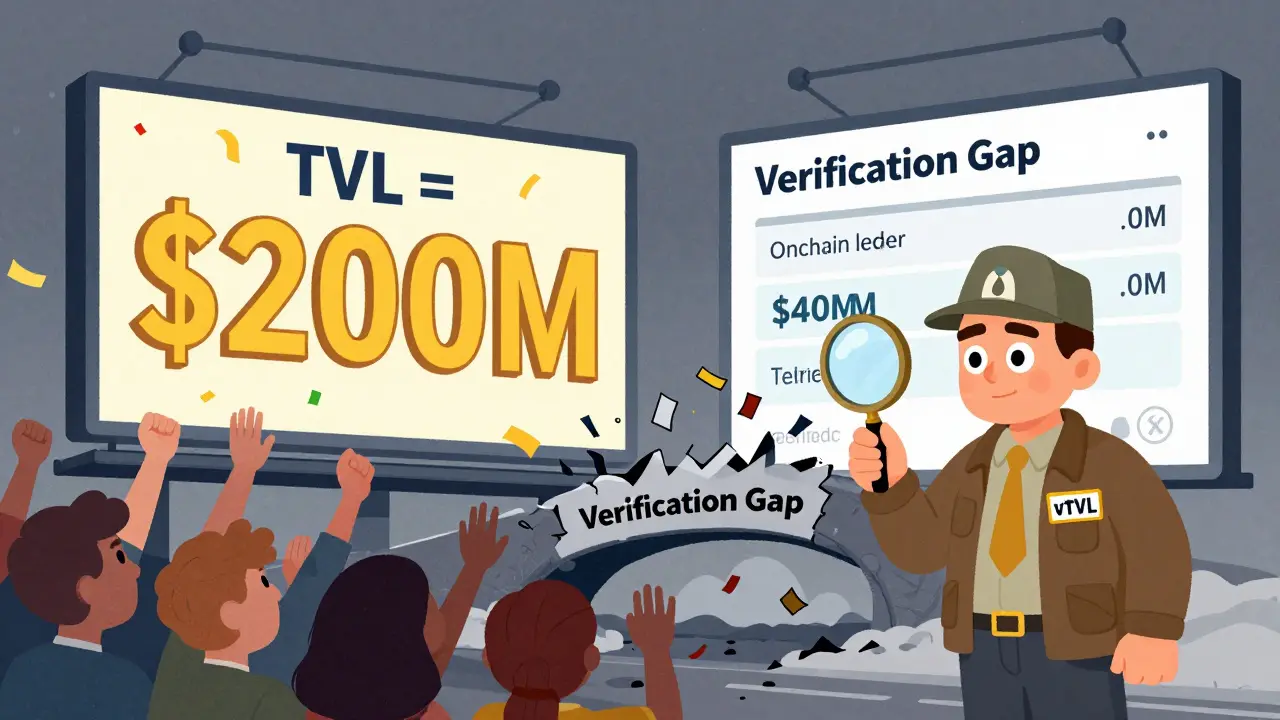
How to Use TVL Wisely
Don’t ignore TVL. But don’t trust it blindly. Here’s how to use it properly:- Compare protocols using the same aggregator - DeFiLlama, CoinGecko, and Dune Analytics all calculate TVL differently. Don’t compare a DeFiLlama number to a CoinGecko number.
- Look for vTVL - If a protocol offers it, prioritize it. It’s the closest thing to truth.
- Check for token concentration - If one wallet holds more than 20% of the TVL, it’s not decentralized. It’s a puppet.
- Watch for sudden spikes - A TVL jump of 50% in a day? Usually means a new token airdrop or a whale dumping assets into the protocol.
- Combine it with other metrics - Look at daily active users, trading volume, fee revenue, and protocol-owned liquidity. TVL is one piece. Not the whole puzzle.
TVL is like the size of a car’s gas tank. It tells you how much fuel is onboard - not how fast it’s going, how far it’s traveled, or if the engine is even running.
The Future of TVL
The DeFi world is waking up. Regulators are asking questions. Institutional investors are demanding transparency. The era of wild, unverified TVL numbers is ending. More protocols are starting to publish on-chain-only metrics. Tools are emerging that auto-verify balances. Standardized reporting frameworks are being drafted by research groups. The goal? A single, trusted way to calculate TVL - one that everyone agrees on. Until then, treat every TVL number like a rumor. Verify it. Question it. Cross-check it. And never make a decision based on it alone.TVL isn’t the end goal. It’s just the first question you need to ask - and the first lie you need to uncover.