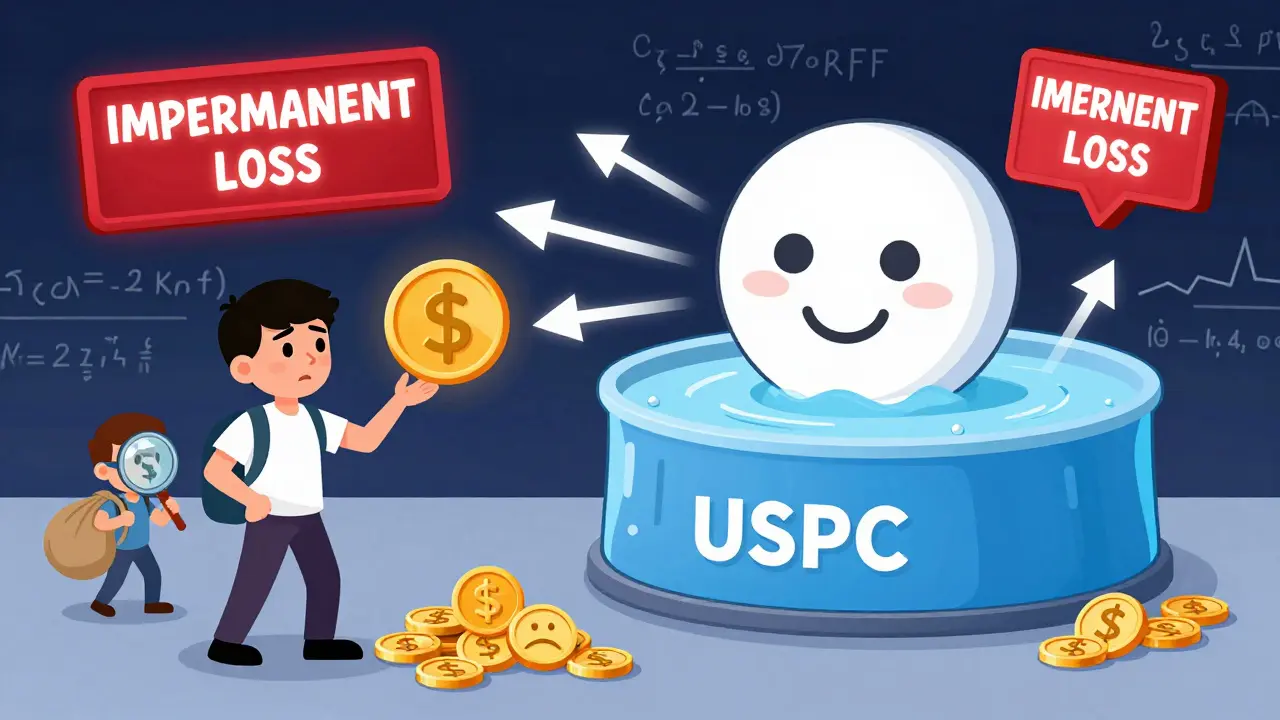
When you provide liquidity to a decentralized exchange like Uniswap or Curve, you’re not just earning trading fees-you’re also taking on a hidden risk called impermanent loss. It’s not a bug. It’s a feature of how automated market makers (AMMs) work. And if you don’t understand it, you could be losing money-even while your pool appears to be profitable.
Here’s the reality: if the price of one token in your pair moves up or down compared to the other, your share of the pool becomes unbalanced. Arbitrage traders step in to fix the imbalance, and in the process, they take away more of the asset that dropped in value. You end up with more of the cheaper token and less of the one that rose. Meanwhile, if you’d just held those tokens in your wallet, you’d have gained more. That gap? That’s impermanent loss.
It’s called “impermanent” because if the prices return to their original ratio, the loss disappears. But in crypto, prices rarely go back. They keep moving. And that’s why hedging isn’t optional anymore-it’s essential.
How Much Money Are You Really Losing?
The math behind impermanent loss is simple but brutal. For a 50/50 liquidity pool, the formula is: 2√d / (1+d) - 1, where d is the price ratio change.
Let’s break it down with real numbers:
- 5% price move → 0.23% loss
- 20% price move → 2.0% loss
- 50% price move → 5.7% loss
- 100% price move (2x) → 19.4% loss
- 300% price move (4x) → 41.4% loss
That last one? If ETH goes from $3,000 to $12,000 and you’re in an ETH/USDC pool, you lose over 40% of what you’d have made just by holding ETH. That’s not a small mistake. That’s a career-ending move if you’re leveraged.
And it gets worse with Uniswap v3. Concentrated liquidity lets you earn higher fees by locking your capital within a narrow price range. But that same narrow range means your exposure to impermanent loss spikes dramatically. A 10% move outside your range? You’re out of the market. A 20% move? You’re stuck with mostly stablecoins and no upside.
Seven Ways to Hedge Against Impermanent Loss
There’s no single fix. But there are seven proven strategies-each with trade-offs. Pick the one that matches your experience, capital, and risk tolerance.
1. Use Stablecoin Pairs
This is the safest path for beginners. Pair USDC with USDT, DAI with USDC, or even FRAX with USDC. These tokens are designed to stay pegged to $1.00. The price divergence? Almost zero.
In 2024 and 2025, liquidity providers on Curve’s 3pool (DAI/USDC/USDT) reported average annual returns of 8-12% from fees alone-with impermanent loss so low, it was negligible. No hedging needed. Just deposit, earn, and forget.
Don’t overcomplicate it. If you’re new to DeFi, start here. You won’t get rich quick, but you won’t lose your shirt either.
2. Direct Hedging With Spot Trading
Here’s the manual version: if you’re in an ETH/USDC pool and ETH starts to rise, you sell some ETH on a centralized exchange like Kraken or Coinbase. You’re essentially offsetting the imbalance.
It works. But it’s exhausting. You need to monitor prices 24/7. Every 1% move? You adjust. Gas fees on Ethereum can eat 2-3% of your profits if you’re trading small amounts. And if you’re doing this with $2,000, you’re paying $50 in fees just to break even.
Most retail users give up after a few weeks. Only those with $10,000+ in liquidity can afford the transaction costs. And even then, it’s a full-time job.
3. Boost Rewards With Yield Farming
Some pools pay you extra-in governance tokens. Aave’s aUSDC pool, for example, paid out 15% APY in AAVE tokens in late 2024. A SushiSwap pool might offer 80% APY in SUSHI.
These rewards can easily cover a 10-20% impermanent loss. In fact, many experienced LPs don’t hedge at all. They just pick high-yield pools and ride the volatility.
But there’s a catch. Governance tokens are volatile. If the token price crashes, your reward disappears. You’re trading one risk for another. Use this strategy only if you believe in the project’s long-term value.
4. Use Impermanent Loss Protection Protocols
Bancor was the first to offer this. They automatically cover your loss over time. The longer you stay in the pool, the more protection you get. After 100 days, you’re fully covered.
Other protocols like Liquidity Network and EtherFi now offer similar features. They don’t eliminate the loss-they reimburse it, gradually. It’s like insurance with a deductible.
Best for: long-term holders who don’t want to manage anything. Worst for: short-term traders. You’ll lose out on fees if you withdraw early.
5. Diversify Across Multiple Pools
Don’t put all your liquidity in one basket. Spread it across 5-10 different pools. Mix stablecoin pairs, blue-chip token pairs (ETH/USDC, BTC/USDT), and even some high-risk, high-reward ones (like a new memecoin pair).
Why? Because not all tokens move together. If ETH crashes but SOL surges, your SOL/USDC pool makes up for the loss in ETH/USDC. This is portfolio theory applied to DeFi.
Studies show that LPs with 7+ diversified pools reduce their average impermanent loss by 60% compared to single-pool providers.
6. Options-Based Hedging
This is the hedge fund approach. Buy put options on the asset you’re worried about. If ETH drops, your puts rise in value and offset your loss in the liquidity pool.
Or sell covered calls on your ETH to earn premium income. That income can cover losses.
But this requires knowing Greeks-delta, gamma, theta. You need to understand expiration dates, strike prices, and volatility surfaces. Most retail users get burned here. It’s not beginner-friendly.
Platforms like Lyra and Derivatives Protocol now offer DeFi-native options. Still, only 3-5% of liquidity providers use this method. The barrier to entry is high.
7. Automated Range Management With Smart Contracts
This is the future. Protocols like ERC-7702 a smart contract standard enabling account abstraction for automated DeFi actions let you write code that moves your liquidity range automatically.
Example: If ETH/USDC moves 5% above your range, your smart contract shifts your liquidity to a new range. No manual work. No gas waste. Just adaptive positioning.
Uniswap v4, launching in Q2 2026, will bake this in. You’ll set your risk tolerance-“I want to be active between $2,800 and $3,200”-and the system handles the rest.
Best for: users with $5,000+ who want hands-off, professional-grade risk management.

Who Should Do What?
Not everyone needs the same strategy. Here’s a quick guide:
- Beginner, under $5,000: Stick to stablecoin pairs. No hedging needed.
- Intermediate, $5,000-$20,000: Use yield farming + diversification. Add impermanent loss protection if available.
- Advanced, $20,000+: Combine automated range management with direct hedging. Consider options if you understand derivatives.
- Institutional, $500,000+: Full-stack hedging: options, automation, cross-chain exposure, correlation modeling.
Most retail users overcomplicate things. They chase 50% APY pools and ignore the 30% loss risk. The smart money? They focus on consistency, not hype.
The Bigger Picture: Why This Matters
As of October 2025, over $45 billion was locked in AMM liquidity pools. About 60% of that was actively hedged. That’s not a coincidence. It’s evolution.
Five years ago, LPs were gambling. Now, they’re managing risk like Wall Street traders. The tools are better. The markets are smarter. And the cost of automation is falling.
Layer 2s like Arbitrum and Optimism cut gas fees by 90%. That makes automated hedging viable for smaller wallets. Machine learning models now predict price moves with 70%+ accuracy based on historical volatility. Cross-chain hedging-protecting ETH on Ethereum while hedging on Solana-is coming this year.
By 2027, 80% of institutional LPs and 40% of retail LPs will use automated hedging. The era of “just deposit and pray” is over.

Final Tip: Track Your Losses
Use tools like Zapper, DeFiLlama, or DeFiPulse. They show you your net position value versus your HODL value. If your pool says you’re up 12%, but your HODL value is up 18%, you’ve got a 6% impermanent loss.
Know your numbers. Don’t guess. If you can’t measure it, you can’t manage it.
Is impermanent loss always a loss?
No. Impermanent loss is only a loss if you withdraw your liquidity before prices return to their original ratio. If you hold long enough, trading fees and token appreciation can offset it. Many LPs break even or profit after 6-12 months, especially in high-volume pools.
Can you avoid impermanent loss entirely?
Yes-if you only provide liquidity in stablecoin pairs like USDC/USDT or DAI/USDC. These tokens are pegged to $1, so their price ratio rarely changes. That’s why over 70% of retail LPs on Curve use stablecoin pools. No volatility, no loss.
Do all DeFi platforms have impermanent loss?
Yes, all AMM-based platforms do-Uniswap, SushiSwap, Curve, Balancer, etc. It’s built into the math of constant product market makers (x * y = k). Centralized exchanges don’t have it because they use order books, not algorithms.
Is using a hedging protocol safe?
It depends. Protocols like Bancor and EtherFi have been audited and live for years. Newer ones? Check their audit reports, team background, and TVL. Never put more in than you can afford to lose. Automation doesn’t mean zero risk-it just means less manual work.
Should I use Uniswap v3 if I’m new to DeFi?
No. Uniswap v3’s concentrated liquidity is powerful but dangerous for beginners. A small price move can knock you out of your range, and you’ll earn zero fees until you rebalance. Stick with Uniswap v2 or Curve for your first 6-12 months.
How much capital do I need to hedge effectively?
For manual hedging, you need at least $10,000 to make gas fees worth it. For automated hedging, $5,000 is enough on Layer 2 networks. For options-based hedging, you need $20,000+ because of premium costs and margin requirements.
Can I hedge on mobile?
Yes-but only with automated tools. Apps like Zapper and DeFiLlama let you monitor your position. Some protocols like Curve and Bancor have mobile wallets with built-in protection. But actively trading or adjusting ranges? You’ll need a desktop wallet and a computer.
What’s the most popular hedging method in 2026?
Automated range management via ERC-7702 and Uniswap v4. It’s growing 340% year-over-year. Retail users are adopting it faster than ever because it’s cheap, hands-off, and works on Layer 2 networks. Stablecoin pairs are still the #1 choice for safety, but automation is the future.
What’s Next?
If you’re serious about DeFi liquidity, stop thinking in terms of “earning yield.” Start thinking in terms of “managing risk.” The most profitable LPs aren’t the ones chasing the highest APY. They’re the ones who survived the 2022 bear market without losing half their capital.
Start simple. Use stablecoins. Track your losses. Then, as you grow, layer in automation. By 2027, the best liquidity providers won’t be the ones with the biggest wallets. They’ll be the ones with the smartest systems.