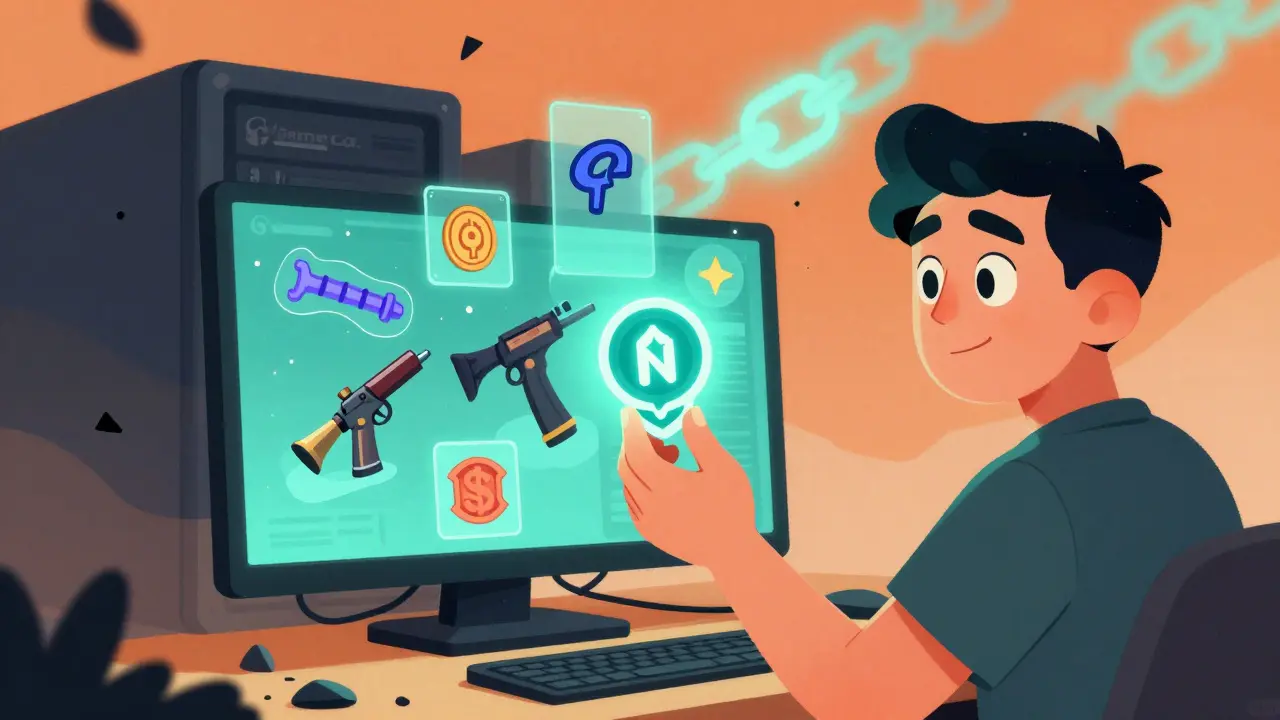
For decades, if you bought a skin, weapon, or character in a video game, you didn’t own it. You just rented it. The game company could delete it, ban you from using it, or shut down the whole server-and your $200 collection of rare items? Gone. No refund. No recourse. That’s the reality of traditional gaming. But NFTs changed the rules. Not completely. Not perfectly. But enough to make players ask: What if I actually owned my stuff?
What NFTs Actually Do in Games
An NFT isn’t the item itself. It’s a digital certificate tied to a blockchain-usually Ethereum, Solana, or Cardano-that proves you own a specific thing in a game. Think of it like a deed to a house. The house is still there, but the deed says who owns it. Same with NFTs. The actual skin or sword might be stored on IPFS (a decentralized file system), but the NFT on the blockchain is your proof you bought it, and no one else can claim it.
Unlike Bitcoin or Ethereum, which are interchangeable (one BTC is the same as another), NFTs are unique. Each has a different ID, metadata, and history. That’s why you can have a one-of-a-kind dragon skin that no one else in the world has. And because it’s on a public ledger, anyone can check: Who bought it? When? Who sold it last? That’s called provenance. It’s what makes NFTs different from Steam skins or Xbox achievements. Those live inside a company’s database. NFTs live on a network no single company controls.
The Promise: True Ownership
Marketers love to say NFTs give you “true ownership.” And for some players, that’s true-on the surface. You can sell your NFT on OpenSea or Blur. You can use it in another game if the developer allows it. You can even lend it out or rent it. That’s something you could never do with a Steam item. And that’s powerful.
Take Axie Infinity. In 2021, thousands of players in the Philippines earned more than $1,000 a month playing the game. They didn’t just play-they built businesses. They bought Axies (NFT creatures), bred them, and sold the offspring. They rented Axies to others who couldn’t afford to buy. This wasn’t a side hustle. It was a livelihood. That’s the dream NFTs sold: you’re not just a customer. You’re a stakeholder.
The Reality: You Don’t Own the Asset
But here’s the catch. Owning the NFT doesn’t mean you own the copyright. It doesn’t mean you can print the skin on a T-shirt and sell it. It doesn’t mean you can modify the code or redistribute the art. The game developer still holds the intellectual property. All you own is the token that says, “This person bought this item.”
Legal experts call this a “license,” not ownership. In 2022, the U.S. updated its Uniform Commercial Code to classify NFTs as “controllable electronic records.” That sounds official. But it doesn’t change the fact that the rights you get depend entirely on the game’s terms of service. One studio might let you trade your NFT freely. Another might lock it to their game only. And if the studio goes under? Good luck getting your item to work anywhere else.
There are real stories. In January 2024, a player lost $8,250 in ETH when the studio behind their NFT game shut down. The NFT still existed on the blockchain. But the game? Dead. The item? Useless. The token was real. The value? Gone.
Why Interoperability Still Doesn’t Work
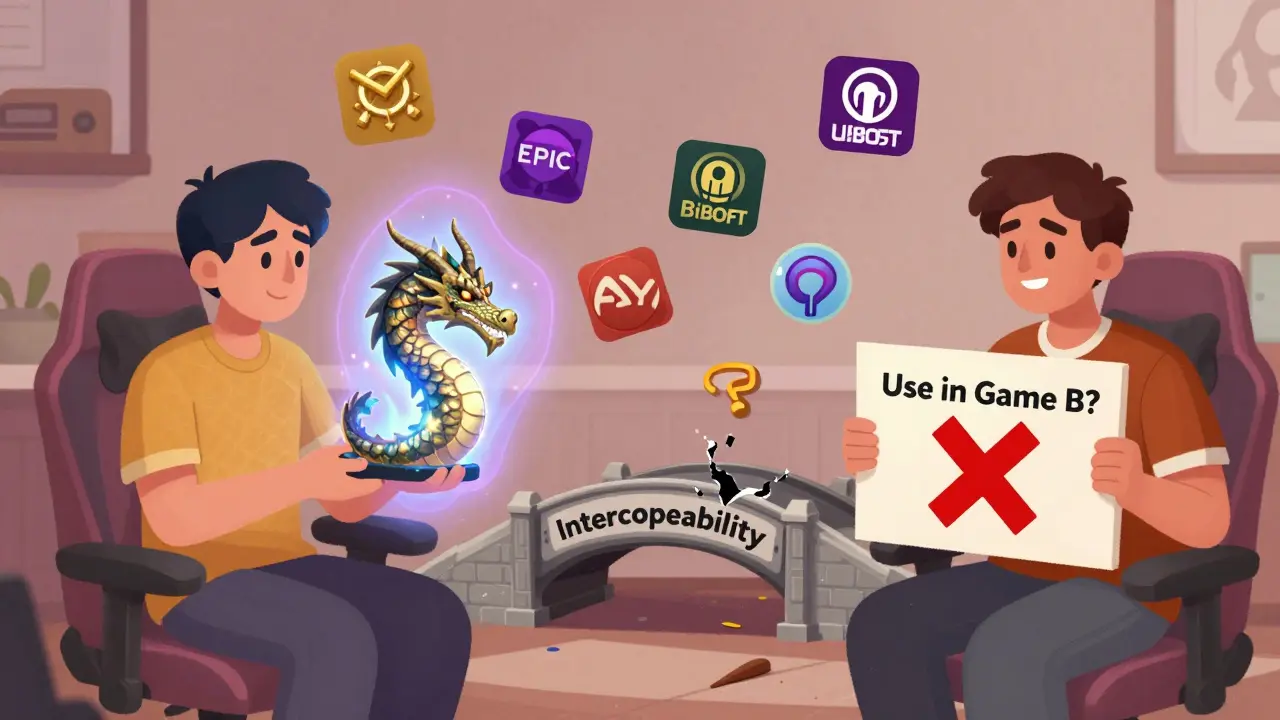
One of the biggest promises of NFT gaming was cross-game use. Imagine buying a sword in Game A and using it in Game B. Sounds cool, right? But in practice, it’s almost nonexistent.
Why? Because every game uses different tech. Different blockchains. Different metadata formats. Different rules. Even if two games use Ethereum, they don’t agree on how to read each other’s NFTs. Enjin and other platforms are trying to fix this with standardized protocols like Efinity, but adoption is slow. Most NFT games are still walled gardens-just with blockchain bricks instead of corporate ones.
And then there’s performance. Ethereum can take 15 to 30 seconds to confirm a transaction. During a big sale or event, gas fees spike to over $50. Solana is faster-thousands of transactions per second-but it’s had outages. Players don’t care about the tech. They just want to buy a skin without waiting 10 minutes or paying a month’s rent in fees.
Market Collapse and Regulatory Pushback
The NFT gaming boom of 2021-2022 didn’t last. By 2023, trading volume dropped 62.3%. The market shrank from $1.24 billion in January 2022 to $467 million by December 2023. Why? Because most games were built on hype, not fun. Players didn’t stick around if the gameplay was bad. And when crypto prices crashed, so did demand.
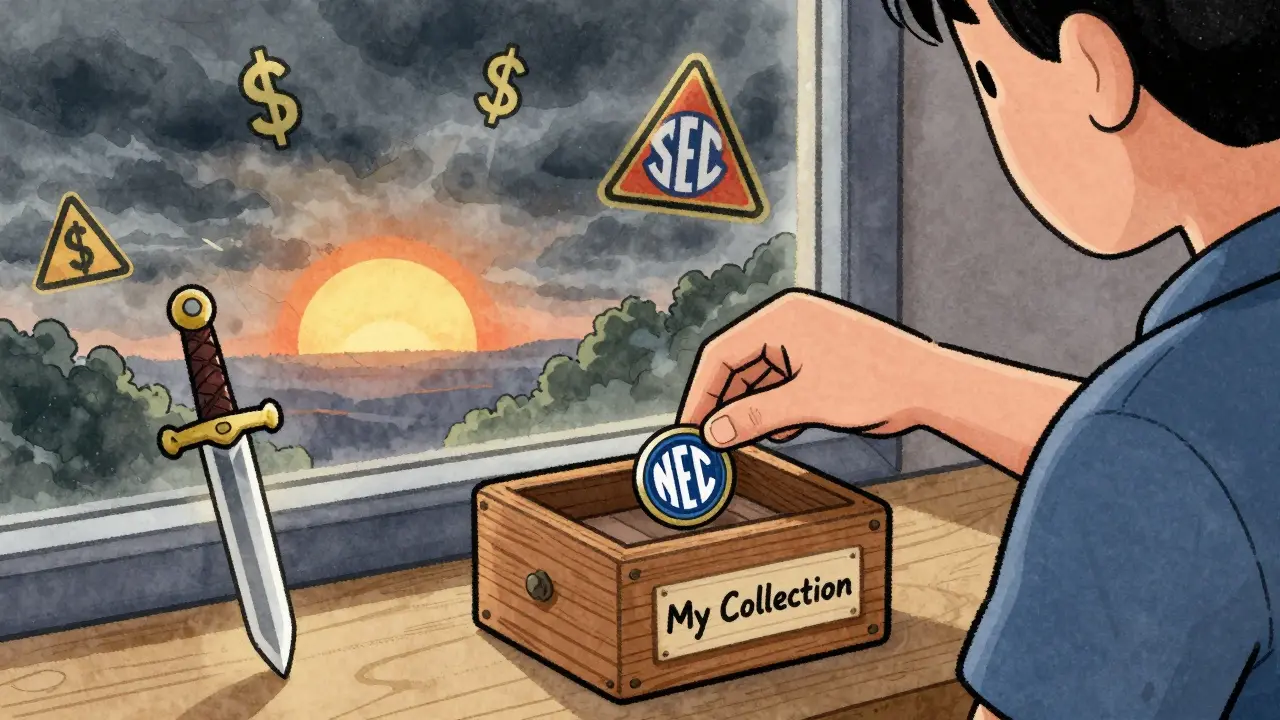
Regulators are stepping in. In February 2024, the U.S. SEC sued Impact Theory for selling unregistered securities through their “Heroes of Mavia” NFTs. The argument? If players expect profits from their NFTs, it’s an investment-not a game item. That’s a big deal. It means NFT games could soon be treated like stocks.
In Europe, MiCA regulations set to launch in June 2024 will force NFT issuers to disclose what rights come with each token. That’s a step toward transparency. But it also means many shady projects will vanish.
Big Players Are Changing Their Minds
Remember when Ubisoft launched Quartz and got hammered by fans? They shut it down in 2022 after 87% negative reviews. Epic Games called NFTs “evil” in 2022. But by January 2024, they reversed course and integrated with ApeChain. Why? Because players kept asking for it. And because the tech improved.
Even Square Enix got in early, selling $1.5 million in NFT assets for “Sands of Destruction” in 2021. But they didn’t make the same mistakes as Axie Infinity. They kept control. They didn’t let players trade items freely. They offered limited-edition cosmetics. No play-to-earn. Just collectibles.
The lesson? NFTs aren’t dead. But the wild-west approach is. The future belongs to games that use NFTs for cosmetic upgrades, limited drops, or verified rarity-not for financial speculation.
What Players Actually Need to Know
If you’re thinking about buying a gaming NFT, here’s what you need to do:
- Read the terms. Not the marketing. The actual legal terms. What rights do you get? Can you resell? Can you use it outside the game?
- Check the wallet. Is the NFT on Ethereum? Solana? Is the blockchain stable? Has it had recent outages?
- Know the fees. Gas fees on Ethereum can kill your profit. Solana is cheaper, but less proven.
- Don’t invest more than you’re willing to lose. If the game dies, your NFT becomes a digital paperweight.
- Look for utility. Does the NFT unlock something cool? Or is it just a JPEG with a blockchain stamp?
Most new users spend 3 to 5 hours learning the basics before buying their first NFT. That’s not a bug-it’s a feature. If it’s too easy, you’re probably being scammed.
The Future: Controlled Ownership
The most promising NFT games aren’t trying to give you full control. They’re giving you *just enough*. A rare skin you can show off. A badge that proves you were there from day one. A weapon that only 100 players in the world have. That’s valuable-not because it’s worth money, but because it’s meaningful.
Blockchain isn’t about replacing publishers. It’s about giving players a seat at the table. Not as investors. As participants. As collectors. As fans.
Right now, NFT gaming is in its awkward teen years. It’s loud, messy, and full of bad ideas. But it’s also learning. The companies that survive won’t be the ones shouting “OWN IT ALL!” They’ll be the ones quietly building games where NFTs enhance the experience-not hijack it.
True ownership isn’t about selling your skin for profit. It’s about knowing that no one can take it away from you. That’s the real win.
Do I really own my NFT game items?
You own the token on the blockchain, not the item itself. The game developer still holds the copyright and can change the rules. Your rights are defined by their terms of service-not by the NFT.
Can I use my NFT in other games?
Almost never. Most NFTs are locked to the game they were created for. A few platforms like Enjin are building cross-game standards, but adoption is still very limited. Don’t count on it.
Are NFT games worth the money?
Only if you’re buying for fun, not profit. Most NFT games have crashed in value. If you’re hoping to make money, you’re likely to lose it. But if you love the game and want a rare item you can keep forever? Then yes-if you understand the risks.
What happens if the game shuts down?
Your NFT still exists on the blockchain-but the item becomes useless. Without the game server, you can’t equip it, use it, or display it. It’s like owning a key to a building that no longer exists.
Why are gas fees so high for NFT games?
Gas fees are payments to miners or validators who process transactions on the blockchain. On Ethereum, fees spike during high demand and can hit $50+. Solana is cheaper and faster, but less reliable. Always check fees before buying.
Is NFT gaming legal?
It’s legal to own NFTs, but regulators are cracking down on games that promise financial returns. If a game lets you earn money through gameplay and trading, it may be classified as a security-making it illegal without proper licensing.
Should I buy NFTs if I’m new to crypto?
Wait. Learn. Most new users need 3-5 hours to understand wallets, gas fees, and smart contracts. Jumping in without knowledge is how people lose money. Start by reading official docs, not Reddit hype.
Game asset ownership isn’t broken-it was never real to begin with. NFTs don’t fix everything. But they do give players something they’ve never had: a chance to keep what they earn. Not because a company lets them. But because the system says so.