
Imagine needing to send money home or save your life's earnings from inflation, but your bank refuses to process the transaction because of government restrictions. For millions of people living in nations with strict financial controls, this is daily reality. Whether it is due to capital controls, outright bans on digital assets, or sanctions, traditional banking channels are often closed off. Yet, the desire for financial freedom persists. This drives citizens in these regions to develop sophisticated, sometimes risky, methods to access cryptocurrency exchanges and global markets.
The landscape of crypto accessibility has shifted dramatically since 2023. With major centralized platforms tightening their compliance rules and governments deploying advanced blockchain surveillance tools, the old ways of simply signing up for an international exchange no longer work for everyone. Today, users rely on a mix of peer-to-peer networks, decentralized protocols, and privacy-enhancing technologies to navigate these barriers. Understanding these methods is crucial not just for accessing funds, but for doing so without losing everything to scams or frozen accounts.
The Current Landscape of Restrictions
To understand how people get around bans, we first need to look at where those bans exist. As of mid-2026, the regulatory environment remains fragmented. Nine countries have implemented complete prohibitions on Bitcoin and other cryptocurrencies: Afghanistan, Algeria, Bangladesh, China, Egypt, Kuwait, Nepal, and North Macedonia. In places like Algeria, using crypto can lead to prison sentences under Anti-Money Laundering laws. In Bangladesh, trading is classified as illegal under the Money Laundering Prevention Act.
Other nations enforce severe restrictions rather than total bans. Turkey banned cryptocurrencies for payments after significant lira depreciation, while Vietnam imposes heavy fines ranging from $6,500 to $8,800 for crypto use. Despite these harsh penalties, adoption does not disappear; it goes underground. According to the Chainalysis Global Adoption Index 2025, Nigeria ranks fourth globally in grassroots crypto adoption, even though its Central Bank has maintained a ban on financial institutions facilitating crypto transactions since 2017. Vietnam follows closely at seventh place, with over 5 million users representing more than 5% of the population.
| Country | Restriction Type | Key Enforcement Mechanism | Adoption Resilience |
|---|---|---|---|
| China | Total Ban | Ban on mining & institutional handling | High (via P2P & DEXs) |
| Nigeria | Banking Ban | Penalties for banks processing crypto | Very High (Global Rank #4) |
| Vietnam | Severe Restrictions | Fines up to $8,800 | High (Global Rank #7) |
| Turkey | Payment Ban | Crypto cannot be used for goods/services | Moderate |
| India | Tax Heavy | 30% flat tax + 1% TDS | High (via intermediaries) |
Peer-to-Peer (P2P) Trading: The Primary Workaround
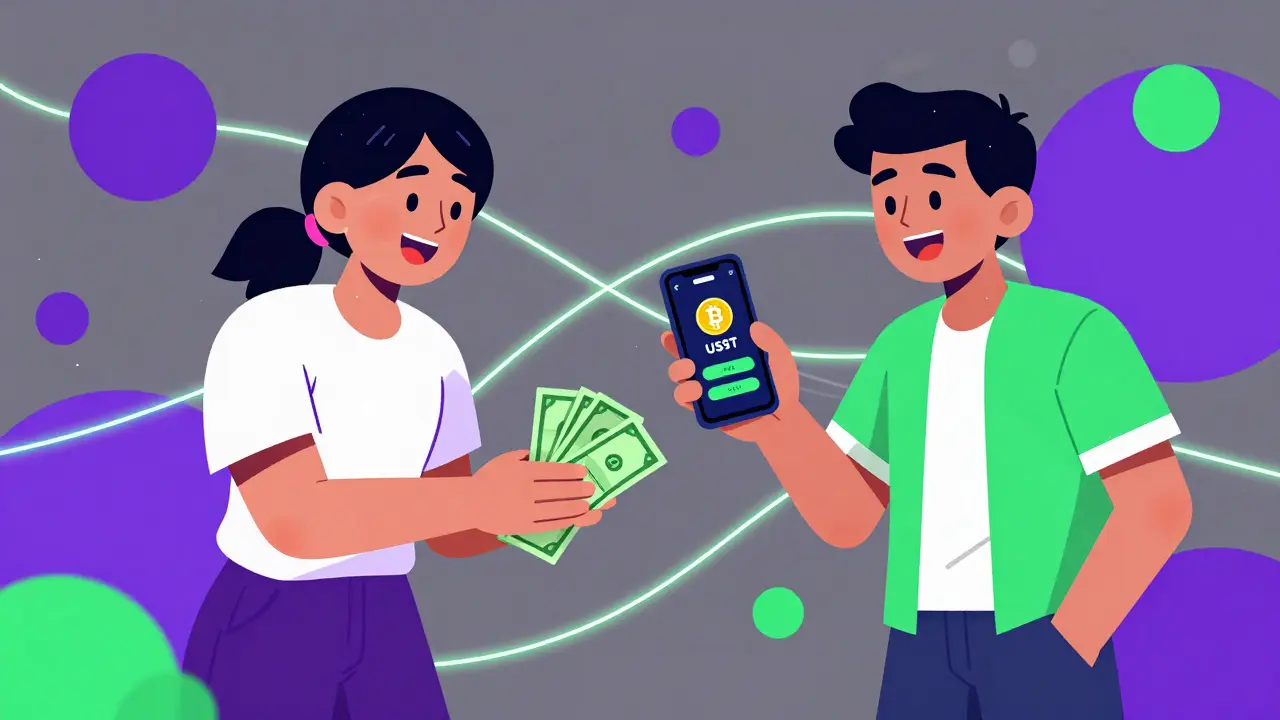
When direct bank transfers to exchanges are blocked, Peer-to-Peer (P2P) trading becomes the lifeline for most users. Platforms like Binance P2P and Paxful allow individuals to trade directly with each other. Instead of sending money to the exchange, you send local currency to another user’s bank account, and they release the crypto from escrow.
This method accounts for nearly 39% of all crypto transactions originating from restricted countries. In Q1 2025 alone, Binance P2P processed $8.7 billion in volume from these regions. For a Vietnamese user, this might mean transferring Dong to a trusted middleman via a local app like MoMo or ZaloPay, while receiving USDT in return. However, this convenience comes with risks. Users often pay a premium of 2-5% above the market rate to facilitate these trades. Additionally, there is always the risk of fraud if the counterparty refuses to release funds or if the platform freezes the account due to suspicious activity linked to local phone numbers.
Decentralized Exchanges (DEXs) and No-KYC Options
For those seeking greater anonymity, Decentralized Exchanges (DEXs) offer a solution that bypasses central authorities entirely. Unlike centralized exchanges, DEXs do not hold your funds or require identity verification (KYC). You connect your personal wallet, such as MetaMask or Trust Wallet, and trade directly on the blockchain.
Popular options include Uniswap, PancakeSwap, and non-custodial order book exchanges like Bisq and Hodl Hodl. A 2025 analysis identified 20 exchanges operating without mandatory KYC. While these platforms provide superior privacy, they suffer from lower liquidity. Bisq, for instance, averages only $1.2 million in daily trading volume compared to billions on centralized giants. This means larger trades may experience significant slippage, costing the user more money. Furthermore, navigating DEXs requires a higher level of technical literacy. Managing seed phrases and understanding gas fees is essential, yet 78% of new users in restricted countries report needing assistance with basic wallet security.
Technical Evasion: VPNs and Privacy Networks
Accessing these platforms often requires hiding your geographic location. Internet Service Providers (ISPs) in many restricted countries actively block known crypto domains. To circumvent this, users rely heavily on Virtual Private Networks (VPNs) and anonymity networks.
Data shows a massive surge in usage. NordVPN reported a 217% increase in users from China and a 342% increase from Nigeria between late 2023 and late 2024. The Tor browser has seen similar growth, with adoption rising 189% in Iran and 223% in North Korea. While effective, relying solely on a free or low-quality VPN can be dangerous. Many free services log user data and sell it to advertisers or, worse, authorities. Experts recommend paid, no-log providers like ExpressVPN or NordVPN, though even these can be detected by sophisticated state-level firewalls. Some users combine multiple layers, routing traffic through Tor before connecting to a VPN, though this significantly slows down connection speeds.
Alternative Payment Methods: Gift Cards and Hawala
When banks are completely off-limits, creative payment methods emerge. One popular strategy is gift card arbitrage. Users purchase Steam, iTunes, or Amazon gift cards with local currency and then trade them for cryptocurrency on platforms like Paxful. In 2024, Chainalysis documented $427 million in crypto transactions derived from gift card trades in restricted jurisdictions.
In the Middle East and parts of Africa, traditional informal value transfer systems known as Hawala have been adapted for crypto. These networks rely on trust and reputation rather than formal banking rails. Users convert fiat to crypto through Dubai-based services compliant with the UAE’s Virtual Asset Regulatory Authority (VARA). Between July 2023 and June 2024, these VARA-compliant hubs processed over $30 billion in transactions, effectively acting as bridges for users in neighboring restricted countries. While efficient, Hawala networks operate in a legal gray area and carry inherent counterparty risks if the broker defaults.

Risks and Security Challenges
The path to accessing crypto in restricted environments is fraught with danger. It is not just about government crackdowns; it is also about predatory actors who target vulnerable users. Professor David Yermack of NYU Stern warned in April 2025 that 67% of users in restricted countries reported at least one security incident. Of those, 12% lost significant funds to scams specifically targeting no-KYC exchange users.
Common pitfalls include:
- Phishing Sites: Fake versions of popular exchanges designed to steal login credentials.
- P2P Scams: Counterparties providing fake proof of payment or chargeback fraud.
- Platform Collapses: Unregulated platforms shutting down overnight, leaving users with inaccessible funds. The IMF noted $217 million in losses in Nigeria alone in 2024 due to platform failures.
- Account Freezes: Even when using allowed methods, exchanges may freeze accounts if they detect links to sanctioned entities or high-risk jurisdictions.
Community-driven resources have tried to mitigate these risks. Telegram channels like 'Crypto Without Borders,' which grew to 147,000 members in 2024, provide country-specific guides and scam alerts. However, support infrastructure remains thin. Only 37% of no-KYC exchanges offer multilingual customer service, with average response times exceeding 58 hours for non-English queries.
Step-by-Step Guide for Secure Access
If you find yourself in a restricted environment, establishing a secure access route takes time-typically 3 to 5 weeks according to recent guides. Here is a recommended approach:
- Secure Your Connection: Subscribe to a reputable, paid VPN service. Avoid free apps. Configure it to kill internet access if the connection drops.
- Create a Non-Custodial Wallet: Download a trusted wallet like Trust Wallet or Exodus. Write down your seed phrase on paper and store it securely. Never share it.
- Acquire Initial Crypto: Use a P2P platform or gift card exchange to buy a small amount of stablecoins (like USDT) or Bitcoin. Start with small amounts to test the process.
- Transfer to a DEX: Move funds to a decentralized exchange if you need to swap tokens without KYC. Ensure you are on the correct blockchain network to avoid losing funds.
- Use Privacy Tools: Consider using privacy-focused coins like Monero (XMR) if anonymity is paramount, though note that their market cap is small and liquidity is lower.
- Establish Recurring Methods: Once a reliable trader or method is found, stick to it. Changing methods frequently increases exposure to risk.
Future Outlook: The Regulatory Arms Race
The battle between regulators and users is intensifying. Governments are investing in blockchain analytics firms to trace illicit flows. In February 2025, the U.S. FinCEN proposed rules requiring KYC for transactions over $300, which could disrupt access methods for users relying on U.S.-connected infrastructure. Simultaneously, exchanges are pulling back. OKX announced expanded restrictions in January 2025 affecting over twenty countries, citing compliance with international sanctions.
However, this pressure drives innovation. Following OKX’s restrictions, Uniswap v4 saw a 187% increase in users from restricted countries. Analysts predict that zero-knowledge proof implementations will grow by 340% in these markets by 2026, enabling more secure and private transactions. While the current methods are imperfect and risky, the demand for financial sovereignty ensures that new solutions will continue to emerge. Users must remain vigilant, educated, and adaptable to survive in this evolving landscape.
Is it illegal to use crypto in my country?
It depends on your specific jurisdiction. In countries like China and Algeria, possession and trading can lead to criminal charges. In others like Nigeria or Vietnam, it may be restricted for businesses but tolerated for individuals, albeit with heavy fines. Always consult local legal experts, as laws change frequently.
What is the safest way to buy crypto without a bank account?
Peer-to-Peer (P2P) platforms are generally the most accessible. Look for traders with high completion rates and long histories. Alternatively, buying gift cards locally and exchanging them on platforms like Paxful is a common workaround, though it carries higher scam risks.
Can I use a VPN to access Binance or Coinbase?
Technically, yes, but it violates the terms of service of most centralized exchanges. If detected, they may freeze your account and confiscate your funds. Using a VPN is safer with decentralized exchanges (DEXs) that do not track user identities.
Are decentralized exchanges (DEXs) truly anonymous?
They are pseudonymous. While you don't provide ID, all transactions are recorded on the public blockchain. If your wallet address is ever linked to your real identity (e.g., through a mistake in a P2P trade), your entire history can be traced. Using privacy coins or mixing services can enhance anonymity but adds complexity.
Why do P2P trades cost more than market price?
The premium compensates the seller for the risk of dealing with restricted currencies, potential bank freezes, and the effort of managing manual transfers. In high-inflation countries, sellers also demand a buffer against rapid currency devaluation during the transaction window.