
China doesn’t just ban cryptocurrency-it makes sure you can’t even pay for it. Since 2021, the government has outlawed all crypto trading, mining, and payments. But the real enforcement doesn’t come from police raids or court orders. It comes from your phone. If you try to send money to a crypto exchange using Alipay or WeChat Pay, the transaction gets blocked before it even leaves your screen. These two apps aren’t just payment tools-they’re the frontline of China’s digital financial control.
How the Ban Works in Practice
Alipay, run by Ant Group, and WeChat Pay, owned by Tencent, together handle over 90% of all digital payments in China. That kind of dominance means regulators don’t need to monitor every bank account. They just need to control these two platforms. The People’s Bank of China (PBOC), along with the National Administration of Financial Regulation (NAFR) and other agencies, issued clear orders: block any transaction linked to cryptocurrency.What does that look like? If you type in a wallet address, scan a QR code from a crypto OTC seller, or even try to pay for a mining rig, the system catches it. The platforms use automated monitoring tools that flag keywords, known exchange domains, and unusual spending patterns. A transaction to a service like Binance or OKX? Rejected. A payment to a seller advertising "Bitcoin in cash"? Blocked. The system doesn’t wait for a report-it acts instantly.
Users who try to bypass this often get flagged. Accounts get temporarily frozen. Some users report being asked to submit documents proving their transaction wasn’t crypto-related. Others get locked out entirely. The message is clear: if you’re using Alipay or WeChat Pay, you’re not allowed to touch crypto-not even indirectly.
Why These Platforms Are So Effective
Unlike banks, which only see account-to-account transfers, Alipay and WeChat Pay track everything: who you pay, how often, how much, and even what you type into the search bar. They combine payment data with user behavior. If someone suddenly starts sending small payments to 15 different contacts every week, the system raises a red flag. It’s not just about the money-it’s about patterns.These platforms also work hand-in-hand with state-owned banks. When a payment is blocked, the bank behind it gets notified. That creates a double layer: the app stops the transaction, and the bank confirms it’s not just a glitch. This coordination makes it nearly impossible to slip through the cracks using domestic channels.
Even foreign crypto services can’t easily reach Chinese users. If a U.S.-based exchange tries to set up a payment link for Chinese customers, Alipay and WeChat Pay will refuse to process it. They don’t need to block every website-they just need to cut off the payment lifeline.
The WeChat Pay Loophole (and Why It’s Still a Problem)
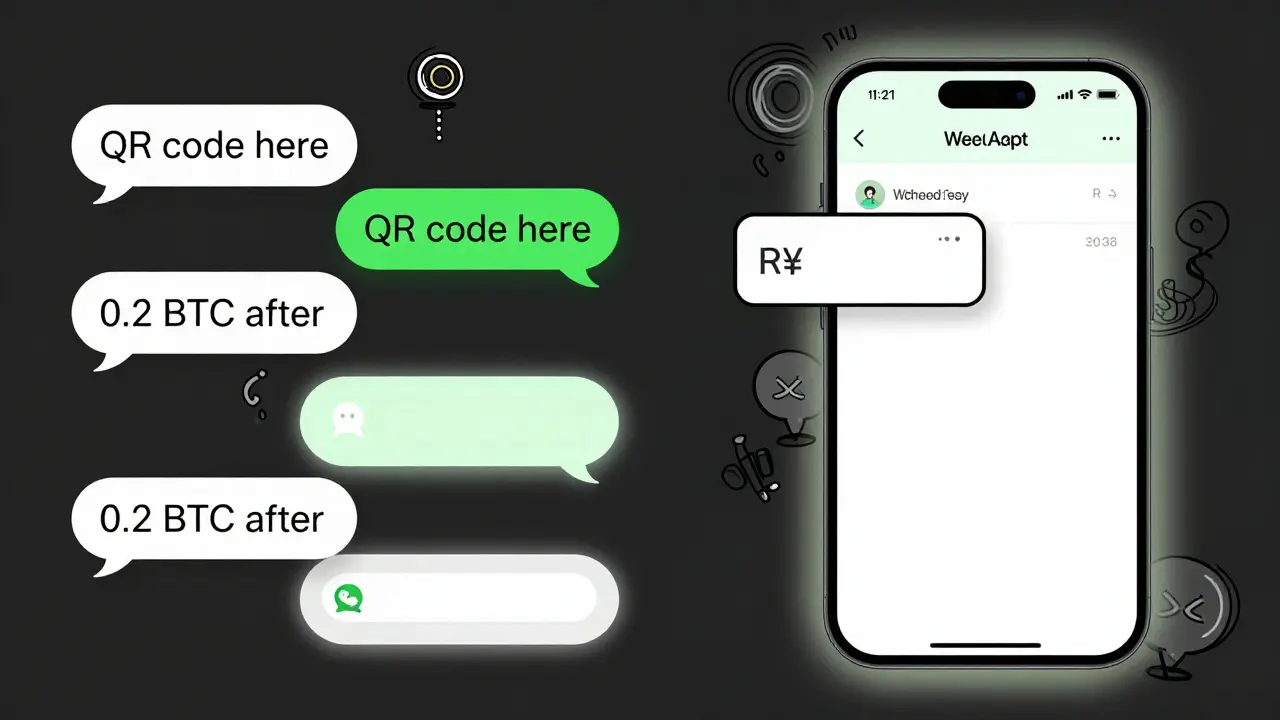
WeChat Pay has a hidden weakness: it’s not just a payment app. It’s also China’s most popular messaging platform. Over 1.3 billion people use WeChat to chat, share photos, and send voice messages. And that’s where the ban starts to fray.Criminals and crypto traders aren’t using WeChat Pay to send Bitcoin. They’re using WeChat chat to coordinate it. Someone might message: "Send 5000 RMB to this QR code. I’ll send you 0.2 BTC after." The payment goes through WeChat Pay as a normal transfer. The crypto part happens outside the app-on a decentralized exchange, a Telegram group, or a peer-to-peer site. The system sees a payment to a friend. It doesn’t see the deal behind it.
Because WeChat’s messages are end-to-end encrypted, regulators can’t read them. Even if they wanted to, Tencent won’t share chat logs with foreign authorities. This creates a blind spot. Law enforcement can see the money moved-but not why. Experts call this "off-chain coordination," and it’s the biggest challenge to China’s crypto ban today.
Some OTC traders have turned this into a business. They post in WeChat groups: "Cash for BTC. Fast. No questions." Buyers send money via WeChat Pay. Sellers transfer crypto via a non-Chinese wallet. The payment is legal. The crypto? Not. But unless someone reports the group, there’s no way for authorities to catch it.
How This Compares to Other Countries
China’s approach is unique. In Singapore, you can legally trade Bitcoin on licensed platforms. Hong Kong lets you buy crypto through regulated apps like HashKey. Even Thailand has clear rules for crypto exchanges. But in mainland China, there’s no middle ground. No licenses. No exceptions. No retail crypto payments. Not even stablecoins-except for government-controlled pilot programs.The contrast is stark. While other countries try to regulate crypto, China is trying to erase it from daily life. Alipay and WeChat Pay aren’t just payment apps here-they’re surveillance tools. Their job isn’t to help you use crypto. It’s to make sure you can’t.
What About the e-CNY?
China isn’t against digital money. It’s against private digital money. That’s why it’s rolling out its own: the e-CNY, or digital yuan. This isn’t blockchain-based. It’s not decentralized. It’s controlled entirely by the People’s Bank of China. And guess who’s helping distribute it? Alipay and WeChat Pay.These platforms are now the main way people receive and spend e-CNY. The government wants you to use its digital currency-not Bitcoin, not Ethereum, not even USDT. The ban on crypto isn’t just about fear. It’s about control. The e-CNY lets the state track every transaction, set spending limits, and even freeze funds remotely. Crypto? No. State-controlled digital cash? Yes.
That’s the real goal: replace private digital assets with a government version that can’t be challenged. And Alipay and WeChat Pay are the delivery system.

Is the Ban Working?
Officially, yes. Domestic crypto exchanges are gone. Mining farms have shut down. Public crypto ads vanished years ago. The number of Chinese users trading on domestic platforms is near zero.But underground, it’s still alive. OTC traders operate in WeChat groups. Some use VPNs to access foreign exchanges. Others rely on friends abroad to buy crypto for them. The risks are high-fines, account freezes, even criminal charges for "illegal fund transfers." But the demand hasn’t disappeared.
There’s also a growing gray zone: cross-border crypto. Some Chinese businesses use blockchain for international trade under state-approved programs like mBridge, which connects China, Hong Kong, Thailand, and the UAE. These are not crypto payments. They’re state-monitored digital ledgers. But they show China isn’t rejecting blockchain technology-it’s just refusing to let private actors use it.
What’s Next?
The ban isn’t going away. In fact, enforcement is getting smarter. Alipay and WeChat Pay are upgrading their monitoring tools to detect even subtle patterns-like repeated small payments to the same wallet, or sudden spikes in mobile wallet usage after midnight. They’re also working with the Ministry of Public Security to flag users who access crypto-related websites.Some analysts think China might soften its stance by 2027, especially as global crypto regulations evolve. But for now, the message is unchanged: if you want to use crypto in China, you’ll have to do it in the shadows. And if you use Alipay or WeChat Pay to do it, you’re asking for trouble.
Can I still buy Bitcoin using Alipay or WeChat Pay in China?
No. Any attempt to send money to a crypto exchange, OTC seller, or wallet address through Alipay or WeChat Pay will be automatically blocked. The system flags these transactions in real time. If you try to bypass it, your account may be frozen or reported to authorities.
Why doesn’t WeChat Pay block crypto messages?
WeChat’s messaging system is end-to-end encrypted, and Tencent does not share chat data with Chinese regulators or foreign governments. This means while payments can be monitored, conversations about crypto-like sharing wallet addresses or arranging trades-are invisible to enforcement tools. This creates a loophole criminals exploit.
Is using a VPN to access crypto exchanges illegal in China?
Yes. Using a VPN to bypass China’s internet restrictions is against state regulations. While enforcement against individuals is inconsistent, combining a VPN with crypto trading increases your risk of being flagged by multiple agencies, including the Cyberspace Administration of China and the Ministry of Public Security.
Can I use WeChat Pay to pay for goods if the seller accepts crypto?
If the seller asks you to pay in crypto, they’re breaking the law. But if you pay in RMB through WeChat Pay for a product that happens to be paid for in crypto elsewhere, the system won’t block it. The issue isn’t the product-it’s whether the payment itself is tied to crypto. As long as the transaction is in yuan and doesn’t go to a known crypto service, it’s technically allowed.
What happens if my Alipay account gets flagged for crypto activity?
You’ll likely receive a notification asking you to verify your transactions. If you can’t prove they weren’t crypto-related, your account may be frozen for 30-90 days. In severe cases-especially if large sums are involved-you could face legal action for "illegal fund transfer" or "money laundering," even if you didn’t buy crypto yourself.