
By early 2025, the Bitcoin network hit a milestone no one expected just five years ago: 1 Zetahash per second. That’s one sextillion calculations every second - more computational power than the entire global supercomputing industry combined. This isn’t science fiction. It’s the reality of Bitcoin’s proof-of-work security model, and it’s only getting stronger. But what happens next? Can this growth continue? And what does it mean for miners, investors, and the long-term health of the network?
Why Hash Rate Matters More Than You Think
Hash rate isn’t just a number on a chart. It’s the heartbeat of Bitcoin’s security. Every time a miner solves a cryptographic puzzle to add a new block, they’re using that computational power to defend the network against attacks. More hash rate means it’s harder - and more expensive - for anyone to try to rewrite history or double-spend coins. That’s why the network’s growth from 14 EH/s in early 2018 to over 929 EH/s by April 2025 isn’t just impressive - it’s essential.Think of it like a fortress. The more guards you have patrolling the walls, the harder it is for attackers to break in. Bitcoin’s hash rate is those guards. And right now, the number of guards is exploding.
How Projections Are Made - And Why They Diverge
There’s no single way to predict the future of Bitcoin’s hash rate. Different models use different assumptions, and that leads to wildly different outcomes.GoMining’s high-growth scenario uses a 52.5% compound annual growth rate (CAGR) based on data from 2018 onward. That’s the period when mining shifted from hobbyists with GPUs to massive industrial operations with custom ASIC chips. Under this model, the network could hit 6,891 EH/s by 2030. That’s more than seven times today’s level.
But not everyone agrees. Markntel Advisors’ 2025 report projects a much slower 14.19% CAGR for the broader cryptocurrency market, suggesting that Bitcoin’s hash rate growth might not outpace overall crypto adoption. CoinGeek’s analysis of the block reward mining market - which includes hardware, energy, and operational costs - forecasts a 12.90% CAGR through 2034. That’s a big clue: mining profitability may be slowing down, even if the network keeps growing.
The difference comes down to what you assume. If you believe Bitcoin’s price will hit $1.16 million by 2030 - as AInvest predicts - then even older ASICs like the 68 TH/s models will still be profitable at $5,000 per BTC. That means miners will keep running them, and new, more efficient machines will flood the market. But if energy costs spike, regulations tighten, or Bitcoin’s price stagnates, growth could stall.
The Role of Halvings and Price
Every four years, Bitcoin’s block reward cuts in half. The last one happened in 2024, reducing miners’ income from 6.25 BTC to 3.125 BTC per block. The next halving is scheduled for 2028. Historically, these events cause short-term hashrate drops as less efficient miners shut down. But they’ve also been followed by massive price rallies that bring those miners back - and then some.What’s different this time? The industry is far more professional. In 2020, about 67% of the network’s hash rate came from industrial-scale operations. By late 2025, that number jumped to 83%. These companies don’t shut down because of a temporary dip. They have access to capital, long-term contracts, and diversified energy sources. They’re built to ride out volatility.
That’s why many analysts now believe halvings won’t cause the same level of disruption. Instead, they’ll act as catalysts for consolidation - the weakest players get squeezed out, and the strongest ones expand. The result? A more resilient, more efficient network.
Hardware, Energy, and the Race for Efficiency
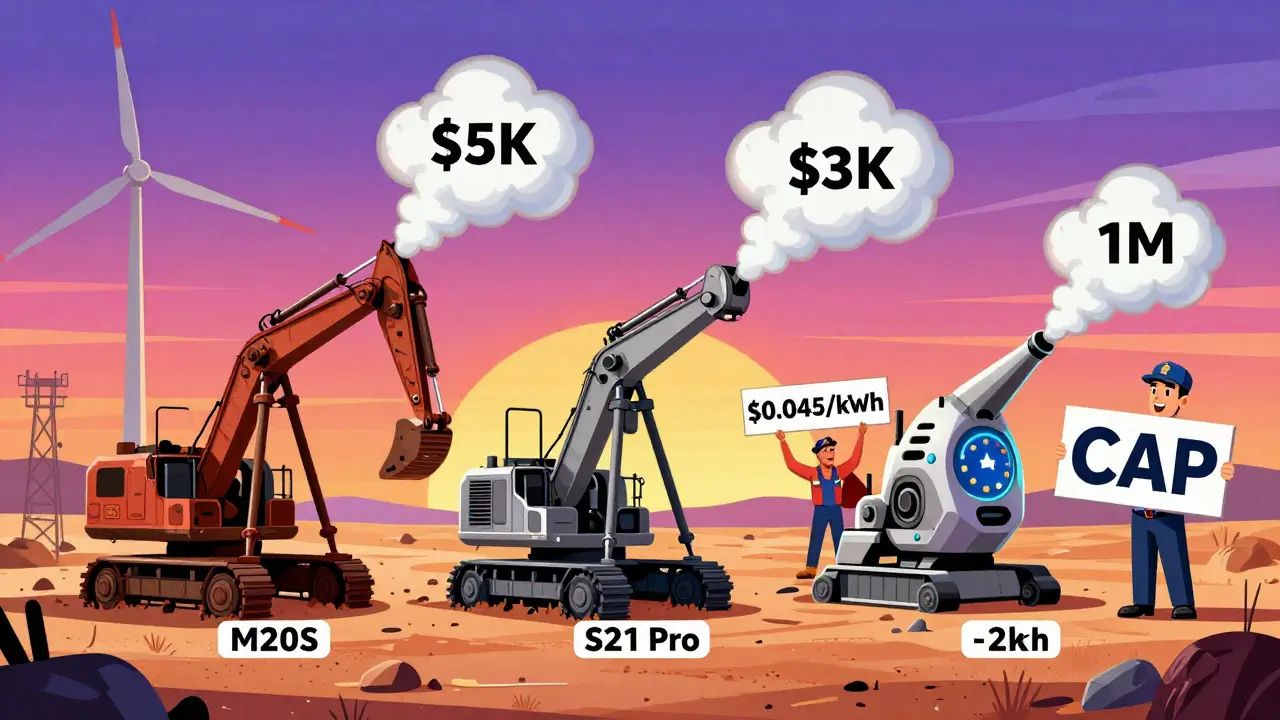
The hardware arms race is real. The WhatsMiner M20S, for example, delivers 68 TH/s while consuming between 2,000 and 20,000 watts. But newer models like the Antminer S21 and S21 Pro are pushing beyond 200 TH/s with better efficiency. The key metric? Turnoff price - the Bitcoin price below which mining becomes unprofitable. For older rigs, it’s around $5,000-$6,000. For the latest machines, it’s closer to $3,000.But hardware alone isn’t enough. Energy costs make up 40-60% of a miner’s expenses. That’s why the best mining operations aren’t in New York or Tokyo. They’re in Texas, where electricity costs $0.045/kWh, or Kazakhstan, where it’s just as cheap. HIVE Digital Technologies, which hit 22 EH/s in October 2025, built its entire strategy around low-cost, renewable energy. They now operate in Sweden, Canada, and the U.S. - all places with stable grids and access to hydro or wind power.
And here’s the twist: 56.1% of global Bitcoin mining now uses sustainable energy, according to the Bitcoin Mining Council’s Q3 2025 report. That’s not just good PR. It’s a strategic advantage. Renewable energy is cheaper, more reliable, and less vulnerable to political shifts than fossil fuels. It’s also becoming a requirement for institutional investors.
Regulation: The Wild Card
No projection can ignore regulation. China’s 2021 mining ban wiped out 40% of the network’s hash rate overnight. Within a year, it recovered - but not without scars. Miners scattered. Infrastructure was abandoned. Costs rose.Today, the biggest regulatory risks aren’t in China. They’re in the U.S. and Europe. Some states are considering bans or heavy taxes on mining. The EU is debating energy use caps. If regulatory costs rise by 150% - as AInvest warns - it could erase years of efficiency gains. That’s why some analysts are skeptical of the 52.5% CAGR projection. They argue that infrastructure can’t scale that fast when governments are watching.
On the flip side, countries like El Salvador and the United Arab Emirates are actively courting miners. They offer tax breaks, cheap power, and legal clarity. That’s where the next wave of growth will come from.

Three Possible Scenarios for 2030
Looking ahead, there are three realistic paths Bitcoin’s hash rate could take:- Conservative (35% CAGR): 2,543 EH/s by 2030. This assumes regulatory headwinds, slower price growth, and energy constraints. It’s the most cautious outlook.
- Base Case (45% CAGR): 4,128 EH/s. This reflects steady adoption, moderate price increases, and continued efficiency gains. Most industry insiders lean toward this.
- High Growth (52.5% CAGR): 6,891 EH/s. This requires Bitcoin to hit $1 million+, sustained innovation in ASICs, and minimal regulatory interference. It’s ambitious - but not impossible.
The difference between these scenarios isn’t just math. It’s about belief. Do you believe Bitcoin will become a global reserve asset? Do you think miners will keep investing billions into new hardware? Do you trust that renewable energy will solve the sustainability debate?
What’s Next? The Bigger Picture
The future of Bitcoin’s hash rate isn’t just about mining. It’s about infrastructure. Companies like HIVE Digital are turning old data centers into high-performance computing hubs - not just for Bitcoin, but for AI. Why? Because the same hardware that mines Bitcoin can also train machine learning models. The energy used to power ASICs can be sold back to the grid during off-peak hours. The heat from mining rigs can warm homes.This isn’t science fiction. It’s happening now. The line between Bitcoin mining and clean energy infrastructure is blurring. That’s the real story behind the numbers.
Quantum computing? MIT’s 2025 report says Bitcoin’s SHA-256 algorithm is safe until at least 2040. Supply chain disruptions? The world still needs semiconductors, and companies like Bitmain and Bitfury are already diversifying manufacturing. Geopolitical risks? They’re real - but so far, the network has shown it can adapt.
The hash rate isn’t just growing. It’s maturing. And that’s what makes the next decade so interesting.
What is the current Bitcoin hash rate as of 2025?
As of April 2025, the Bitcoin network’s 7-day moving average hash rate reached 929 EH/s, with the 1-day average briefly surpassing 1 ZH/s (1,000 EH/s). This represents the highest level of computational power ever recorded on the network.
Will Bitcoin’s hash rate continue to grow after the 2028 halving?
Yes, most experts believe it will. Unlike in past cycles, today’s mining industry is dominated by professional, well-capitalized operators who use long-term contracts, diversified energy sources, and efficient hardware. While some less efficient miners may shut down temporarily after the 2028 halving, the overall network is expected to recover quickly - especially if Bitcoin’s price rises as projected.
How do energy costs affect Bitcoin mining profitability?
Energy costs make up 40-60% of a miner’s total expenses. Miners in regions with electricity under $0.05/kWh - like Texas or Kazakhstan - have a major advantage over those in areas where rates exceed $0.12/kWh. A single percentage point increase in energy costs can turn a profitable operation into a losing one, especially with older ASIC models.
Can regulatory changes stop Bitcoin’s hash rate growth?
Regulations can slow growth, but they’ve never stopped it. China’s 2021 ban wiped out 40% of the network, yet the hash rate recovered within 12 months. Today, miners are relocating to jurisdictions with clear rules and low energy costs - like the U.S., Canada, and parts of Europe. The network’s resilience comes from its decentralized nature: as long as there’s demand for Bitcoin, miners will find a way to operate.
Is quantum computing a threat to Bitcoin’s hash rate?
Not anytime soon. According to MIT’s 2025 Quantum Computing Report, Bitcoin’s SHA-256 algorithm is expected to remain secure against quantum attacks until at least 2040. Even if quantum computers become viable, Bitcoin’s protocol can be upgraded with quantum-resistant cryptography - a change that would require consensus, not a network collapse.