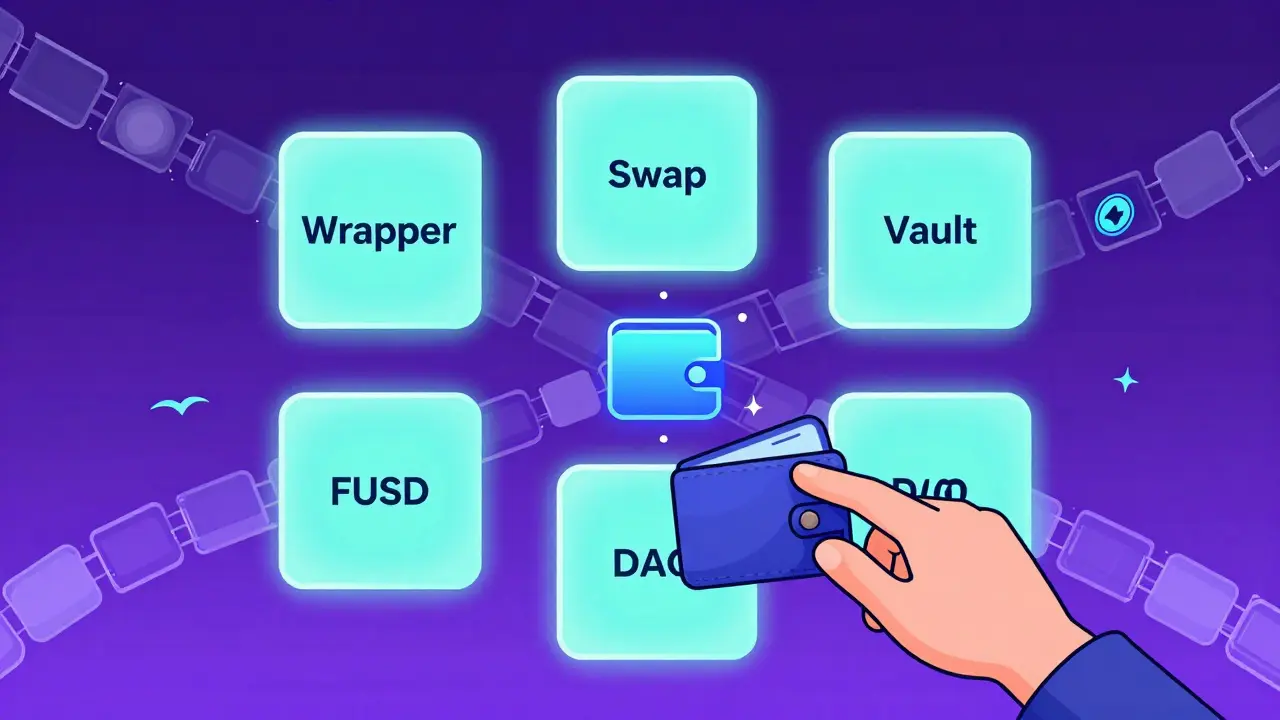
Flamingo Finance isn’t your typical crypto exchange. You won’t find a sign-up form, KYC checks, or customer support lines. Instead, it’s a DeFi platform that lets you swap tokens, stake liquidity, borrow, lend, and trade perpetual contracts-all from your wallet. If you’ve used Uniswap or Aave before, you’ll recognize the vibe. But Flamingo tries to do more. It bundles six DeFi tools into one interface and runs across multiple blockchains. That’s ambitious. But is it practical? Here’s what you need to know in 2026.
What Flamingo Finance Actually Does
Flamingo Finance started on the Neo blockchain in 2020. It wasn’t built to compete with Binance or Coinbase. It was built to combine what most DeFi protocols keep separate. Think of it as a Swiss Army knife for decentralized finance. Its six core modules are:
- Wrapper: Lets you wrap assets across chains (like turning ETH into wETH on Neo).
- Swap: An AMM-based exchange that lets you trade tokens without order books.
- Vault: Automatically farms yield across multiple protocols and tokens.
- Perp: Perpetual contracts for leveraged trading, up to 10x.
- FUSD: A synthetic stablecoin pegged to the US dollar, used for lending and borrowing.
- DAO: Governance powered by the FLM token.
You don’t need an account. Just connect your wallet-MetaMask, NeoLine, or any EVM-compatible one-and you’re in. No emails. No passwords. Just your private keys. That’s the whole point.
How FLM, the Native Token, Works
FLM is the heartbeat of Flamingo Finance. It’s not a utility token like ETH or SOL. It’s a governance token. Holders vote on:
- Which new assets to list
- How fees are distributed
- Changes to the FUSD stablecoin
- Protocol upgrades
As of March 2026, there are 558 million FLM tokens in total, with about 546 million circulating. The price hovers around $0.035 USD. That’s down from its all-time high of $0.1475 in 2024. Market cap sits at roughly $19 million. Compared to Uniswap’s $4 billion, it’s tiny. But size isn’t everything. The real question is: does FLM have value beyond voting?
Right now, not really. There’s no staking reward tied directly to holding FLM. No fee discounts. No buybacks. That’s a red flag for many. Users on Reddit and Trustpilot have called the token economics “vague” and “underdeveloped.” Without clear incentives, demand for FLM relies almost entirely on speculation.
Why Liquidity Fragmentation Is a Big Problem
Flamingo runs on Neo, zkSync, and a few other chains. That sounds cool-multi-chain access! But here’s the catch: liquidity is split.
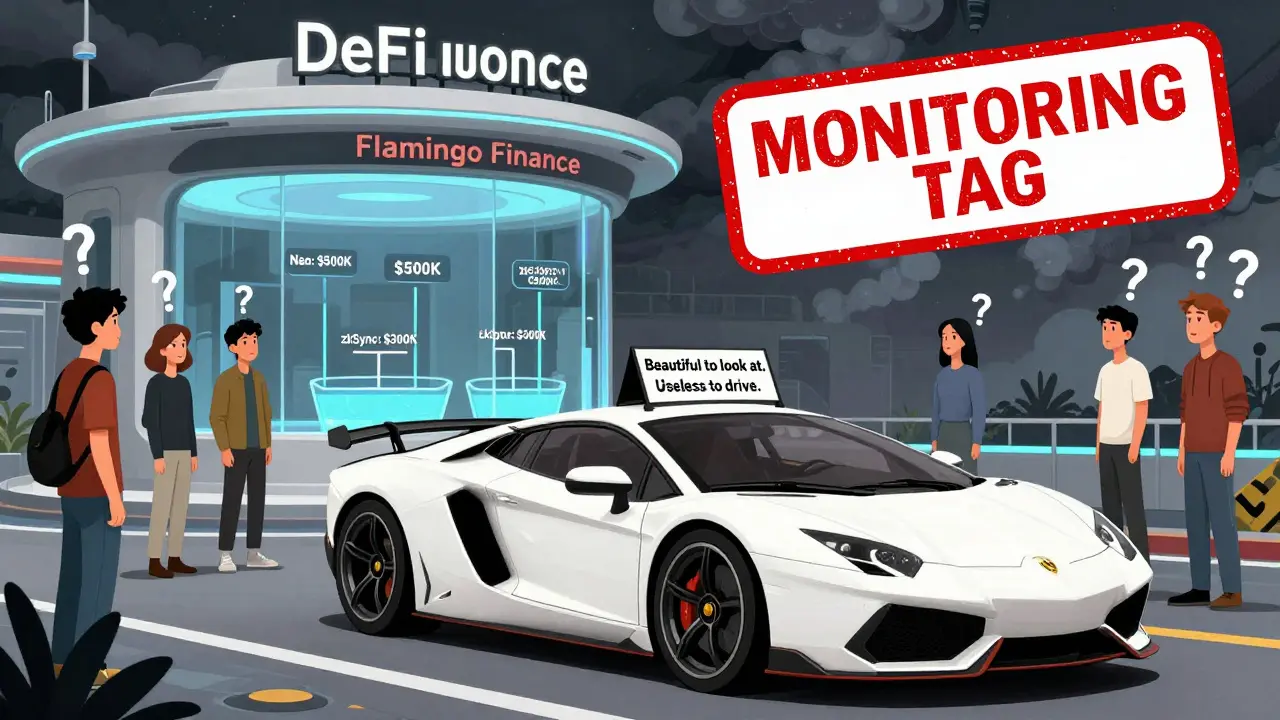
On Neo, you might find 500k in TVL (total value locked). On zkSync, another 300k. That’s nowhere near Ethereum’s $20 billion pools. The result? Slippage. Delayed trades. Low trading volume. The 24-hour volume on Flamingo is around $9 million-barely enough to handle large orders without price impact.
Compare that to THORChain ($420M TVL) or SushiSwap ($480M). Flamingo’s $23.5 million TVL across all chains puts it at #147 among DeFi protocols. Most users who trade more than $500 at a time end up switching to centralized exchanges-or worse, getting stuck with bad fills.
Even the reopening of the Neo N3 cross-chain bridge in May 2025 didn’t fix this. It helped users move assets, but didn’t bring in new liquidity. The problem isn’t tech. It’s adoption.
User Experience: Easy to Start, Hard to Master
Flamingo’s UI is clean. Clean enough that even someone who’s never used DeFi before can navigate it. First-time users report completing their first swap in 15-20 minutes. No onboarding forms. No waiting. Just connect, approve, swap.
But here’s where it gets messy. The vaults promise 15-20% APY. Some users get that. Others report 5% after gas fees. Why? Because yields change daily. The platform doesn’t guarantee returns. It just aggregates what’s available. If a lending pool on Aave drops, your vault yield drops too.
And then there’s FUSD. It’s supposed to be stable. But since it’s algorithmic-backed by collateral and supply adjustments-it’s not FDIC-insured like USDC. In volatile markets, it can deviate from $1. Users who borrowed FUSD during a price crash reported being liquidated unexpectedly.
The documentation on GitHub is detailed, but it assumes you already know what impermanent loss is, how AMMs work, and why gas fees vary across chains. It’s not beginner-friendly. It’s “DeFi intermediate” friendly.
The Binance Monitoring Tag: A Major Red Flag
In April 2025, Binance placed a “Monitoring Tag” on FLM. That means they’re reviewing it for potential delisting. No official reason was given. But in crypto, that tag is a death sentence for small tokens.
Why? Because Binance is the largest exchange. If FLM gets delisted, trading volume plummets. Liquidity evaporates. Price crashes. And the community panic sets in. Reddit threads from May 2025 show users saying things like, “I sold half my FLM after the tag.” “I’m not holding anything until it’s removed.”
As of March 2026, the tag is still active. No update. No clarification from Flamingo’s team. That’s silence. And silence in crypto is often worse than bad news.

Price Predictions: Bullish or Bearish?
Analysts can’t agree. CoinCodex predicts FLM will drop to $0.01957 by November 2026. That’s a 45% fall from current levels. Their model uses technical indicators, social sentiment, and market cycles-all pointing down.
But CoinLore says the opposite. They predict FLM could hit $0.1249 by year-end-a 250% surge. Their model factors in potential ecosystem growth, new chain integrations, and a possible FLM tokenomics overhaul.
Here’s the reality: no one knows. The market is split. Some traders are doubling down, betting on a comeback. Others are cutting losses. The highest price ever recorded was $0.1475. The lowest in 2025 was $0.018. That’s a 700% swing in under a year. Volatility like that isn’t a feature. It’s a warning.
Who Should Use Flamingo Finance?
Flamingo isn’t for everyone. Here’s who it’s for:
- DeFi veterans who want one dashboard for swaps, vaults, and perps.
- Neo blockchain users who need access to DeFi tools beyond just staking.
- Experimenters who don’t mind risk and want to test new protocols.
It’s NOT for:
- New crypto users who don’t understand wallets or gas fees.
- Large traders who need deep liquidity and tight spreads.
- Long-term holders who want stable tokenomics and clear incentives.
If you’re looking for a simple place to buy Bitcoin or swap ETH for USDT, use a centralized exchange. Flamingo is for people who want to control everything-and are willing to deal with the mess that comes with it.
What’s Next for Flamingo Finance?
Flamingo’s roadmap for late 2026 includes:
- Integration with 2-3 new EVM-compatible chains
- A complete revamp of FLM tokenomics (possibly introducing staking rewards)
- Improved cross-chain liquidity pools
- More transparency around FUSD collateralization
But none of that matters unless they fix the trust gap. The Binance tag is still there. The liquidity is still thin. The token still has no real utility beyond voting.
Right now, Flamingo Finance is a platform with great design and a confusing future. It’s like a luxury car with no fuel tank. Beautiful to look at. Useless to drive.
If they deliver on their roadmap, this could become a niche leader in multi-chain DeFi. If they don’t? It’ll fade into obscurity like dozens of other once-promising projects.
Is Flamingo Finance safe to use?
Flamingo Finance hasn’t been hacked, and its smart contracts didn’t get affected during the npm supply chain breaches in May 2025. That’s a good sign. But safety in DeFi isn’t just about code-it’s about liquidity, token stability, and team transparency. The Binance Monitoring Tag on FLM raises serious concerns. Use it only with funds you can afford to lose.
Can I stake FLM for rewards?
No, not directly. As of March 2026, holding FLM doesn’t earn you staking rewards. You can only use it to vote on governance proposals. Some users try to stake FLM in third-party DeFi protocols, but that adds risk and complexity. The team has hinted at adding staking in a tokenomics revamp, but there’s no timeline.
Why is Flamingo Finance’s trading volume so low?
Because liquidity is split across multiple chains-Neo, zkSync, and others-instead of concentrated on one high-volume network like Ethereum. Most users still trade on centralized exchanges for better prices and faster execution. Flamingo’s volume is under $10 million daily, while top DeFi platforms move billions.
Is FUSD really stable?
FUSD is designed to stay pegged to $1, but it’s algorithmic-not backed by cash reserves like USDC. That means it can temporarily deviate during market stress. In late 2025, FUSD dropped to $0.97 for over 48 hours. Users who borrowed FUSD got liquidated. It’s not as stable as centralized stablecoins.
Where can I buy FLM tokens?
FLM is listed on Binance, MEXC Global, Gate.io, OKX, and Bitget-all trading against USDT. You can’t buy it directly on Flamingo Finance. You need to purchase it on one of those exchanges first, then transfer it to your wallet to use on the platform.
Should I invest in Flamingo Finance?
Only if you’re comfortable with high risk. FLM is volatile, has low liquidity, lacks clear token utility, and carries a Binance monitoring tag. The platform has potential, but so far, it hasn’t delivered enough to justify holding FLM as an investment. Treat it like a speculative experiment, not a portfolio cornerstone.