
If you're running a crypto business or holding digital assets in the EU, ignoring sanctions compliance isn't an option anymore. As of December 30, 2024, the Markets in Crypto-Assets Regulation (MiCA) became fully enforceable across all 27 EU member states. This isn't a guideline. It's the law. And it comes with real penalties-fines, shutdowns, and being blacklisted from the entire EU market. No second chances. No grace periods for serious violations.
How MiCA Changes Everything for Crypto Businesses
Before MiCA, crypto companies in the EU operated in a patchwork of national rules. Some countries were strict. Others were loose. Now, there’s one rulebook. And it treats crypto firms like banks. That means you need a license to operate. Not just any license. One issued by your country’s financial authority and recognized across the entire EU. This is called the "passporting" system. Get approved in Germany? You can serve clients in Spain, Poland, or Lithuania without reapplying. But getting that license isn’t easy. You must prove you have:- Robust anti-money laundering (AML) controls
- Systems to trace every crypto transaction
- Staff trained to spot suspicious activity
- Clear policies against insider trading and market manipulation
The Transfer of Funds Regulation (TFR): No More Anonymous Transfers
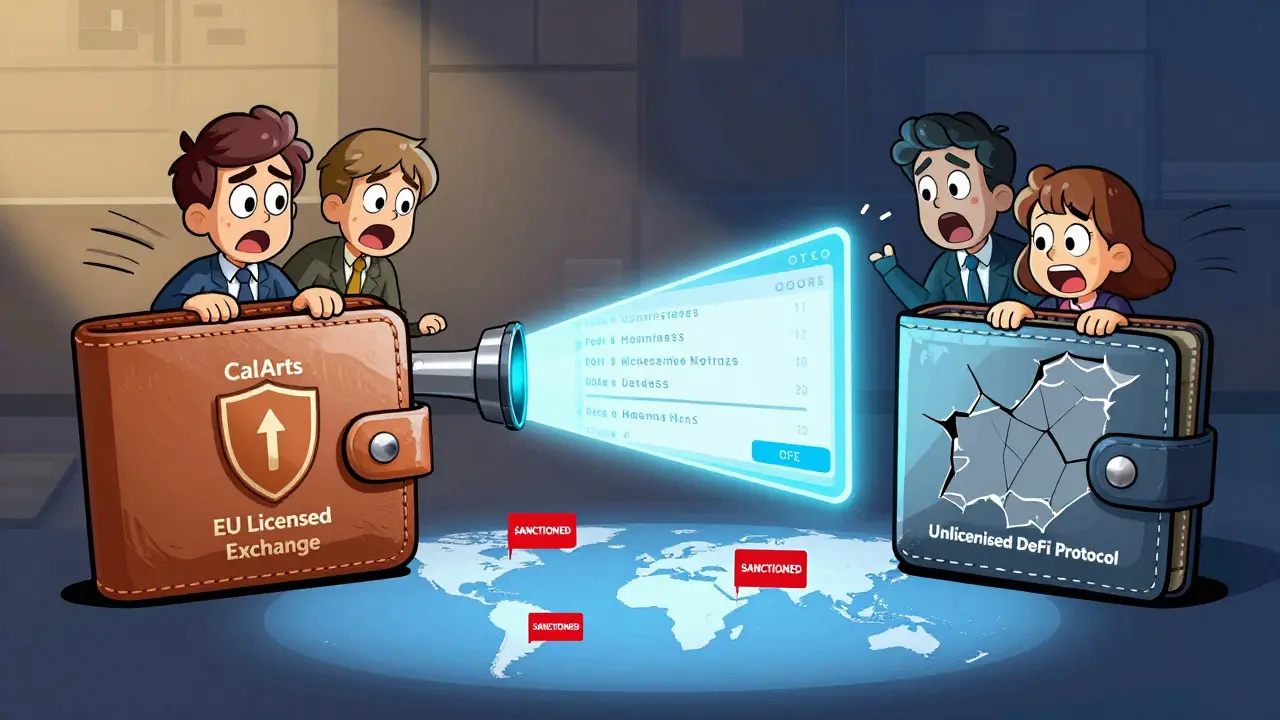
Here’s where things get real. The TFR, which kicked in on the same day as MiCA, kills the idea of private crypto transfers. If you send €1,000 or more in crypto, you must send the sender’s and recipient’s full names, addresses, and ID numbers along with the transaction. Yes, even if you’re sending to a friend. Even if you’re using a non-custodial wallet. This isn’t just about tracking criminals. It’s about blocking sanctioned individuals. If someone is on the EU’s sanctions list, and they try to receive crypto from an EU-based exchange, the system must freeze it. The TFR forces crypto service providers (CASPs) to build real-time screening tools that check every transfer against global sanctions lists. The catch? Many platforms still can’t do this properly. Smaller exchanges, DeFi apps, and wallet providers are struggling to upgrade their systems. Some still rely on manual checks. Others don’t collect enough data. ESMA has already warned that non-compliant platforms face immediate enforcement-no warnings, no delays.Stablecoins Are Under the Microscope
Not all crypto is treated the same. Stablecoins-coins like USDT or USDC that claim to be worth $1-are under the heaviest scrutiny. Why? Because they’re used like money. And the EU doesn’t want them undermining its currency. Under MiCA, stablecoins must:- Hold 1:1 reserves in cash or ultra-safe assets
- Prove those reserves are audited daily
- Cap daily transactions at €200 million unless they get special approval
- Get explicit authorization before offering services to EU users
Other Rules You Can’t Ignore
MiCA doesn’t work alone. It’s part of a trio of laws that lock down crypto compliance:- DORA (Digital Operational Resilience Act): Starting January 17, 2025, all crypto firms must pass cyber resilience tests. This includes backup systems, incident response plans, and third-party vendor checks. If your platform gets hacked because you didn’t patch a known vulnerability? You’re liable.
- CARF (Crypto-Asset Reporting Framework): By 2026, every CASP must report user transaction data to tax authorities. This isn’t optional. It’s automatic. Think of it as crypto’s version of Form 1099 in the US. If you don’t report, you face tax penalties and sanctions.
- AML Directives: MiCA layers on top of existing EU anti-money laundering rules. That means you must verify every customer’s identity (KYC), monitor for unusual activity, and file suspicious transaction reports. Failure? Fines up to 5% of your annual turnover.
What Happens If You Don’t Comply?
The EU doesn’t just talk. It acts. - **Fines**: Up to 5% of your global annual revenue. For a mid-sized exchange, that’s millions. - **Shutdowns**: Authorities can order you to stop operations immediately. No appeal. No delay. - **Blacklisting**: Your company gets added to a public EU sanctions list. Banks will cut you off. Payment processors will refuse you. Clients will leave. - **Criminal Liability**: In some member states, executives can be personally fined or even jailed for willful non-compliance. There’s no gray area. If you’re serving EU customers and you’re not licensed, you’re breaking the law. Even if your company is based in the US, Canada, or Singapore-you still need to comply if EU users are on your platform.
US vs EU: Two Different Paths
While the EU is locking down crypto with strict rules, the US took a different route. In July 2025, the GENIUS Act passed, creating a lighter, innovation-friendly framework for stablecoins. It allows firms to operate under federal or state charters without the same level of transactional transparency. The EU sees this as a threat. The ECB believes US crypto firms could bypass EU sanctions by routing transactions through non-compliant platforms. That’s why MiCA is designed to be a firewall. It doesn’t just regulate. It isolates. If you’re a US-based crypto firm, you can’t ignore the EU. You might be fine under US law, but if you want EU customers, you have to play by EU rules. There’s no workaround. No loophole.Real-World Challenges
Many companies are still struggling. One German exchange told regulators they couldn’t update their legacy system to handle TFR data. They were given 90 days to fix it-or shut down. Another DeFi protocol in Estonia was fined €2.3 million for letting users transfer crypto without verifying identities. Even large platforms aren’t immune. A major US wallet provider lost its license in France after failing to report 12,000 suspicious transactions over six months. They’re now barred from operating in the entire EU. The truth? Compliance isn’t about tech. It’s about culture. If your team thinks "crypto is anonymous," you’re already behind. You need auditors, legal experts, and engineers working together. And you need to train them constantly.What You Should Do Now
If you’re a crypto business:- Check if you’re licensed in any EU country. If not, apply now.
- Upgrade your transaction monitoring system to handle TFR data.
- Verify all stablecoin reserves are audited and documented.
- Train your team on AML procedures and red flags.
- Prepare for CARF reporting by 2026-start collecting user tax IDs now.
- Don’t assume your wallet is safe from scrutiny. If you’re sending large amounts, expect scrutiny.
- Use only licensed exchanges. Unlicensed ones are at risk of being frozen or shut down.
- Keep records of all transactions. You may need them for tax or legal purposes.
Do EU crypto sanctions apply to non-EU companies?
Yes. If your crypto platform serves EU customers-even if you’re based in the US, Canada, or Asia-you must comply with MiCA, TFR, and other EU regulations. Ignoring this won’t protect you. EU authorities can block your services, freeze your assets, or fine you. There’s no geographic loophole.
What happens if I use an unlicensed crypto exchange in the EU?
You’re at risk. Unlicensed exchanges can be shut down at any time. If that happens, your funds may be frozen or lost. You also lose legal protections under MiCA. If you’re scammed or hacked, you have no recourse. Only licensed providers are required to follow strict security and insurance rules.
Can I still use DeFi protocols in the EU?
Technically yes-but you’re on your own. DeFi protocols aren’t licensed under MiCA, so they’re not regulated. That means no investor protection, no dispute resolution, and no accountability. If you lose funds on a DeFi platform, there’s no authority to appeal to. The EU doesn’t ban DeFi, but it doesn’t protect you either.
Are personal crypto wallets affected by TFR?
Only indirectly. TFR applies to crypto service providers (exchanges, custodians), not individuals. But if you send crypto from a licensed exchange to a personal wallet, the exchange must still collect and transmit your data. If you send crypto from one non-custodial wallet to another, no data is collected-but you’re not protected by any regulation either.
How do I know if a crypto platform is EU-licensed?
Check the website of your country’s financial regulator (e.g., BaFin in Germany, AMF in France). They publish official lists of licensed CASPs. You can also look for a clear "Licensed by [EU Authority]" label on the platform’s homepage. If it’s missing, assume it’s not compliant.