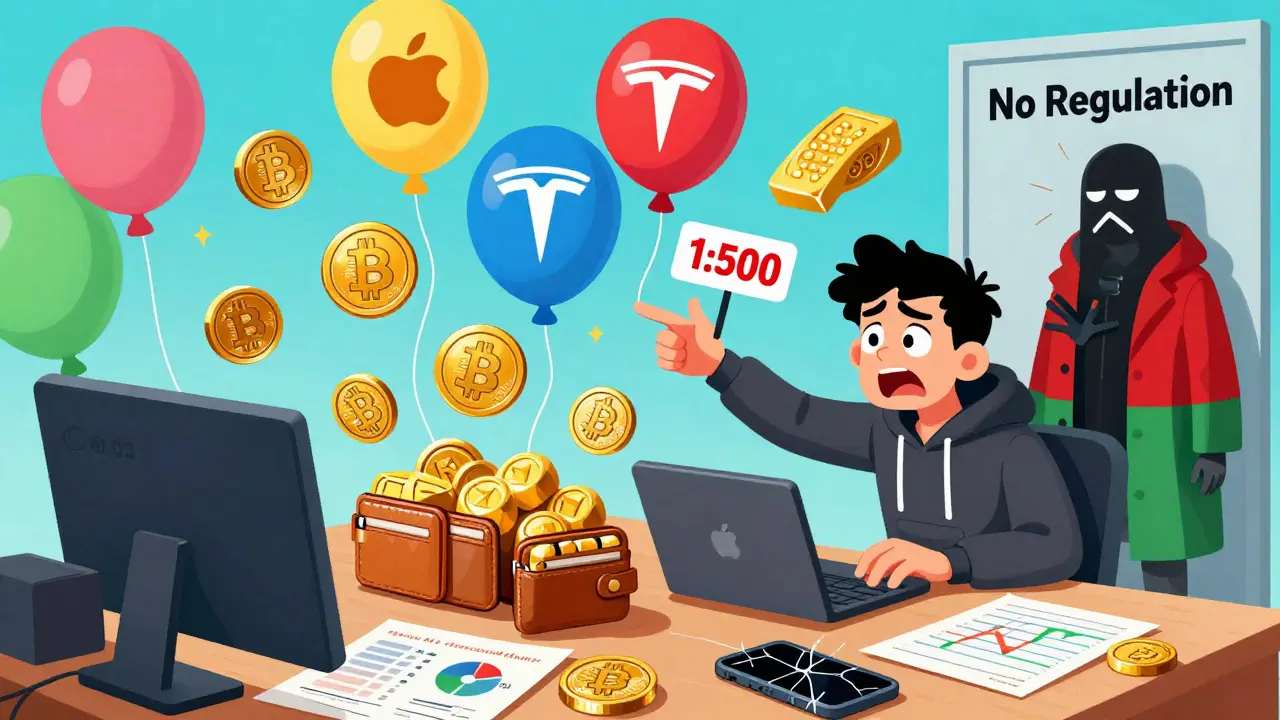
Want to trade Bitcoin and Apple stock on the same platform? Dzengi.com claims you can. Launched in 2018 and based in Belarus, this exchange doesn’t just let you buy crypto-it lets you trade tokenized versions of Tesla shares, gold, EUR/USD forex pairs, and even stock indices, all without converting to fiat. That’s the big hook. But behind the flashy feature set lies a shaky foundation: minimal regulation, a laggy app, and no staking or lending. If you’re looking for a one-stop shop for traditional and digital assets, Dzengi.com might seem perfect. But is it safe? Let’s break it down.
What Dzengi.com Actually Offers
Dzengi.com isn’t just another crypto exchange. It’s trying to be a financial superstore. On the surface, it looks like Binance or Coinbase: you can trade Bitcoin, Ethereum, Dogecoin, and Tether. But then you scroll further and find something unusual-tokenized Apple, Amazon, and Netflix shares. Not ETFs. Not futures. Actual digital tokens that mirror the price of real company stocks. Same goes for commodities like gold and over 150 currency pairs. You can trade EUR/USD, GBP/JPY, or even exotic pairs like USD/TRY without ever touching a bank account.
This isn’t marketing fluff. The platform lists over 300 tokenized assets alongside 50+ cryptocurrencies. For traders who want to switch between crypto and stocks in seconds, it’s a rare feature. Most exchanges force you to cash out to fiat, then deposit into a brokerage. Dzengi.com skips that. You buy a tokenized Tesla share with USDT, then sell it for ETH-all within the same app.
The minimum deposit? Just $20. Minimum withdrawal? $10. That’s lower than most platforms. You can fund your account with bank cards, bank transfers, crypto wallets, or ERIP (a regional payment system popular in Eastern Europe). If you’re in Europe, this makes sense. But if you’re in the U.S.? You’re locked out. Dzengi.com doesn’t serve American customers at all.
Leverage Trading Up to 1:500-High Risk, High Reward
If you’re an experienced trader, Dzengi.com’s leverage options are hard to ignore. The platform offers up to 1:500 leverage on certain assets. That means with $100, you can control $50,000 worth of Bitcoin or a tokenized stock. For comparison, most regulated exchanges cap leverage at 1:10 or 1:20 for retail traders. Even Binance’s max is 1:125 for perpetual swaps.
This isn’t a feature for beginners. A 2% move against your position can wipe you out. A 5% swing? Gone. There’s no margin call warning system mentioned in user reports. No automatic liquidation buffer. Just a toggle between "Trading" mode (spot only) and "Leverage" mode (with stop-loss, limit, and short-selling options). If you don’t understand how margin works, you shouldn’t touch this. But if you do? You’ve got one of the most aggressive platforms on the market.
Regulation: The Elephant in the Room
Dzengi.com says it’s "regulated under Belarusian legislation." That’s technically true. Belarus passed laws in 2017 allowing crypto businesses to operate legally if registered with the government. But here’s the catch: Belarus doesn’t have a financial regulator that oversees crypto exchanges the way the SEC does in the U.S., or the FCA in the UK. There’s no independent audit, no investor protection fund, no requirement to hold client funds in segregated accounts.
Third-party review sites like FxVerify state outright that Dzengi.com "does not appear to be regulated by any government authority." Meanwhile, the company claims compliance with international AML/KYC rules. That’s not the same as being regulated. It’s like saying your neighbor follows traffic rules-fine, but they don’t have a driver’s license.
Compare that to Coinbase, which is licensed in 50+ U.S. states and regulated by the NYDFS. Or Binance, which holds licenses in the UAE, Hong Kong, and parts of Europe. Dzengi.com has none of that. If the platform disappears tomorrow, you have no legal recourse. No deposit insurance. No complaints process. Just a website and a support ticket.

App Performance: Great Features, Terrible Execution
Users love the asset variety. They praise the 24/7 customer support. But almost everyone complains about the app.
On the Google Play Store and Apple App Store, reviews are split. One user writes: "The support team is amazing-answered my question in 12 minutes." Another says: "The app freezes every time I try to switch between markets. Fingerprint login doesn’t work. I’ve reinstalled it five times."
These aren’t isolated complaints. Multiple users report laggy transitions, unresponsive touch controls, and crashes during high-volume trading periods. The web version runs smoother, but mobile trading is the norm these days. If you’re day trading or scalping, a laggy app can cost you hundreds-or thousands-of dollars in missed entries or exits.
There’s no mention of recent app updates fixing these issues. No changelog. No developer response. That’s a red flag. If a company doesn’t prioritize its core product (the trading app), what else are they neglecting?
No Staking, No Lending, No Yield
Most modern crypto exchanges don’t just let you trade-they let you earn. Binance has staking for over 100 coins. Crypto.com offers up to 12% APY on stablecoins. Even smaller platforms like KuCoin have lending markets.
Dzengi.com? Nothing. No staking. No lending. No savings accounts. No yield. Just spot and leverage trading.
That’s a huge gap. In 2025, passive income is expected. If you’re holding Ethereum or Solana, why not earn interest on it? Dzengi.com forces you to be an active trader. No safety net. No fallback. If the market goes sideways, you make nothing. That’s a missed opportunity-and a disadvantage compared to nearly every competitor.

Fees: Too Good to Be True?
Dzengi.com advertises 0.00% maker and taker fees. That sounds incredible. But here’s the fine print: it’s likely only for basic trading tiers. Most exchanges offer zero fees to high-volume traders or those using their native token. Dzengi.com doesn’t have a native token. It doesn’t offer volume discounts publicly. And no independent source has verified these claims.
There’s also a lack of transparency around withdrawal fees. Bank transfers? Crypto withdrawals? Currency conversions? No clear fee schedule is published. That’s dangerous. You could be hit with hidden charges when you try to cash out.
Compare that to Kraken, which publishes a full, downloadable fee table. Or Binance, which shows real-time fees based on your 30-day trading volume. Dzengi.com leaves you guessing.
Who Should Use Dzengi.com?
Let’s be clear: this isn’t for everyone.
Good fit: European retail traders who want to switch between crypto and tokenized stocks without fiat conversions. Traders comfortable with high leverage and willing to accept regulatory risk. People who value customer support over institutional trust.
Avoid if: You’re in the U.S. You want to earn interest on your crypto. You need a reliable mobile app. You prefer regulated platforms with investor protection. You’re new to trading and don’t understand leverage.
Dzengi.com is a niche tool. It’s not a replacement for Coinbase or Kraken. It’s a specialized platform for a very specific type of trader-one who wants to blend traditional finance with crypto in one place, and doesn’t mind cutting corners on safety to get there.
Final Verdict: Innovative but Unreliable
Dzengi.com is bold. It’s ahead of its time in offering tokenized stocks and forex alongside crypto. The asset selection is impressive. The low entry barrier is attractive. The customer support is genuinely responsive.
But it’s also a gamble. No real regulation. A broken app. No yield features. No transparency on fees. And no presence in the biggest market: the U.S.
If you’re willing to take the risk, start small. Deposit $50. Trade a few tokenized assets. Test the app under real conditions. Don’t touch leverage until you’ve used it for weeks without losing money.
But if you’re looking for a safe, long-term place to hold and grow your crypto? Look elsewhere. Dzengi.com feels like a tech demo that never got fully built. It’s clever-but not trustworthy enough to bet your money on.
Is Dzengi.com regulated?
Dzengi.com claims to operate under Belarusian legislation, but it is not regulated by any internationally recognized financial authority like the SEC, FCA, or CySEC. While Belarus allows crypto businesses to register, this doesn’t equate to investor protection or oversight. Independent reviewers like FxVerify state the platform "does not appear to be regulated by any government authority." Treat this as a high-risk platform.
Can I trade stocks on Dzengi.com?
Yes, but not directly. Dzengi.com offers tokenized versions of real company stocks like Apple, Amazon, Tesla, and Netflix. These are digital tokens that mirror the price of the underlying stock. You’re not buying actual shares-you’re trading a derivative. This means you don’t own the stock, get dividends, or have voting rights. It’s purely a price speculation tool.
Does Dzengi.com have a mobile app?
Yes, Dzengi.com has apps for iOS and Android. But users consistently report serious performance issues: freezing screens, unresponsive touch controls, laggy tab transitions, and fingerprint login failures. The web version is more stable. If you plan to trade on the go, expect frustration. This is one of the platform’s biggest weaknesses.
Is Dzengi.com safe for long-term holding?
No. Dzengi.com doesn’t offer staking, savings, or yield products. It’s designed for active trading, not holding. There’s also no deposit insurance, and the platform operates under minimal regulation. If the company shuts down or gets hacked, you likely won’t get your funds back. For long-term crypto storage, use a hardware wallet or a regulated exchange with insurance.
Why doesn’t Dzengi.com serve U.S. users?
The U.S. has some of the strictest crypto regulations in the world. To serve American customers, exchanges need licenses from multiple state agencies and federal compliance with the SEC and FinCEN. Dzengi.com hasn’t pursued these licenses, likely because its business model-offering tokenized stocks without proper securities registration-would violate U.S. law. Excluding the U.S. market removes legal risk but also cuts off 25% of global crypto trading volume.
What are the fees on Dzengi.com?
Dzengi.com advertises 0.00% maker and taker fees, but this isn’t independently verified. Withdrawal fees, currency conversion fees, and deposit fees aren’t clearly listed. Most exchanges charge fees based on volume or payment method-Dzengi.com provides no transparency. Always assume hidden costs exist until proven otherwise.