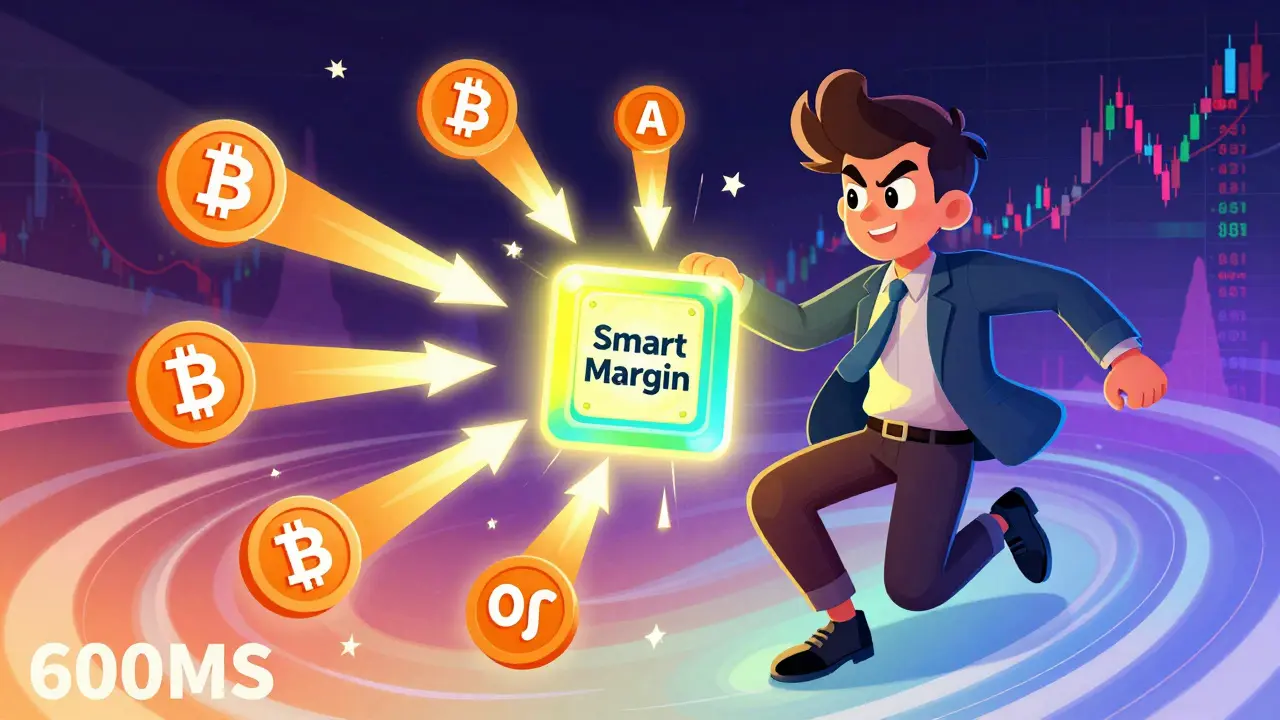
Drift Protocol isn't another crypto exchange trying to copy Binance. It's a decentralized exchange built from the ground up for one thing: fast, efficient, high-leverage trading on Solana. If you're tired of waiting 10 seconds for a trade to fill on Ethereum-based DEXs, or tired of juggling multiple wallets for different positions, Drift might be the answer you didn't know you needed.
What Makes Drift Different?
Most decentralized derivatives platforms force you into isolated margin accounts. That means if you want to trade BTC, SOL, and ETH, you need separate collateral pools for each. It’s clunky. It ties up capital. Drift fixes that with its Smart Margin a unified margin account system that lets you use any supported asset as collateral across all trading positions. Think of it like a single bank account for all your leveraged trades. You can use SOL to back a BTC position, or USDC to cover an ETH trade-no more locked-up funds or complex collateral transfers. This isn’t just a UX tweak. It’s a game-changer for capital efficiency. Internal tests show traders using Smart Margin can deploy 37% more capital across correlated markets compared to isolated margin systems. That means more positions, better risk distribution, and higher potential returns without needing more money upfront.Speed That Actually Matters
Drift runs on Solana, and Solana delivers. Trade execution averages under 600 milliseconds. That’s faster than most centralized exchanges. The platform uses a Just-In-Time (JIT) liquidity mechanism that dynamically matches orders without relying on traditional order books. Instead of waiting for a counterparty to match your order, Drift pulls liquidity from a pool of market makers in real time. This keeps slippage low-even during spikes. In high-volatility moments, like a sudden BTC pump, most DEXs freeze or get clogged. Drift doesn’t. Quant firms report 92% of stop-loss orders execute within one second on Drift, compared to 63% on Ethereum-based platforms. That kind of reliability turns Drift into a serious tool for active traders, not just weekend speculators.Markets, Leverage, and Liquidity
As of Q3 2025, Drift supports 43 trading pairs, including major crypto assets like BTC, ETH, SOL, and even niche ones like RAY, JUP, and MKR. Leverage goes up to 50x for the most liquid markets. That’s higher than most centralized exchanges offer without additional KYC. But here’s the catch: liquidity depth. While Drift’s execution speed is top-tier, its order book depth doesn’t match giants like Binance Futures. At 0.1% slippage, Drift averages 1.2 BTC in depth. Binance? Around 8.7 BTC. That means if you’re trying to open a 50 ETH position during a CPI release, you might only get 32 ETH filled before the price moves against you. For retail traders trading 1-10x leverage, this rarely matters. For institutions or large traders? It’s a dealbreaker.
Security and Risk Management
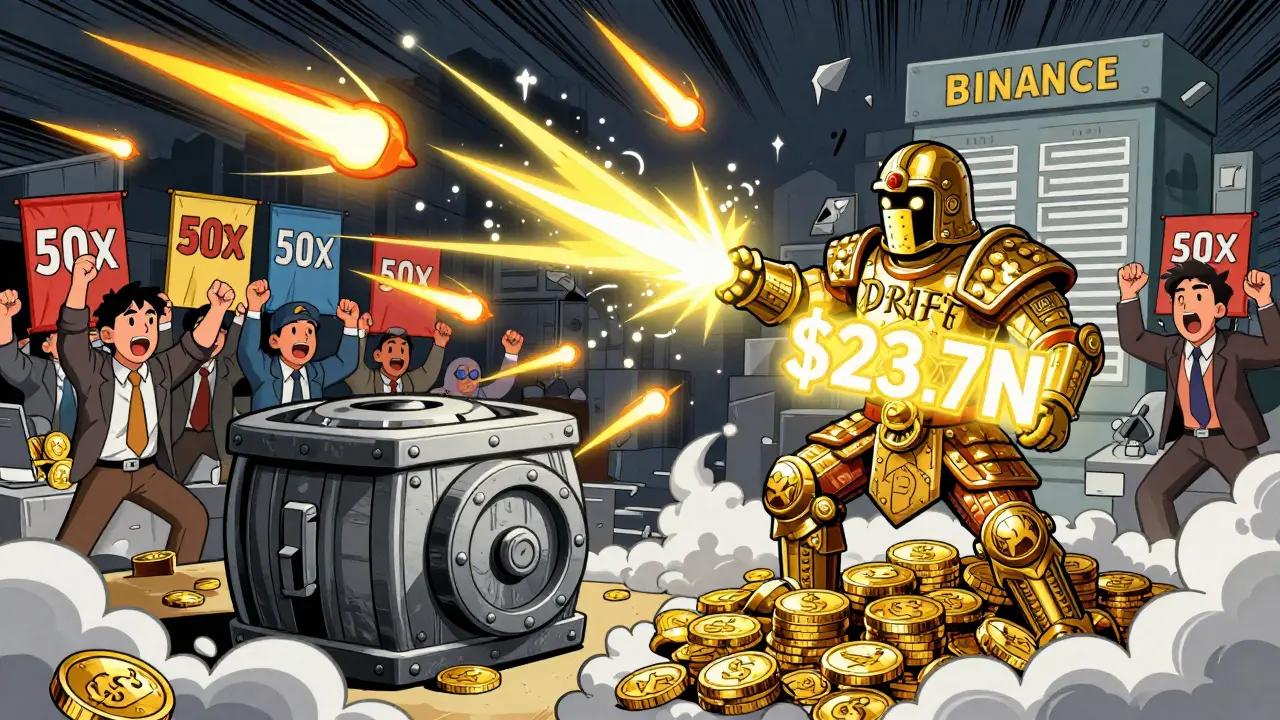
Drift doesn’t just rely on smart contracts-it has layers. The Dangerous System Module (DSM) an on-chain insurance fund funded by DRIFT token stakers acts as a backstop. As of September 2025, it held $23.7 million and has already covered $867,000 in bad debt from 12 liquidation events. That’s not perfect, but it’s real protection. The protocol uses Pyth Network oracles for price feeds, updating every 15 seconds. That’s fast enough to avoid major manipulation, but not immune. Trail of Bits flagged “oracle manipulation during low-liquidity hours” as a medium-risk concern. Drift’s risk engine checks positions every 400 milliseconds. If a position looks like it’s about to go negative, it triggers liquidation before the user loses everything. Drift’s code has been audited 14 times-by Trail of Bits, Neodyme, OtterSec, and others. All critical bugs were patched within 30 days. The Immunefi bug bounty program has paid out $1.7 million since launch. That’s not luck. That’s discipline.The DRIFT Token and Tokenomics
The DRIFT token used to be just a fee-sharing token. Now, it’s the backbone of the protocol’s risk system. Holders can stake DRIFT to earn fees, but more importantly, they contribute to the DSM. The more you stake, the more influence you have over risk parameters like liquidation thresholds and funding rates. Price predictions are all over the map. TradingBeast sees $1.02 by December 2025. WalletInvestor says it’ll crash to $0.38. Reality? It’s been stuck around $0.75 for over 200 days. That’s not a bubble or a crash-it’s consolidation. The real value isn’t in speculation. It’s in utility: if Drift grows its trading volume, DRIFT becomes more valuable as a governance and insurance asset.Who Is Drift For?
Drift isn’t for beginners. It’s not for people who just want to buy BTC and HODL. This is a tool for traders who:- Trade with leverage regularly (10x or higher)
- Use multiple assets as collateral
- Need sub-second execution
- Are comfortable with Solana’s ecosystem
- Understand the risks of decentralized derivatives
How to Get Started
You need a Solana wallet-Phantom, Backpack, or Solflare. Connect it to Drift’s website. Deposit SOL, USDC, or another supported asset. Then trade. No KYC. No account approval. No waiting. The interface is clean but dense. There are 37 tutorial videos on GitHub, 12 interactive walkthroughs, and an active Reddit community (r/Drift101) with 1,200+ daily posts. Expect to spend 8-12 hours learning advanced features like cross-margin optimization and JIT liquidity provision. It’s not easy, but the payoff is real.Where It Falls Short
Drift isn’t flawless. During Solana network congestion, price feeds can lag. Wallet connections occasionally drop. The platform paused three times in Q2 2025 due to network issues, causing $4.2 million in unrealized PnL discrepancies. That’s a systemic risk tied to Solana’s architecture. During the March 2025 BTC flash crash, Drift’s liquidation engine only processed 78% of positions within safety limits-compared to 91% on Hyperliquid. That’s a red flag. It means Drift’s risk engine still has room to improve under extreme stress. Also, geo-blocking is real. Drift restricts access in 32 jurisdictions due to regulatory pressure. If you’re in the U.S., UK, or parts of Asia, check if you’re blocked before you start.Final Verdict
Drift Protocol is the most advanced decentralized derivatives exchange on Solana. It combines unmatched speed, innovative margin architecture, and serious security measures. It’s not perfect. Liquidity depth is thin. Network dependency is risky. But for active traders who prioritize execution and capital efficiency, there’s no better DEX. It’s not a place to store crypto. It’s not for casual traders. But if you’re serious about leveraged trading on-chain, Drift isn’t just an option-it’s the benchmark.Is Drift Protocol a centralized or decentralized exchange?
Drift Protocol is a fully decentralized exchange (DEX). It runs on the Solana blockchain, is non-custodial, and uses smart contracts to execute all trades. No central authority holds your funds or controls your account. You trade directly from your Solana wallet.
Can I trade Bitcoin on Drift Protocol?
Yes. Drift supports BTC perpetual futures with up to 50x leverage. The BTC/USDC market is one of the most liquid on the platform, with tight spreads and fast execution, even during high volatility.
What wallets work with Drift Protocol?
Drift supports all major Solana wallets: Phantom, Backpack, Solflare, and MathWallet. You must use a wallet that supports Solana’s SPL tokens and can sign transactions. Mobile wallets like Phantom work best for most users.
Is Drift Protocol safe to use?
Drift is one of the most audited DeFi protocols in existence, with 14 comprehensive audits from top firms like Trail of Bits and Neodyme. It has a $23.7 million insurance fund (DSM) and a $1.7 million bug bounty program. However, it’s still a DeFi platform-smart contract risk exists. Never deposit more than you can afford to lose.
Does Drift Protocol have a mobile app?
No, Drift doesn’t have a native mobile app. But you can access it through your mobile browser using a Solana wallet like Phantom. The interface is fully responsive and works well on phones, though advanced trading is easier on desktop.
How does Drift’s Smart Margin system save capital?
Traditional DEXs require you to lock separate collateral for each position. Drift lets you use any supported asset-SOL, USDC, ETH, etc.-as collateral across all your trades. This means you don’t need to hold extra USDC just for BTC trades. Your capital works harder, letting you open more positions with the same funds.
What are the trading fees on Drift Protocol?
Drift charges 0.02% for takers and 0.005% for makers. There are no withdrawal or deposit fees. Gas fees are paid in SOL, but order placement and cancellation are gasless due to its JIT system. This makes frequent trading much cheaper than on Ethereum-based platforms.
Can I earn interest on Drift Protocol?
Yes. Drift’s Earn system lets you stake over 20 assets-including DRIFT, SOL, USDC, and JUP-to earn yield. Rates vary by asset and demand. However, staking carries impermanent loss risk, especially in sideways markets. It’s best for users who already hold these assets long-term.
Why does Drift have geo-restrictions?
Drift blocks access in 32 jurisdictions due to regulatory pressure, especially after the SEC’s July 2025 enforcement actions against derivatives platforms. This includes users from the U.S., UK, Singapore, and parts of the EU. The team implements these restrictions to avoid legal liability, even though the protocol is decentralized.
How does Drift compare to dYdX or GMX?
Drift trades faster than dYdX (Solana vs Ethereum) and has better capital efficiency than GMX’s isolated margin. But dYdX has deeper liquidity and more market depth. GMX offers more stablecoin pairs. Drift wins on speed and unified margin; dYdX wins on volume and brand trust; GMX wins on simplicity. Choose based on your trading style.