
Most people assume that cryptocurrency is a currency, but the Australian Taxation Office (or ATO) sees it differently. In Australia, your digital assets are treated as property. This means every time you swap, sell, or spend your coins, you aren't just making a payment-you're disposing of an asset. If that asset grew in value, you've triggered a taxable event. For many, the shock comes when they realize that even paying a network fee in crypto can land them in the tax office's crosshairs.
| Factor | Short-Term (< 12 Months) | Long-Term (≥ 12 Months) |
|---|---|---|
| Tax Rate | Marginal Tax Rate (19% - 45%) | Marginal Tax Rate on 50% of gain |
| CGT Discount | None | 50% Discount Available |
| Reporting | Required in annual tax return | Required in annual tax return |
Understanding Capital Gains Tax (CGT) for Crypto
When we talk about Capital Gains Tax (or CGT), we're talking about the profit you make when you sell an asset for more than you paid for it. Because the ATO classifies crypto as property, Capital Gains Tax applies the moment you "dispose" of it. Disposal doesn't just mean selling for cash; it also includes trading one coin for another, using crypto to buy a coffee, or gifting it to a friend.
The calculation is straightforward in theory: you take the proceeds (what you got for the asset) and subtract the cost base (what you paid for it plus any associated costs). For example, if you bought a coin for $1,100 and paid a $100 exchange fee, your cost base is $1,200. If you sell it for $2,000, your capital gain is $800. That $800 is then added to your taxable income for the year.
The Magic of the 12-Month Holding Period
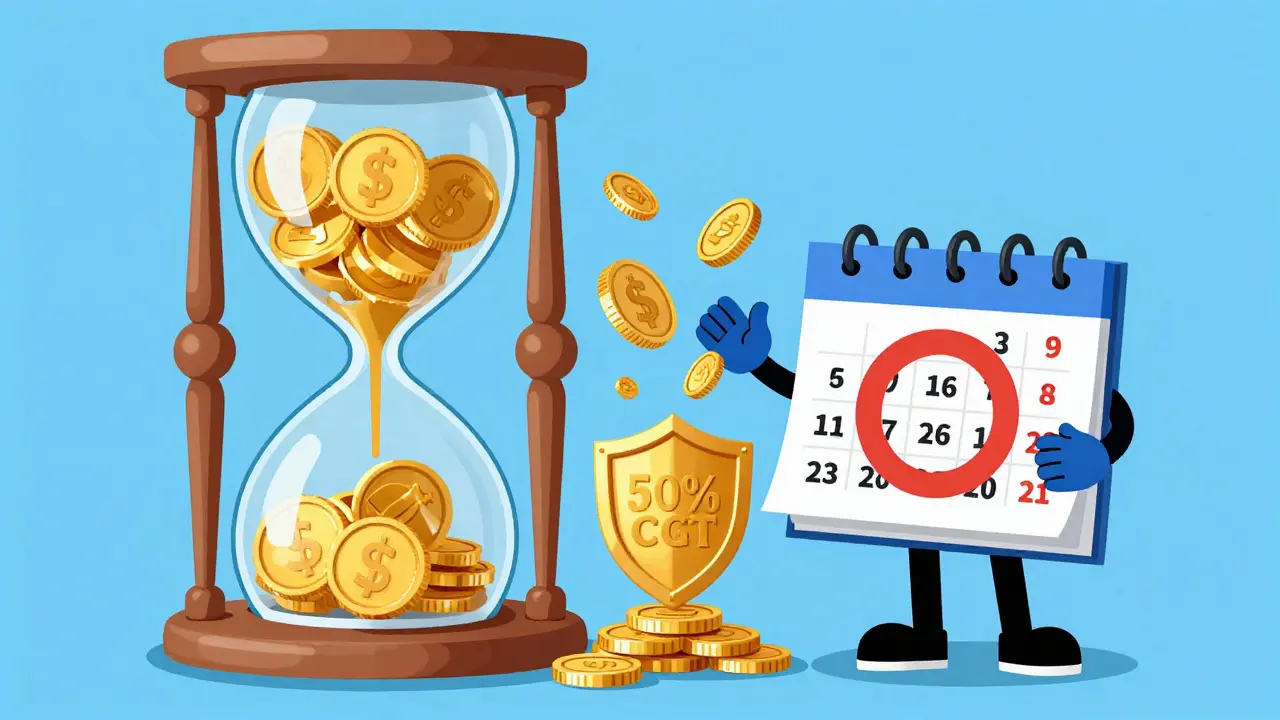
If you're a "HODLer," the Australian system has a massive advantage: the 50% CGT discount. If you hold your crypto for at least 12 months before selling, you only pay tax on half of the gain. This is the single most powerful tax planning tool available to Australian investors. Imagine a high-income earner making a $100,000 profit; by waiting until the 12-month mark, they could potentially shave $18,000 off their tax bill.
However, this is a binary rule. There is no "sliding scale." If you sell at 11 months and 29 days, you pay tax on 100% of the gain. This has led to a lot of frustration in trading communities, where users have lamented missing out on thousands of dollars in savings by selling just a few days too early.
Investor vs. Trader: Which One Are You?
There is a critical distinction between being a passive investor and a professional trader. If you buy and hold assets for the long term, you are generally treated as an investor and can access the CGT discounts. But if you're day trading with 100+ transactions a year, the ATO might decide you're "carrying on a business."
If you're classified as a trader, your gains are treated as ordinary income rather than capital gains. This means you lose the 50% discount entirely. The ATO is currently ramping up its focus on frequent traders, using direct data-sharing agreements with major Australian exchanges like CoinSpot and Swyftx to identify those who might be misreporting their status.
The Hidden Traps: Network Fees and Cost Bases
One of the most overlooked parts of crypto tax is the "transfer fee trap." Many users believe that paying a small network fee to move coins between wallets is a non-event. In reality, because you are using a piece of property (your crypto) to pay for a service, the ATO views this as a disposal. You must calculate the capital gain or loss on the specific amount of crypto used to pay that fee.
Calculating the cost base can also get messy. If you've acquired the same coin over several months at different prices, you need a consistent method to track them. While the ATO prefers the specific identification method, the sheer volume of transactions often makes manual tracking impossible. This is why many investors move toward software like Koinly or CoinTracker to automate the conversion of every single transaction into Australian dollars at the exact time of the trade.

Offsetting Gains with Capital Losses
Not every trade ends in profit. The silver lining of a market crash is the ability to use capital losses to reduce your tax bill. If you have a project that went to zero-like a failed NFT collection-you can use that loss to offset your gains from other successful trades. This happens before you apply the 50% discount, effectively lowering your total taxable gain and potentially saving you from a huge tax hit during a bullish year.
The Compliance Landscape in 2026
The days of "hoping the ATO doesn't find out" are over. With the integration of the Digital Asset Data Exchange and mandatory reporting for transactions exceeding $10,000, the government has a very clear view of most crypto activity. Compliance rates are expected to jump significantly as the ATO's data-matching capabilities evolve.
For most, the best path is meticulous record-keeping. Keep track of your acquisition dates, the market value in AUD at the time of receipt (especially for staking rewards or airdrops), and every single disposal event. Treating your crypto portfolio like a business ledger today prevents a nightmare audit tomorrow.
Does the tax-free threshold apply to crypto gains?
Yes. The standard tax-free threshold (currently $18,200) applies to your total taxable income, which includes your net capital gains from cryptocurrency. If your total income, including crypto profits, is below this threshold, you generally won't pay tax on those gains.
Are staking rewards and airdrops taxed under CGT?
No, not initially. Staking rewards and airdrops are usually treated as ordinary income at the time you receive them, based on their market value in AUD. However, once you hold those rewards, any future increase in value is then subject to CGT when you eventually sell or trade them.
Can I claim my crypto as a "personal use asset"?
It is possible, but difficult. If you bought crypto specifically for personal use (like buying a game item) and the cost was under $10,000, it might be exempt. However, the ATO rarely accepts "investing for a rainy day" as personal use. Most crypto holdings are viewed as investment assets regardless of the amount.
What happens if I hold crypto for exactly 12 months?
The 50% CGT discount applies if you hold the asset for at least 12 months. To be safe, most tax professionals recommend waiting until day 366 to ensure there is no ambiguity regarding the holding period before triggering the disposal event.
How do I handle losses from a defunct exchange?
If your assets are permanently lost or the exchange collapses and the assets are unrecoverable, you may be able to claim a capital loss. You will need evidence that the assets are gone and cannot be recovered to justify the loss to the ATO.