
Why Vesting Matters in Blockchain Projects
When you join a blockchain startup or get tokens as part of your compensation, you’re not getting them all at once. That’s by design. Vesting is the process that controls when and how much of your token allocation becomes yours to use, sell, or hold. Two of the most common approaches are cliff vesting and linear vesting. Understanding the difference isn’t just about paperwork-it affects your income, motivation, and even whether you stay with the project long-term.
Most early-stage crypto teams use a mix of both. But knowing how each works helps you evaluate offers, plan your finances, and spot red flags in token distribution models.
What Is Cliff Vesting?
Cliff vesting means you get nothing until a specific date-then you get it all at once.
Imagine you’re granted 10,000 tokens with a one-year cliff. For the first 365 days, you earn zero. No tokens unlock. No access. Then, on day 366, your entire 10,000 tokens become available instantly. There’s no partial release. No gradual buildup. Just a hard stop and a full unlock.
This model is brutal but effective. It forces employees to stick around for at least a year. If someone leaves after 11 months, they walk away with nothing. That protects the company from short-term hires who take tokens and leave before contributing meaningfully.
Smart contracts handle this automatically. They check the current date against the cliff date. If the current date is before the cliff, the tokens stay locked in a wallet only the project can access. Once the cliff passes, the contract releases the full amount to your wallet. No human intervention needed.
Some projects use longer cliffs-two or even three years-for core developers or founders. The idea is simple: if you’re building something that takes years to gain traction, you need people who are in it for the long haul.
What Is Linear Vesting?
Linear vesting is the opposite of cliff vesting. Instead of waiting for a single date, your tokens unlock evenly over time.
Take the same 10,000 tokens, but with a four-year linear schedule. That means 2,500 tokens unlock each year. Or if you break it down monthly, about 208.33 tokens per month. Every single month, you get a predictable, equal slice of your total allocation.
This approach is great for morale. You don’t have to wait a year to see any reward. You get something every month. That helps with financial planning, reduces stress, and keeps motivation steady. People know exactly where they stand: if you’ve been there six months, you’ve earned half of your first year’s allocation.
Linear vesting is common in more mature crypto projects or companies that aren’t in survival mode. It’s also popular for advisors who contribute intermittently but aren’t full-time employees. Their vesting is often set to a linear schedule over 12-24 months, so their incentives stay aligned without requiring constant presence.
The Hybrid Model: Why Most Projects Use Both
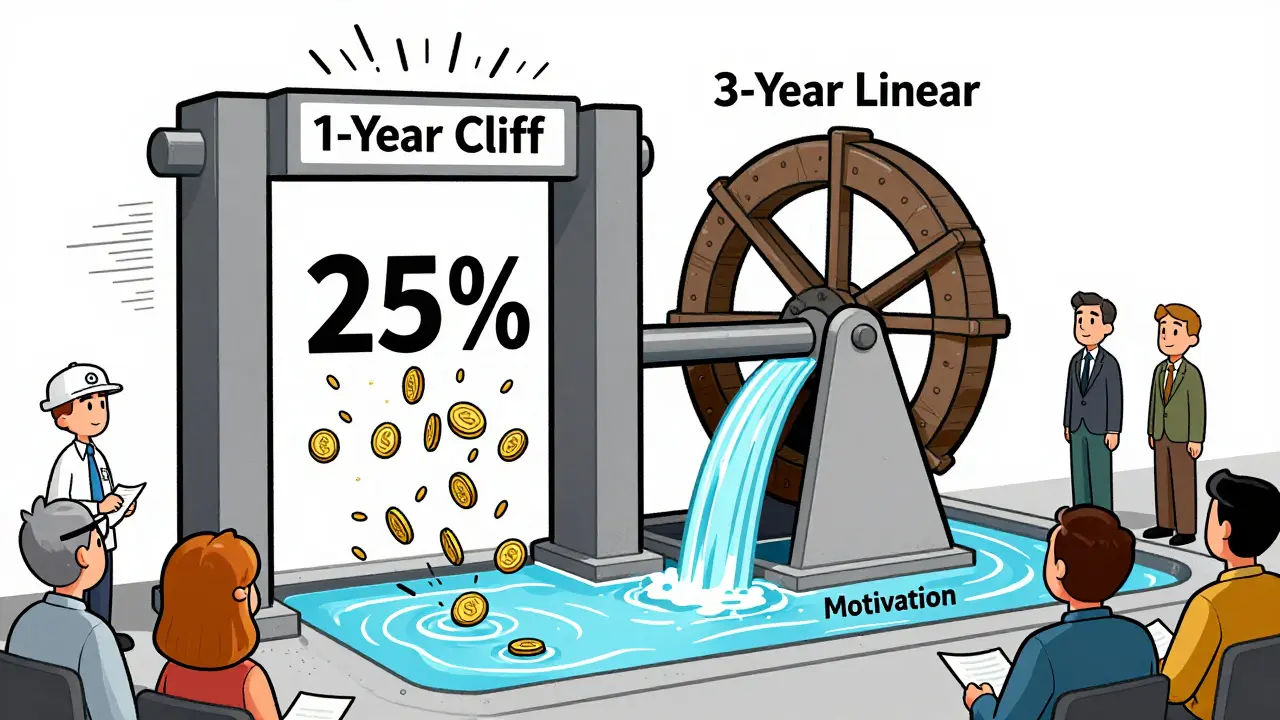
Here’s the real secret: almost no one uses pure cliff or pure linear vesting. The industry standard is a four-year vesting schedule with a one-year cliff.
How it works:
- Year 1: No tokens unlock until day 365. Then, 25% (2,500 tokens) release all at once.
- Years 2-4: The remaining 75% (7,500 tokens) unlock evenly over 36 months-about 208.33 tokens per month.
This combo gives you the best of both worlds. The cliff protects the company from early departures. The linear portion keeps you engaged after you’ve passed the initial hurdle.
It’s the model used by nearly every major crypto startup-from early Ethereum teams to Solana validators. Even large exchanges like Kraken and Coinbase use this structure for their token grants.
Why does it dominate? Because it balances risk. Too much cliff? You risk demotivating people during their first year. Too little? You risk losing talent before they’ve proven their value.

Which One Is Better for You?
It depends on your role, your risk tolerance, and the project’s stage.
If you’re joining a brand-new team with no revenue, no users, and high uncertainty, a one-year cliff makes sense. You’re betting on the long game. The cliff ensures everyone’s aligned: if you don’t believe in the project enough to stick around for a year, you shouldn’t get rewarded.
If you’re joining a project that’s already launched, has a working product, and is scaling-then linear vesting matters more. You want steady growth. You want to see your effort reflected monthly. You don’t want to feel like you’re playing a game of “wait and see.”
Here’s a quick guide:
| Feature | Cliff Vesting | Linear Vesting |
|---|---|---|
| First payout | After cliff period (e.g., 1 year) | Immediately (monthly/quarterly) |
| Best for | Early-stage startups, high-risk projects | Mature teams, steady growth |
| Retention power | High-forces commitment | Low to moderate-rewards consistency |
| Psychological impact | Stressful during cliff, rewarding after | Steady, predictable, less anxiety |
| Administrative complexity | Simple-only one trigger | Higher-continuous calculations |
| Common in | Founders, core engineers, early hires | Advisors, non-engineering roles, public chains |
What Happens If You Leave Early?
This is where people get surprised.
If you leave before the cliff, you lose everything. No partial credit. No pro-rata. Just zero. That’s intentional. The contract doesn’t calculate what you’ve earned-it checks if the cliff has passed. If not, no tokens move.
If you leave after the cliff but before full vesting, you keep what’s already vested. In the hybrid model, if you leave after 18 months, you keep the 2,500 tokens from the cliff plus 6 months of linear vesting (about 1,250 tokens). Total: 3,750 tokens. The rest are forfeited.
Some projects now offer “accelerated vesting” if the company is acquired or goes public. That’s rare, but it’s a nice perk when it happens.
Real-World Examples
Take Sui’s 2023 token distribution. They granted 1,000 tokens each to 10 core team members with a one-year cliff. None of them received anything until the 365-day mark. After that, 25% released, and the rest followed monthly. All 10 stayed past year one.
On the other hand, Polygon’s advisor pool uses linear vesting over 24 months. Advisors get paid monthly based on contributions, not time. No cliff. Just steady, predictable releases.
Even Bitcoin mining pools are adopting this. Some now use linear vesting for node operators-rewarding consistent uptime rather than one-time setup.
What’s Changing in 2026?
More projects are customizing vesting by role.
- Marketing hires: 2-year linear, no cliff.
- Core developers: 4-year with 1-year cliff.
- Advisors: 18-month linear, no cliff.
- Founders: 5-year with 2-year cliff.
Why? Because not all roles need the same level of protection. A designer can be replaced faster than a blockchain engineer. A marketing lead might leave after six months if the product flops-so a no-cliff, 2-year linear schedule keeps them motivated without locking them in too hard.
Smart contracts now make this easy. You can set different schedules per wallet, per role, even per individual. The days of one-size-fits-all vesting are over.
Common Mistakes to Avoid
- Assuming you’ll get tokens right away. Always check the vesting schedule before accepting a role.
- Ignoring the cliff. If you’re offered 10,000 tokens, but there’s a one-year cliff, your effective starting value is zero until day 365.
- Not asking about acceleration events. What happens if the project is bought? Will you get your remaining tokens early?
- Thinking linear vesting = less risk. It doesn’t protect the company. If you leave after 6 months with linear vesting, you’ve already earned half your tokens.
Final Thoughts
Cliff vesting is a gate. Linear vesting is a stream. The best systems use both: the gate to keep out short-term players, the stream to keep everyone moving forward.
If you’re evaluating a crypto job offer, don’t just look at the total token amount. Look at the schedule. Ask: When do I get my first payout? What happens if I leave early? Is there a cliff? How long is it?
Token allocation isn’t just compensation-it’s a signal of how the company thinks about loyalty, risk, and long-term value.