
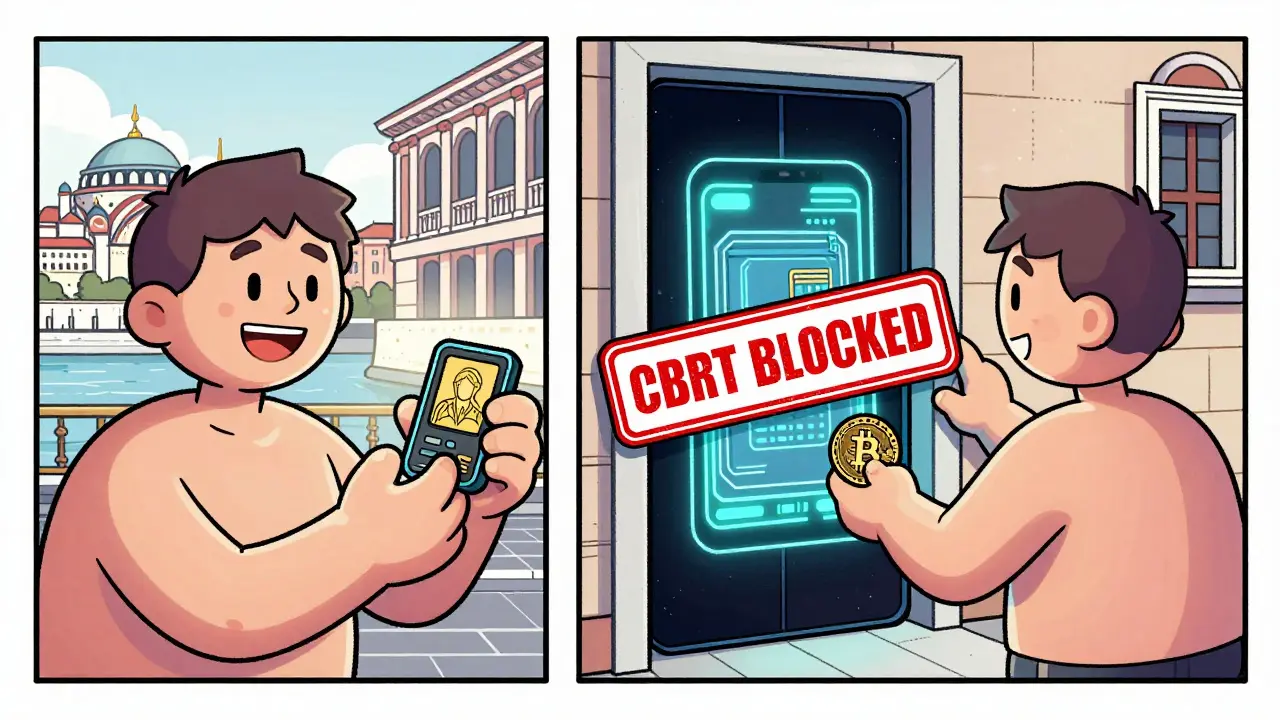
If you live in Turkey and use cryptocurrency, you’ve probably noticed something strange: you can buy Bitcoin, sell Ethereum, and hold digital assets in your wallet-but you can’t use them to pay for coffee, rent, or even a used car. That’s not a glitch. It’s the law. Since April 2021, the Central Bank of the Republic of Turkey (CBRT) is the nation’s monetary authority responsible for issuing the Turkish Lira and maintaining financial stability. Also known as CBRT, it has maintained a strict ban on using cryptocurrencies for payments, even as Turkey became one of the world’s top crypto markets.
By 2026, this rule hasn’t changed. In fact, it’s gotten stricter. The CBRT didn’t just slap on a ban and walk away. It built a full regulatory machine around it. And that machine is now fully operational. If you think crypto in Turkey is just about buying and selling, you’re missing half the story. The real story is how the government let people trade crypto like crazy-but made sure it could never become money.
Why Ban Crypto Payments? It’s Not About Fear
Some countries banned crypto because they were scared of losing control. Turkey didn’t. Turkey banned crypto payments because it was scared of not losing control.
The Turkish Lira has been losing value for years. Inflation hit 85% in 2022. People lost trust in banks. So they turned to Bitcoin, USDT, and other cryptocurrencies-not to gamble, but to save. Crypto became a lifeline. A way to protect savings from being eaten away by inflation. And that’s exactly what the CBRT wanted to stop.
Allowing crypto to be used for everyday purchases would mean people could bypass the banking system entirely. Imagine someone paying rent in Bitcoin. The landlord cashes out on a Turkish exchange. The money flows back into the Lira system. But the CBRT loses visibility. It can’t track capital flows. It can’t control liquidity. And worst of all-it can’t print its way out of trouble anymore.
So the CBRT made a smart, cold-blooded decision: Let people trade crypto as an investment. But block it as a payment tool. The goal wasn’t to kill crypto. It was to keep the Lira alive.
The 2025 Rules: What Changed
Before March 2025, crypto rules in Turkey were messy. Exchanges operated in gray zones. Some followed rules. Others didn’t. The government waited until the market got too big to ignore. Then, on March 13, 2025, four official communiqués dropped in the Official Gazette. They didn’t just clarify rules-they rewrote them.
Here’s what matters now:
- All crypto exchanges and custodians must be licensed by the Capital Markets Board (CMB) is Turkey’s primary securities regulator responsible for overseeing financial markets, including crypto asset service providers. No exceptions.
- Minimum capital: Exchanges need 150 million Turkish Lira (about $4.1 million). Custodians? 500 million Lira ($13.7 million). This isn’t a suggestion. It’s a hard cutoff.
- Company structure: Only joint-stock companies with shares issued in cash and registered by name are allowed. No anonymous shell companies.
- Anti-money laundering: Every transaction over 15,000 Turkish Lira ($425) requires full KYC. ID, address, source of funds-all verified. Even canceled trades must be logged.
- Reporting: All platforms must report daily activity to the CMB. Suspicious patterns? They get flagged. Automated systems are required.
And here’s the kicker: Derivatives are banned. No crypto futures. No leveraged trading. No options. Just spot buying and selling.
Even foreign platforms like Binance or Coinbase can’t market directly to Turkish users. If you’re a Turkish citizen and you sign up on a foreign exchange, you’re technically not breaking the law-but the platform is. And they know it. That’s why most big exchanges stopped advertising in Turkey after the 2025 rules.
What You Can Still Do
Don’t panic. You’re not banned from owning crypto. You’re just banned from using it like cash.
Here’s what’s still legal in 2026:
- Buying Bitcoin, Ethereum, or any other crypto on a licensed Turkish exchange.
- Holding crypto in your personal wallet.
- Selling crypto for Turkish Lira or foreign currency.
- Using crypto as an investment asset-like gold or real estate.
- Participating in initial coin offerings (ICOs), as long as the platform is CMB-approved.
And here’s what’s still illegal:
- Paying for groceries, rent, or utilities with Bitcoin.
- Using crypto to buy real estate (yes, even if the seller agrees).
- Using crypto to send money abroad without going through a licensed exchange first.
- Using unlicensed platforms (including foreign ones) to trade if they’re actively targeting Turkish users.
So if you want to buy a house in Istanbul, you can’t pay with ETH. But you can sell your ETH on Binance TR, get TL, then use that TL to buy the house. The CBRT doesn’t care how you make money. It just cares that the money you spend is in Lira.

How People Are Getting Around It
Rules don’t stop demand. They just change behavior.
Many Turkish users still trade on foreign exchanges like Binance, Kraken, or Bybit. They use P2P platforms to swap TL for USDT. They use crypto as a bridge to stable foreign currencies. It’s not perfect. It’s not legal. But it’s common.
The government knows. That’s why the Financial Crimes Investigation Board (MASAK) is Turkey’s anti-money laundering and financial intelligence unit responsible for monitoring suspicious financial activity, including crypto transactions. started cracking down harder. In late 2024, MASAK fined Binance TR the maximum penalty-8 million Turkish Lira (about $750,000)-for failing to verify users and track suspicious transactions. They didn’t shut it down. They fined it. Then they watched.
Now, MASAK is preparing even tougher moves: freezing crypto accounts, blocking access to rented wallets, and requiring banks to flag transfers linked to unlicensed platforms. The goal? Make it harder to hide.
Why This Matters Beyond Turkey
Turkey isn’t just a weird outlier. It’s a blueprint.
Other countries with high inflation-Argentina, Nigeria, Lebanon-are watching closely. Can you allow crypto as a savings tool without letting it replace your currency? Turkey says yes. And they’re proving it works.
They didn’t ban crypto. They didn’t embrace it. They managed it. They created a cage: wide enough for trading, narrow enough to keep it from becoming money.
This is the future for many nations. Not outright bans. Not full legalization. But strict, layered control. You can own it. You can trade it. But you can’t spend it. And that’s exactly what the CBRT designed.
The Digital Lira Is Coming
The CBRT isn’t just fighting crypto. It’s building its own.
The Digital Lira is Turkey’s central bank digital currency (CBDC) project aimed at digitizing the national currency for secure, traceable, and efficient transactions. is in active development. Unlike Bitcoin, this won’t be decentralized. It’ll be fully controlled by the central bank. You’ll be able to send it instantly. Track every transaction. Freeze it if needed.
The Digital Lira isn’t meant to replace cash. It’s meant to replace crypto as a payment tool. And it’s coming fast. By 2027, Turkish citizens may be able to use a government-backed digital wallet for everything-from paying bills to buying groceries.
It’s ironic. The very thing people turned to to escape inflation-the Lira-might soon be digitized and made more reliable than crypto ever was.
What’s Next? Tokenization and Real-World Assets
While crypto payments are blocked, Turkey is quietly opening the door to something else: tokenized assets.
Real estate, gold, even art-are being tested for blockchain-based tokenization. Imagine owning 1% of a building in Istanbul through a digital token. You can’t use it to pay your rent, but you can trade it, sell it, or earn dividends from it.
This isn’t crypto. It’s not Bitcoin. It’s regulated digital ownership. And it’s where the CBRT wants innovation to go: not as money, but as investment.
By 2026, Turkey is becoming a lab for this model. The world’s most active crypto market-without crypto payments.
Final Takeaway
Turkey didn’t ban crypto. It redefined it.
It said: You can own it. You can trade it. But you can’t spend it. And that’s the only way it could let millions of people use crypto as a hedge-without letting it break the currency.
If you’re in Turkey, treat crypto like gold. Not cash. Buy it. Hold it. Sell it. But don’t try to use it to pay your phone bill. The system won’t let you. And if you try to sneak around it, the fines are real.
The CBRT isn’t anti-crypto. It’s pro-Lira. And for now, that’s the rule that matters most.
Can I still buy Bitcoin in Turkey in 2026?
Yes. You can buy Bitcoin and other cryptocurrencies on licensed Turkish exchanges like Binance TR, Paribu, and Bitcointurk. You can also use P2P platforms to trade Turkish Lira for crypto. The ban only applies to using crypto for payments-not buying or holding it.
Can I use crypto to pay for rent or groceries in Turkey?
No. Since April 2021, the Central Bank of Turkey has banned all direct use of cryptocurrencies for payments of goods and services. This includes rent, utilities, groceries, and even real estate. Any payment must be made in Turkish Lira or through a regulated bank transfer.
Are foreign crypto exchanges like Binance or Coinbase allowed in Turkey?
Foreign exchanges can’t legally market to Turkish users or operate locally without a CMB license. Many still serve Turkish customers through unregulated P2P channels, but they risk fines and account freezes. Binance TR, the local subsidiary, was fined 8 million Turkish Lira in 2024 for failing AML checks. Using foreign platforms is not illegal for users, but it’s risky and unsupported.
What happens if I use crypto to buy a house in Turkey?
You can’t legally do it. Real estate transactions in Turkey must be conducted in Turkish Lira or foreign currency converted through a bank. If you try to pay with Bitcoin, the transaction won’t be registered with the land registry. Even if both parties agree, the sale is invalid under Turkish law. You could also trigger a MASAK investigation for money laundering.
Is the Turkish government planning to ban crypto entirely?
No. The government has no plans to ban owning or trading crypto. Instead, it’s tightening control through licensing, reporting, and payment restrictions. The goal is to keep crypto as an investment asset-not a currency. The Digital Lira project shows they’re focused on replacing crypto’s payment function, not eliminating crypto itself.
Why is Turkey one of the top crypto markets if payments are banned?
Because of high inflation and weak trust in the Turkish Lira. Many Turks use crypto as a store of value, similar to gold. Since 2020, over 17 million Turks have owned crypto at some point. The payment ban doesn’t stop people from buying Bitcoin to protect savings-it just stops them from using it as cash. That’s why trading volume remains among the highest in the world.