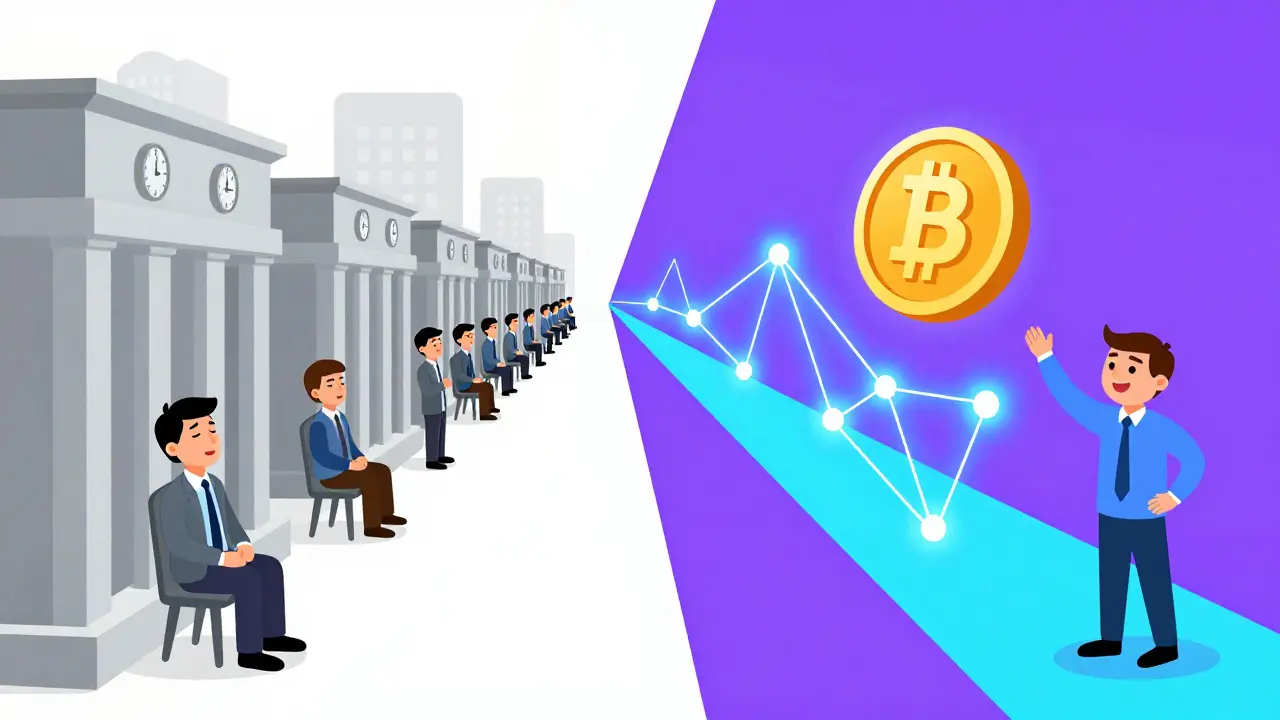
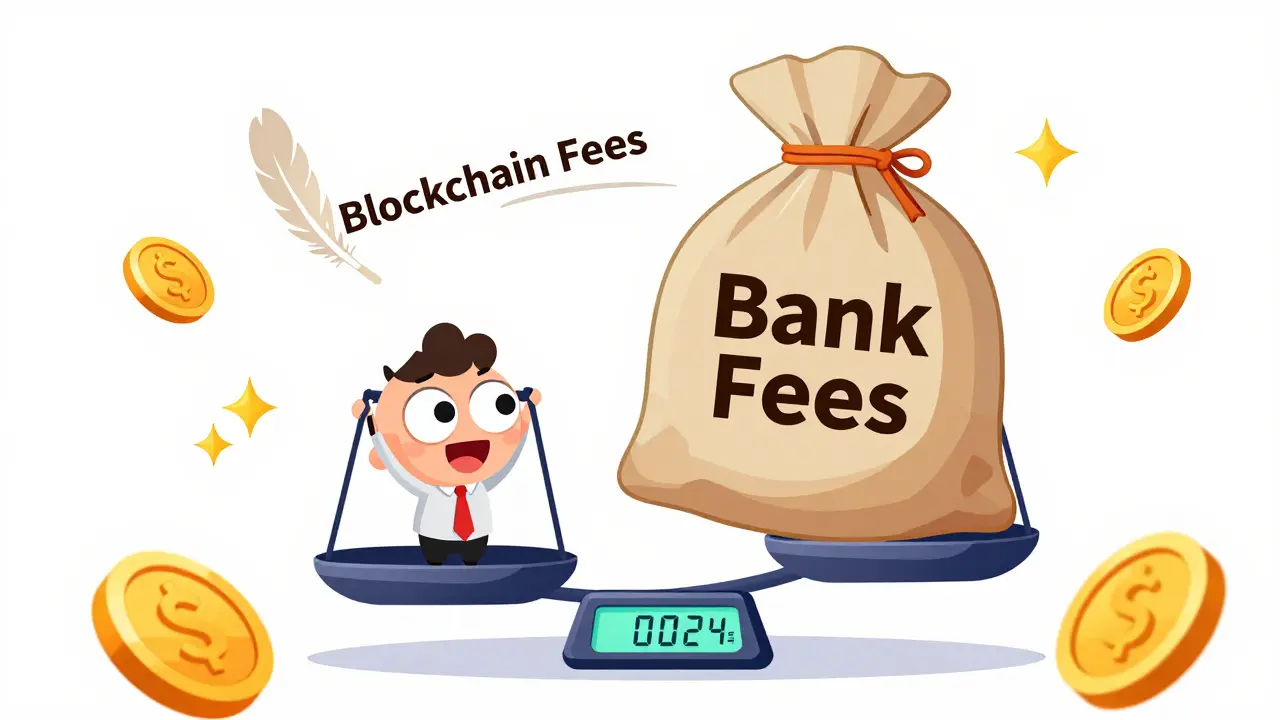
If you're still relying on legacy systems, you're essentially paying a 'slow tax'. Recent data shows that while traditional cross-border transfers can eat 2% to 7% of your capital in fees and exchange spreads, blockchain payment speed and cost efficiency have pushed those costs down to between 0.5% and 1%. We're talking about a fundamental shift where the friction of moving money globally is nearly disappearing.
The Real Cost of Moving Money: Banks vs. Blockchain
Let's be honest: banks don't make it easy to see where your money goes. Between transfer fees, hidden foreign exchange (FX) spreads, and intermediary charges, a simple payment to a supplier in Mexico or Vietnam can become an expensive ordeal. In contrast, blockchain systems operate on a transparent, peer-to-peer basis.
Consider a real-world example. An e-commerce retailer doing $500,000 in annual sales typically pays around $35,000 in gateway fees when using processors like PayPal or Stripe. By switching to crypto payment gateways, that same retailer can bring those costs down to roughly $5,000. That's $30,000 kept in the business instead of handed to a payment processor. For logistics firms, the savings are even more dramatic, with some reporting a 40% drop in supplier payment costs.
| Fee Type | Traditional Processors (e.g., Stripe, PayPal) | Blockchain Gateways |
|---|---|---|
| Transaction Fee | 2.9% - 3.5% + fixed fee | 0% - 1% |
| Currency Conversion | 1% - 5% | Negligible / None |
| International Fee | 1.5% - 2% | None |
| Settlement Time | 3 - 5 Business Days | Seconds to Minutes |
Speed and Finality: Not All Blockchains Are Equal
One common mistake is thinking all blockchains are equally fast. If you try to run a high-volume retail shop on Bitcoin, you're going to have a bad time. Bitcoin is great as a store of value, but with 10-minute confirmation times and fees that can spike to $20 per transaction, it's not built for buying coffee.
To get real speed, you need to look at networks optimized for throughput. Solana is a high-performance blockchain supporting scalable cryptocurrencies and decentralized apps, known for extremely high transaction speeds. Networks like this, along with Avalanche, provide near-instant finality. While a traditional bank transfer is 'pending' for days, an Avalanche transaction settles in about 0.8 seconds. Cosmos is even faster in terms of raw volume, processing up to 10,000 transactions per second (TPS).
For those focusing on cross-border remittances, Ripple is a digital payment network and currency designed for rapid, low-cost international money transfers. A business user recently shared on Reddit that switching supplier payments to RippleNet dropped their payment time from four days to just eight seconds, saving them nearly $187,000 annually on $1.2 million in transactions. That's the kind of ROI that makes Fortune 500 CFOs pay attention.
The Role of Stablecoins in Commercial Payments
The biggest hurdle to blockchain payments was always volatility. Nobody wants to pay a supplier in a currency that might drop 10% in value by the time the invoice is due. This is where Stablecoins are cryptocurrencies pegged to a stable asset, typically the US Dollar, to minimize price volatility. assets like USDC (Circle) and USDT (Tether) have changed the game.
Stablecoins provide the speed and cost benefits of blockchain without the gambling aspect of Bitcoin. In early 2025 alone, these assets processed over $1.2 trillion in commercial volume. They allow a company in New Zealand to pay a freelancer in Brazil instantly, using a digital dollar, without waiting for the SWIFT network to wake up. McKinsey & Company has noted that this shift toward tokenized cash is fundamentally transforming how global liquidity moves.
Implementation Hurdles: It's Not Just Plug-and-Play
If it's so much better, why hasn't every company switched? Because integrating a blockchain payment system into an old-school accounting department is a headache. Most businesses need about 4 to 14 weeks to get their systems talking to the blockchain. The biggest pain point isn't the tech itself-it's reconciling these instant transactions with traditional ERP (Enterprise Resource Planning) systems that were designed for monthly billing cycles.
There's also the regulatory mess. Depending on where you are, the legal status of crypto payments can be a gray area. The IMF has warned that without a coordinated international framework, we might just be replacing old financial silos with new, digital ones. Plus, you lose the 'chargeback' safety net. In a traditional credit card transaction, you can dispute a charge. On a blockchain, once the money is gone, it's gone. This makes the technology fantastic for B2B payments between trusted partners, but a bit riskier for random consumer retail.

Looking Ahead: The Future of Global Value Transfer
We are moving toward a world where money moves like data. We're seeing this with the rise of Central Bank Digital Currencies (CBDCs), which are currently being developed in over 120 countries. When the government's own money is on a blockchain, the efficiency gains will be even larger.
Expect to see fees drop even further. Some analysts predict average blockchain payment fees will hit 0.25% by the end of 2026. As Visa integrates networks like Solana for enterprise clients, the bridge between 'crypto' and 'money' is disappearing. Eventually, you won't say you're 'using a blockchain payment'; you'll just be sending money, and it will happen instantly, for almost free.
Is blockchain payment faster than a credit card?
In terms of user experience, a credit card feels instant, but the actual settlement (the money moving from the merchant's bank to the customer's bank) can take days. Blockchain payments, especially on networks like Solana or Avalanche, achieve actual settlement in seconds, meaning the funds are truly transferred and available immediately.
How can businesses avoid price volatility when using blockchain?
The most effective way is to use stablecoins like USDC or USDT. These are pegged 1:1 to the US Dollar, meaning you get the speed and low cost of blockchain without the price swings associated with Bitcoin or Ethereum.
What are the main risks of switching to blockchain payments?
The primary risks include regulatory uncertainty, the lack of a centralized one-click chargeback mechanism for fraud, and the technical complexity of integrating blockchain data into traditional accounting software (ERP systems).
Which blockchain is best for low-cost payments?
For micropayments, networks like Nano and IOTA offer virtually zero fees. For enterprise-grade cross-border transfers, Ripple and Stellar are leaders. For a balance of speed, ecosystem size, and low cost, Polygon and Solana are currently the top choices for commercial use.
How long does it take to integrate a blockchain payment system?
Depending on the company size, it usually takes 4 to 6 weeks for basic integration. For large enterprises with complex legacy systems, the process often takes 10 to 14 weeks, primarily due to the need for staff training and accounting reconciliation updates.
Next Steps for Implementation
If you're a business owner looking to cut costs, don't just jump into a random coin. Start by identifying your most expensive payment corridor-usually the one with the highest international fees. Try a pilot program using stablecoins for a single trusted supplier. This allows you to test the settlement speed and the accounting workflow without risking your entire cash flow. Once you've cleared the hurdle of ERP integration, you can scale the system to other partners and start seeing those 70-80% fee reductions in your bottom line.