
When it comes to securing blockchain networks, the debate between automated and manual security auditing isn't about which is better-it's about which one works where. Blockchain systems run 24/7, handle millions in value, and are immutable once deployed. A single flaw in a smart contract can lead to losses of millions. That’s why choosing the right audit method isn’t optional-it’s critical.
How Manual Security Auditing Works in Blockchain
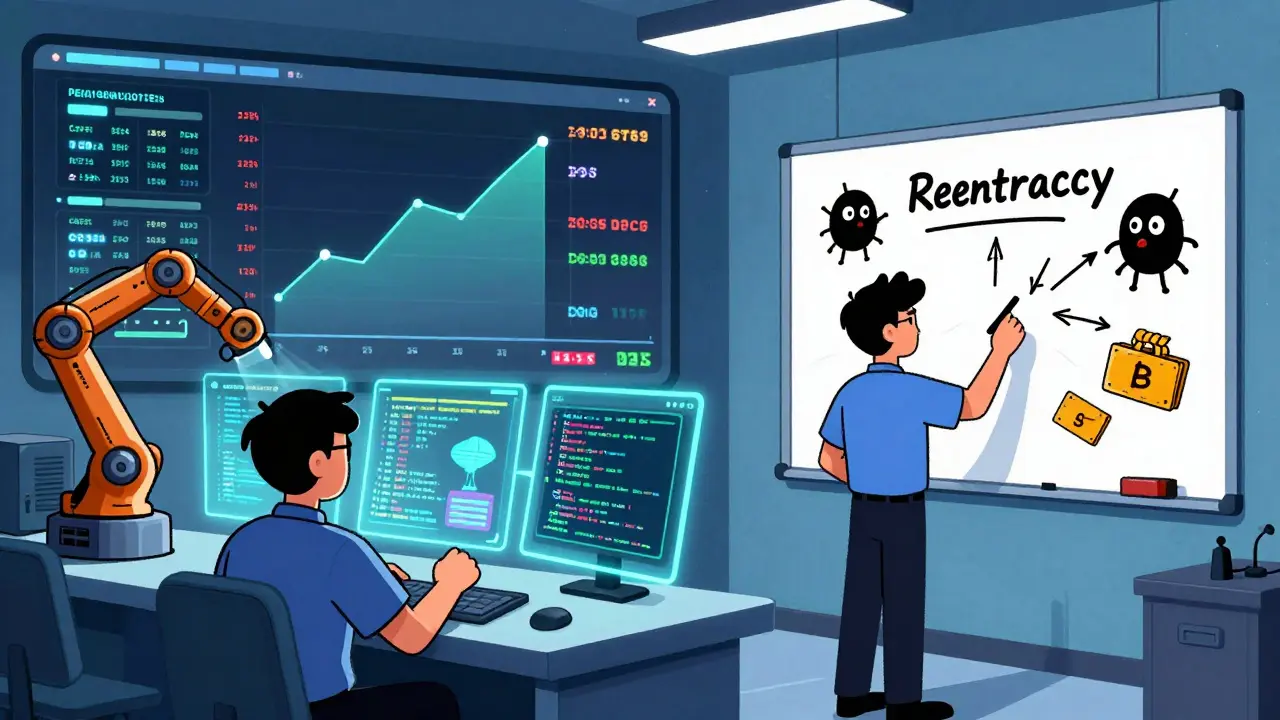
Manual security auditing for blockchain means hiring skilled experts to manually review code, test logic, and simulate attacks. These auditors don’t just scan lines of code-they think like attackers. They look for subtle flaws: reentrancy bugs in Ethereum smart contracts, improper access controls in permissioned chains, or flawed token economics that could be exploited.
A typical manual audit takes days to weeks. A team of two or three certified professionals-often CISSP or CISA holders-will spend 40 to 60 hours per audit cycle. They examine every function, trace data flows, and simulate real-world attack scenarios. For example, in a DeFi protocol, they might try to drain liquidity by manipulating price oracles or exploiting time-based restrictions.
Manual auditors are unmatched at finding business logic errors. In 2024, TechMagic found that manual testers caught 32% more critical vulnerabilities than automated tools in complex DeFi applications. These weren’t code-level bugs-they were flaws in how the system was designed to behave. Automated tools can’t understand intent. Humans can.
But manual audits have serious limits. They’re slow. They’re expensive-averaging $15,000 to $25,000 per audit. And they’re inconsistent. One auditor might miss a vulnerability another catches. Capterra’s 2024 survey showed 34% of manual auditors reported conflicting findings across different teams. Worse, they’re periodic. Most blockchains get audited once or twice a year. That leaves months of exposure.
How Automated Security Auditing Works in Blockchain
Automated auditing uses tools that scan code continuously. These tools connect to your blockchain environment via API and check every smart contract, wallet, and permission setting in real time. Platforms like Scytale and Secureframe can scan thousands of lines of Solidity code in minutes. They detect known vulnerabilities like unchecked external calls, integer overflows, and improper event emissions.
Black Duck’s 2023 report showed automated tools can process over 50,000 software components in under 30 minutes. A manual audit of the same scope would take over 200 hours. That’s not just faster-it’s scalable. For a blockchain project with dozens of contracts, manual audits are impossible to keep up with.
Automation also brings consistency. Tools don’t get tired. They don’t overlook things. They run daily, weekly, or even hourly. Secureframe’s 2024 survey found that 97% of organizations using automated tools reduced monthly compliance tasks, with 76% cutting that time by at least half. That translates to 300 hours saved per year.
But automation has blind spots. It generates false positives 15% to 30% of the time, according to NIST SP 800-115. It can’t understand context. If a contract has a risky pattern but is intentionally designed that way for regulatory reasons, the tool will flag it as a vulnerability. It can’t tell the difference between a flaw and a feature.
And it can’t find logic flaws. Automated tools won’t catch a flaw where users can bypass a withdrawal limit by splitting transactions across wallets. That requires human insight. Tools see code. Humans see intent.
Cost, Speed, and Coverage: The Numbers Don’t Lie
Let’s break it down with real data:
| Aspect | Automated Auditing | Manual Auditing |
|---|---|---|
| Speed | Minutes to hours | Days to weeks |
| Frequency | Continuous (24/7) | 2-4 times per year |
| Cost per audit | $3,000-$8,000 | $15,000-$25,000 |
| False positives | 15-30% | Near 0% |
| Business logic detection | Low | High |
| Coverage | 100% of code and configs | Typically 60-80% |
| ROI timeline | 6-9 months | Not applicable |
Organizations using automation report median annual savings of $127,000, according to Secureframe. For blockchain startups, that’s not just cost-it’s survival. Manual audits can delay launches for months. Automated tools let you deploy faster and safer.
But here’s the catch: automation alone isn’t enough. A 2023 Sonrai Security report documented 14 major blockchain breaches where companies trusted automated scans too much. One DeFi project ignored a flagged vulnerability because the tool said it was a false positive. Turns out, it wasn’t. The attacker drained $87 million.
The Hybrid Approach: Why Most Experts Recommend Both
The smartest teams don’t choose one. They use both.
Start with automated auditing. Let it run continuously. Scan every new contract, every wallet update, every permission change. Use it to catch the obvious stuff-known vulnerabilities, misconfigurations, outdated dependencies.
Then, layer in manual audits. Do them quarterly. Focus on the high-value areas: payment logic, governance mechanisms, critical smart contracts. Use manual testing to validate the automated results and dig into the gray areas.
One financial services firm on Solana reduced their PCI DSS compliance prep from 14 weeks to 3 weeks by using this hybrid model. They automated the routine checks but kept manual testing for their core payment logic-because regulators required it.
AI is making this even smarter. Tools like Scytale’s Scy AI Agent now use natural language processing to interpret audit results. They reduce false positives by 45% by understanding context. These aren’t just scanners anymore-they’re assistants.
Gartner predicts that by 2027, 90% of blockchain security audits will be hybrid. Automated tools will handle 70-80% of technical checks. Humans will focus on logic, policy, and regulatory alignment.

What You Should Do Right Now
If you’re running a blockchain project-whether it’s a DeFi app, an NFT marketplace, or a private chain-here’s your action plan:
- Start with an automated scanner. Pick one that supports your blockchain (Ethereum, Solana, etc.). Run it daily.
- Fix the high-severity issues it flags. Don’t ignore warnings-even if they seem minor.
- Every quarter, hire a reputable manual auditor. Focus on core contracts. Ask them to validate your automated findings.
- Document everything. Use audit logs. Keep records for regulators and investors.
- Train your team. Even if you use automation, your devs need to understand secure coding practices.
Don’t wait for a breach to decide. The cost of an automated audit is a fraction of the cost of a single exploit. And manual audits? They’re not going away-they’re becoming more targeted. The future isn’t automation or manual. It’s automation with human oversight.
Why This Matters for Blockchain
Blockchain isn’t like traditional software. Once code is live on-chain, you can’t patch it. You can’t roll back. You’re stuck. That’s why security isn’t a one-time task-it’s an ongoing process.
Automated tools give you constant visibility. Manual audits give you deep trust. Together, they form a defense that’s faster, smarter, and more reliable than either alone.
The market is shifting fast. The global security compliance automation market will hit $9.2 billion by 2028. Manual auditing is growing at just 4.1% a year. The choice isn’t whether to automate-it’s how fast you can integrate it with human expertise.
Can automated auditing replace manual auditing for blockchain security?
No. Automated tools are excellent at catching known vulnerabilities and misconfigurations, but they miss complex business logic flaws-like improper access controls or economic exploits. Manual audits are still needed to verify context, validate assumptions, and test real-world attack scenarios. The most secure systems use both.
How often should I audit my blockchain smart contracts?
Use automated tools to scan continuously-daily or even hourly. Perform manual audits at least quarterly, especially before major upgrades or new contract deployments. If you’re handling user funds or regulated assets, consider monthly manual reviews for critical components.
What’s the biggest risk of relying only on automated auditing?
Overconfidence. Automated tools can miss logic flaws, generate false positives, and misinterpret intent. Several major blockchain breaches in 2023 occurred because teams trusted automated results without manual verification. Always validate critical findings with human auditors.
Are manual audits still worth the cost?
Yes-if done right. Manual audits are expensive, but they’re essential for high-value systems. For a DeFi protocol managing millions in TVL, a $20,000 audit is a tiny cost compared to the potential loss from a single exploit. The key is to use manual audits strategically: focus on core logic, not every line of code.
What tools are best for automated blockchain auditing?
Popular tools include Slither (for Ethereum), Securify, and MythX. For enterprise use, platforms like Scytale, Secureframe, and Chainalysis offer integrated continuous monitoring. Choose based on your blockchain-Ethereum tools won’t work for Solana, and vice versa. Always pair them with manual validation.
How do regulatory standards like SOC 2 or GDPR affect audit choices?
Regulators increasingly accept continuous automated monitoring as equivalent to periodic manual audits-for technical controls. But for process-related controls (like user consent or data handling), manual reviews are still required. The best approach is automated monitoring for technical compliance and manual audits for policy and procedural compliance.
The bottom line? Blockchain security isn’t about picking sides. It’s about layering automation for speed and scale with human insight for depth and trust. The most secure projects don’t choose one-they use both.