
When you hear "Acala Swap," you might picture a standalone website where you log in and trade coins like on Binance. But here’s the catch: Acala isn’t just an exchange. It’s a massive financial hub built on the Polkadot network, designed to be the go-to place for decentralized finance (DeFi) across multiple blockchains. If you’re looking to swap tokens, use lending protocols, or earn yield without handing over your keys to a central company, understanding how Acala works is crucial. This review breaks down what Acala Swap actually is, how it compares to other options, and whether it’s worth your time in 2026.
What is Acala Swap?
Acala Swap refers to the decentralized trading functionality within the Acala Network ecosystem. It allows users to exchange assets seamlessly between different blockchains connected to Polkadot, utilizing liquidity pools rather than an order book.
Understanding the Acala Ecosystem
To get a real sense of Acala, you have to look past the simple act of swapping. Acala Network is a Layer-1 smart contract platform that acts as the DeFi hub for the Polkadot ecosystem. Unlike many exchanges that operate in silos, Acala was built from the ground up to solve interoperability issues. It uses both Substrate technology (native to Polkadot) and Ethereum Virtual Machine (EVM) compatibility. This dual approach means developers can build apps that talk to both worlds, and you, as a user, can move assets around with fewer friction points.
The core idea behind Acala is that it provides ready-made financial infrastructure. Instead of every new project having to build their own stablecoin or oracle system, they plug into Acala’s existing systems. For you, this translates to deeper liquidity and more reliable prices when you execute a swap. The network doesn't just let you trade; it lets you participate in a broader economy of lending, borrowing, and staking, all secured by the robust consensus mechanisms of Polkadot.
How Acala Swap Works: Mechanics and Speed
So, how do you actually perform a swap? You don’t need to create an account with email verification or undergo KYC (Know Your Customer) checks. That’s the beauty of decentralization. You connect your wallet-whether it’s MetaMask, Talisman, or Nova-and interact directly with the smart contracts.
Here is the typical flow:
- Connect Wallet: Link your preferred Web3 wallet to the Acala interface.
- Select Assets: Choose the token you want to send (e.g., DOT) and the token you want to receive (e.g., ACA or USDT).
- Check Rates: The system aggregates liquidity from various pools to give you the best possible rate.
- Approve & Swap: Confirm the transaction in your wallet. The smart contract executes the trade almost instantly.
Speed is a major selling point. Because Acala operates as a parachain on Polkadot, it benefits from shared security and fast finality. Transactions typically settle in seconds, not minutes. However, keep in mind that while the swap itself is quick, moving assets onto the Polkadot network from another chain (like Ethereum) might take longer due to bridge times. Platforms like Kwikswap Protocol, which integrates with Acala, emphasize these swift transactions and minimal network fees, making them attractive for high-frequency traders who value efficiency.
Fees and Costs: What Will It Cost You?
One of the biggest questions for any trader is cost. In the world of centralized exchanges, you often face hidden withdrawal fees or wide spreads. With Acala Swap, the fee structure is transparent but varies based on network congestion and the specific liquidity pool you are using.
Generally, you will encounter two types of costs:
- Trading Fees: A small percentage of your trade goes to liquidity providers. This is usually lower than traditional broker fees.
- Network Gas Fees: Since Acala is on Polkadot, transaction fees are paid in DOT. These are historically very low compared to Ethereum mainnet fees, often costing fractions of a cent.
If you prefer not to deal with direct DEX interfaces, third-party aggregators like SwapSpace allow you to swap ACA against over 3,850 other cryptos. They gather rates from major exchanges and Acala’s own pools, ensuring you get competitive rates without adding extra markup. Similarly, services like Exolix offer anonymous ACA swaps for major coins like BTC or ETH in under nine minutes, highlighting the speed and discretion available in the broader ecosystem.

Security and Trust: Is Your Money Safe?
Security is non-negotiable in crypto. Acala’s architecture relies heavily on the security model of Polkadot. By being a parachain, Acala inherits the collective security of the entire Relay Chain. This means attackers would need to compromise the vast majority of Polkadot validators to steal funds from Acala-a scenario that is computationally and economically impractical.
Furthermore, because Acala is decentralized, there is no central honeypot for hackers to target. Your funds remain in your wallet until you explicitly authorize a transaction. Smart contracts governing the swaps have undergone extensive audits by leading firms in the industry. However, always remember: if you lose your private keys or seed phrase, no customer support team can help you recover your assets. Self-custody comes with self-responsibility.
Acala vs. Competitors: Where Does It Stand?
To truly evaluate Acala Swap, we need to compare it against other popular options. Here is a breakdown of how it stacks up against centralized exchanges and other DeFi platforms.
| Feature | Acala Swap (DEX) | Binance (CEX) | Uniswap (DEX) |
|---|---|---|---|
| Custody | Non-Custodial (You hold keys) | Custodial (Exchange holds keys) | Non-Custodial (You hold keys) |
| KYC Required | No | Yes (for fiat and higher limits) | No |
| Interoperability | High (Cross-chain via Polkadot) | Medium (Internal transfers only) | Low (Primarily Ethereum/EVM chains) |
| Transaction Speed | Fast (Seconds) | Instant (Internal ledger) | Variable (Depends on ETH gas) |
| Fee Structure | Low network fees + small trading fee | Maker/Taker fees + withdrawal fees | High gas fees during peak times |
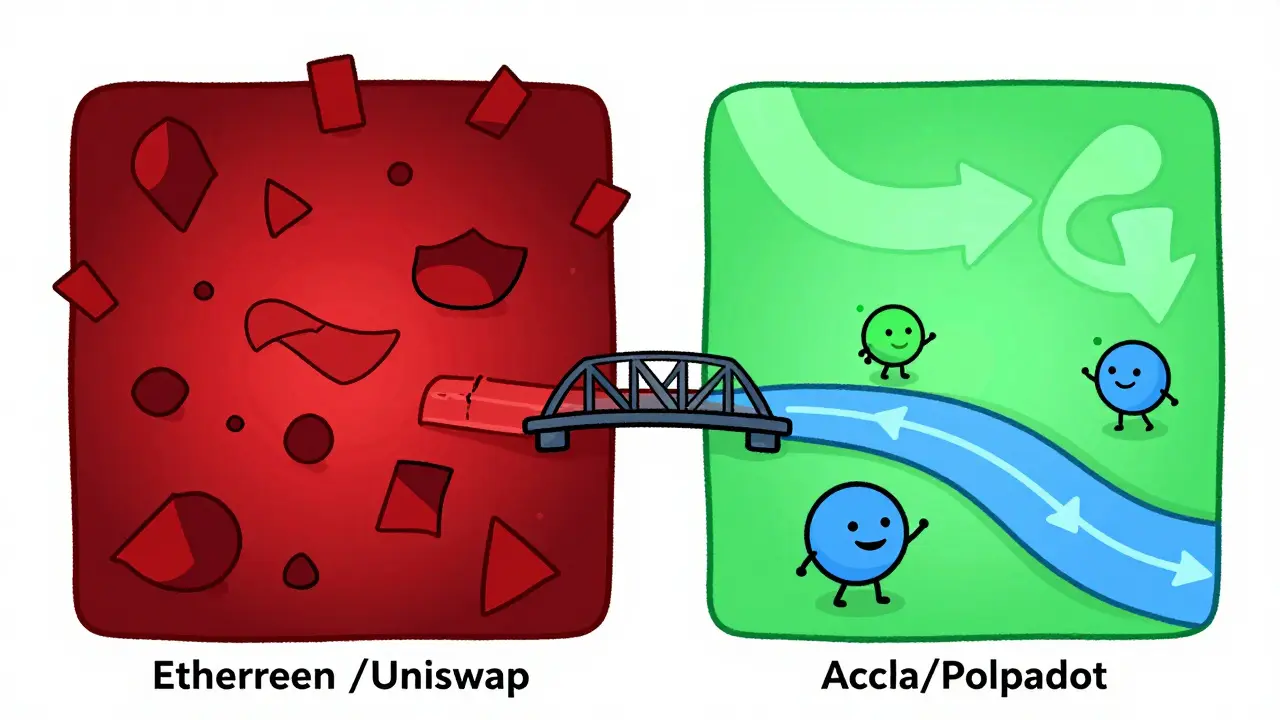
Acala shines in interoperability. While Uniswap dominates the Ethereum space, it struggles with cross-chain assets unless you use complex bridges. Acala was built for this exact purpose. Compared to Binance, Acala offers superior privacy and control, though Binance may offer better liquidity for obscure altcoins due to its massive user base.
Market Context and Token Performance
The health of the Acala ecosystem is closely tied to its native token, ACA. As of mid-2026, ACA has shown significant volatility, trading around the $0.023 mark. This price action reflects broader market sentiments and technical indicators. Currently, ACA trades below key moving averages, such as the 7-day SMA at $0.0255, suggesting short-term bearish pressure among traders.
However, long-term projections vary wildly. Some analysts predict ACA could reach $0.47 by 2030, driven by increased adoption of Polkadot’s DeFi sector. Others are more optimistic, citing potential surges to $2.79 or even higher if mainstream adoption accelerates. Conversely, conservative models suggest it might stagnate in the current range. These discrepancies highlight the speculative nature of crypto investments. Always conduct your own research (DYOR) before allocating capital based on price predictions.
Risks and Limitations to Consider
No platform is perfect, and Acala has its share of challenges. The primary risk is its dependence on the Polkadot network. If Polkadot fails to gain traction or faces severe regulatory hurdles, Acala’s growth could be stifled. Additionally, the regulatory landscape in regions like the United States and Europe remains uncertain. Changes in laws regarding DeFi protocols could impact how Acala operates or who can access it.
Another limitation is liquidity depth for niche tokens. While major pairs like DOT/ACA or ACA/USDT have deep pools, smaller assets might suffer from slippage, meaning you get less than the quoted price due to large trade sizes relative to the pool. Always check the estimated output before confirming a swap.
Who Should Use Acala Swap?
Acala Swap is ideal for users who prioritize privacy, control, and cross-chain flexibility. If you are already invested in the Polkadot ecosystem, it is arguably the best option for managing your assets. It suits DeFi enthusiasts who want to lend, borrow, and swap without intermediaries. However, if you are a beginner unfamiliar with wallets and gas fees, the learning curve might be steep. In that case, starting with a user-friendly centralized exchange and gradually moving to DEXs might be a safer path.
Is Acala Swap safe for beginners?
While the underlying technology is secure, the user experience requires knowledge of Web3 wallets and private key management. Beginners should start with small amounts and thoroughly understand how to connect wallets securely before trading larger sums.
Can I swap ACA for Bitcoin on Acala?
Directly, Acala focuses on Polkadot ecosystem assets. To swap ACA for BTC, you may need to use a cross-chain bridge or a third-party aggregator like Exolix or SwapSpace that supports multi-chain pairs.
What happens if the Polkadot network goes down?
As a parachain, Acala relies on Polkadot's relay chain for security. If Polkadot experiences downtime, Acala transactions will also halt until the network recovers. However, Polkadot has a strong track record of uptime and resilience.
Are there hidden fees on Acala Swap?
No, the fee structure is transparent. You pay a small trading fee to liquidity providers and a network gas fee in DOT. Third-party aggregators may add their own service fees, so always check the total cost before confirming.
How does Acala compare to Uniswap?
Uniswap is primarily Ethereum-based, leading to higher gas fees during congestion. Acala, built on Polkadot, offers lower fees and better cross-chain interoperability, making it a cost-effective alternative for users in the Polkadot ecosystem.